Atlas of Ancient History › People › The late Republic
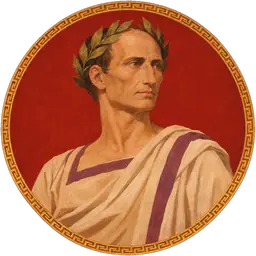
Julius Caesar
Gaius Julius Caesar was the nephew of Marius' wife Julia, and married Cornelia, the daughter of Cinna; when Sulla came to power he would not divorce her, and Sulla confiscated her dowry.1 He won the office of pontifex maximus with lavish bribery, and in the senate's debate on Catiline's accomplices he proposed every punishment short of death.2 He reconciled Pompey and Crassus and joined them in an irresistible alliance, and Pompey married his daughter Julia.3 In nine years in Gaul he made the whole country from the Pyrenees to the Rhine a province, and he was the first Roman to cross the Rhine and then to go into Britain.4 Ordered to give up his army, he crossed the Rubicon, the boundary of his province, saying 'the die is cast', and as master of Rome he reformed the calendar so that the year followed the sun.5 More than sixty men, led by Cassius and the two Brutuses, conspired against him, and at the meeting of the senate on the Ides of March he was stabbed with twenty-three wounds, in his fifty-sixth year.6
Open Julius Caesar in the atlas
Events
Ties
- Gaius Marius uncle by marriage of Julius Caesar Plutarch, Marius 6.2
- Cinna father-in-law of Julius Caesar Plutarch, Caesar 1.1
- Sulla tried to make divorce Cornelia Julius Caesar Plutarch, Caesar 1.1
- reconciled with Pompey Marcus Licinius Crassus Plutarch, Crassus 14
- father-in-law of Pompey Plutarch, Pompey 47.6
- allied with, then fought Pompey Plutarch, Crassus 14
- Marcus Junius Brutus killed Julius Caesar Suetonius, Julius 82.2
- Cassius led the conspiracy against Julius Caesar Appian, Civil Wars 2.16.111
- Cato the Younger opposed Julius Caesar Sallust, Catiline 54
- said he would have spared Cato the Younger Plutarch, Cato the Younger 72
- Clodius profaned the house of Julius Caesar Cicero, Letters to Atticus 1.12.3
- Catullus lampooned Julius Caesar Suetonius, Julius 73
- Sallust officer of Julius Caesar African War 8
- Varro surrendered to Julius Caesar Caesar, Civil War 2.20
- received the surrender of Vercingetorix Plutarch, Caesar 27.5
- defeated Ariovistus Caesar, Gallic War 1.53
- pardoned Marcus Junius Brutus Plutarch, Brutus 6
- lover of Cleopatra VII Plutarch, Caesar 49.2
- reputed father of Caesarion Plutarch, Antony 81.2
- husband of Calpurnia Plutarch, Pompey 47.6
- lover of Servilia Suetonius, Julius 50.2
- father of Julia, daughter of Caesar Plutarch, Pompey 47.6
- Juba I fought against Julius Caesar African War 97
- great-uncle and adoptive father of Augustus Suetonius, Augustus 7.2
What the sources say
“Then Caesar cried: Take we the course which the signs of the gods and the false dealing of our foes point out. The die is cast, said he”
tunc Caesar: eatur, inquit, quo deorum ostenta et inimicorum iniquitas uocat. iacta alea est, inquit
Suetonius, Julius 32 · tr. John C. Rolfe
“So Caesar was then the first of the Romans to cross the Rhine, and after that into Britain, in the consulship of Pompey and Crassus”
ὁ οὖν Καῖσαρ τόν τε Ῥῆνον πρῶτος τότε Ῥωμαίων διέβη, καὶ ἐς Βρεττανίαν μετὰ ταῦτα, τοῦ τε Πομπηίου καὶ τοῦ Κράσσου ὑπατευόντων
Cassius Dio 39.50.1 · AI translation (Claude)
“Caesar caught Casca’s arm and ran it through with his stylus,but as he tried to leap to his feet, he was stopped by another wound. When he saw that he was beset on every side by drawn daggers, he muffled his head in his robe, and at the same time drew down its lap to his feet with his left hand, in order to fall more decently, with the lower part of his body also covered. And in this wise he was stabbed with three and twenty wounds, uttering not a word, but merely a groan at the first stroke, though some have written that when Marcus Brutus rushed at him, he said in Greek, You too, my child?”
Caesar Cascae brachium arreptum graphio traiecit conatusque prosilire alio uulnere tardatus est; utque animaduertit undique se strictis pugionibus peti, toga caput obuoluit, simul sinistra manu sinum ad ima crura deduxit, quo honestius caderet etiam inferiore corporis parte uelata. atque ita tribus et uiginti plagis confossus est uno modo ad primum ictum gemitu sine uoce edito, etsi tradiderunt quidam Marco Bruto irruenti dixisse: καὶ σὺ τέκνον;
Suetonius, Julius 82.2 · tr. John C. Rolfe
“I see that as yet there are two opinions. One that of Decius Silanus, who thinks that those who have endeavoured to destroy all these things should be punished with death the other, that of Caius Caesar, who objects to the punishment of death, but adopts the most extreme severity of all other punishment”
video duas adhuc esse sententias, unam D. Silani qui censet eos qui haec delere conati sunt morte esse multandos, alteram C. Caesaris qui mortis poenam removet, ceterorum suppliciorum omnis acerbitates amplectitur
Cicero, Against Catiline 4.7 · tr. Charles Duke Yonge
First named
The earliest text in the library that names Julius Caesar, written about 63 BC (a modern estimate of when it was written):
“I see that as yet there are two opinions. One that of Decius Silanus, who thinks that those who have endeavoured to destroy all these things should be punished with death the other, that of Caius Caesar, who objects to the punishment of death, but adopts the most extreme severity of all other punishment”
video duas adhuc esse sententias, unam D. Silani qui censet eos qui haec delere conati sunt morte esse multandos, alteram C. Caesaris qui mortis poenam removet, ceterorum suppliciorum omnis acerbitates amplectitur
Cicero, Against Catiline 4.7 · tr. Charles Duke Yonge
Found by searching every text in the library for these spellings and reading the earliest hits to rule out namesakes: Καῖσαρ, Caesar, Caesaris, Caesari, Caesarem, C. Caesar, Gaius Caesar, Caius Caesar, Julius Caesar, Iulius, Gaius Julius Caesar. Texts lost, or not in the library, may name Julius Caesar earlier.
The passages behind each sentence
- Plutarch, Caesar 1.1 (tr. Bernadotte Perrin) ↩
- Suetonius, Julius 13 (tr. John C. Rolfe); Cicero, Against Catiline 4.7 (tr. Charles Duke Yonge) ↩
- Plutarch, Crassus 14 (tr. Bernadotte Perrin); Plutarch, Pompey 47.6 (tr. Bernadotte Perrin) ↩
- Suetonius, Julius 25.1 (tr. John C. Rolfe); Cassius Dio 39.50.1 (AI translation (Claude)) ↩
- Suetonius, Julius 31.2 (tr. John C. Rolfe); Suetonius, Julius 32 (tr. John C. Rolfe); Suetonius, Julius 40.1 (tr. John C. Rolfe) ↩
- Suetonius, Julius 80.4 (tr. John C. Rolfe); Suetonius, Julius 82.2 (tr. John C. Rolfe); Suetonius, Julius 88 (tr. John C. Rolfe) ↩
Cite this page
MLA “Julius Caesar.” Atlas of Ancient History, Skirnir Studios, 2026, history.skirnirstudios.com/people/caesar/.
APA Skirnir Studios. (2026). Julius Caesar. Atlas of Ancient History. https://history.skirnirstudios.com/people/caesar/
Chicago “Julius Caesar.” Atlas of Ancient History. Skirnir Studios, 2026. https://history.skirnirstudios.com/people/caesar/.
The atlas was written by AI from the ancient sources. Where you can, cite the ancient passage itself by its reference (Herodotus 7.228, Livy 22.7.3) and name the translation you read.