Atlas of Ancient History › People › The early Empire
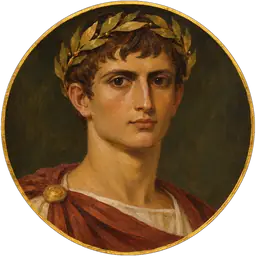
Augustus
Gaius Octavius was born on 23 September 63 BC, in the consulship of Cicero and Gaius Antonius, the son of Octavius and Atia, whose mother Julia was the sister of Julius Caesar.1 He was studying at Apollonia when he heard that his great-uncle had been killed and had made him his heir; he went back to Rome and took up the inheritance against the advice of his mother and his stepfather Marcius Philippus, and with it the name Gaius Caesar.2 He fought five civil wars, at Mutina, Philippi, Perusia, in Sicily and at Actium, and held power first with Antony and Lepidus and then with Antony alone, for about twelve years in all, and then alone for forty-four.3 The senate and people then gave him the name Augustus: Suetonius says Munatius Plancus proposed it when others wanted to call him Romulus, and Dio that he gave up Romulus for fear of seeming to want a crown, and that the Greeks called him Sebastos.4 Tacitus says he dropped the title of triumvir, called himself consul and relied on a tribune's power, won over the soldiers with gifts and the people with cheap grain, and drew to himself the work of the senate, the magistrates and the laws.5 He died at Nola on 19 August AD 14, in the room where his father Octavius had died, thirty-five days short of his seventy-sixth birthday.6
Events
Ties
- triumvir with Mark Antony Appian, Civil Wars 4.1.2
- deposed Lepidus Appian, Civil Wars 5.13.126
- Julius Caesar great-uncle and adoptive father of Augustus Suetonius, Augustus 7.2
- brother of Octavia Suetonius, Augustus 4.1
- let Antony proscribe Cicero Plutarch, Cicero 46.3
- put to death Caesarion Plutarch, Antony 82.1
- led in triumph the image of Cleopatra VII Plutarch, Antony 86.3
- Livia wife of Augustus Tacitus, Annals 5.1
- Agrippa son-in-law and partner in victory of Augustus Tacitus, Annals 1.3
- father of Julia, daughter of Augustus Tacitus, Annals 1.53
- gave charge of Rome and Italy to Maecenas Tacitus, Annals 6.11
- Virgil sang of the Actian victory of Augustus Propertius, Elegies 2.34b
- banished Ovid Ovid, Tristia 2
- Livy friend of Augustus Tacitus, Annals 4.34
- confirmed the kingship of Herod the Great Josephus, Jewish Antiquities 15.195
- Drusus the Elder stepson of Augustus Tacitus, Annals 1.3
- Tiberius stepson and adopted heir of Augustus Suetonius, Tiberius 21
- great-uncle of Germanicus Tacitus, Annals 2.53
What the sources say
“He afterwards assumed the name of Caius Caesar, and then of Augustus; the former in compliance with the will of his great-uncle, and the latter upon a motion of Munatius Plancus in the senate. For when some proposed to confer upon him the name of Romulus, as being, in a manner, a second founder of the city, it was resolved that he should rather be called Augustus, a surname not only new, but of more dignity, because places devoted to religion, and those in which anything is consecrated by augury, are denominated august, either from the word auctus, signifying augmentation, or ab avium gestu, gustuve, from the flight and feeding of birds; as appears from this verse of Ennius: When glorious Rome by august augury was built”
postea Gai Caesaris et deinde Augusti cognomen assumpsit, alterum testamento maioris auunculi, alterum Munati Planci sententia, cum quibusdam censentibus Romulum appellari oportere quasi et ipsum conditorem urbis, praeualuisset, ut Augustus potius uocaretur, non tantum nouo sed etiam ampliore cognomine, quod loca quoque religiosa et in quibus augurato quid consecratur augusta dicantur, ab auctu uel ab auium gestu gustuue, sicut etiam Ennius docet scribens: Augusto augurio postquam incluta condita Roma est.
Suetonius, Augustus 7.2 · tr. Alexander Thomson
“Augustus Caesar, kindred unto Jove. He brings a golden age”
Augustus Caesar, Divi genus, aurea condet
Virgil, Aeneid 6.792 · tr. Theodore C. Williams
“Then followed much talk about Augustus himself, and many expressed an idle wonder that the same day marked the beginning of his assumption of empire and the close of his life, and, again, that he had ended his days at Nola in the same house and room as his father Octavius … Yet the State had been organized under the name neither of a kingdom nor a dictatorship, but under that of a prince”
Multus hinc ipso de Augusto sermo, plerisque vana mirantibus quod idem dies accepti quondam imperii princeps et vitae supremus, quod Nolae in domo et cubiculo in quo pater eius Octavius vitam finivisset … non regno tamen neque dictatura sed principis nomine constitutam rem publicam
Tacitus, Annals 1.9 · translator not recorded
“When he had actually carried these things out, he then received the name Augustus from both the senate and the people. For when they wished to address him by some special title, and some proposed and chose one name and some another, Caesar was very eager to be called Romulus; but when he saw that this made him suspected of wanting the kingship, he no longer pursued it, and was named Augustus, as being something more than human; for all the most honoured and most sacred things are called augusta. For this reason they also called him, in Greek, Sebastos, as if 'revered', from sebazesthai, to revere.”
ἐπεὶ δὲ καὶ τῷ ἔργῳ αὐτὰ ἐπετέλεσεν, οὕτω δὴ καὶ τὸ τοῦ Αὐγούστου ὄνομα καὶ παρὰ τῆς βουλῆς καὶ παρὰ τοῦ δήμου ἐπέθετο. βουληθέντων γάρ σφων ἰδίως πως αὐτὸν προσειπεῖν, καὶ τῶν μὲν τὸ τῶν δὲ τὸ καὶ ἐσηγουμένων καὶ αἱρουμένων, ὁ Καῖσαρ ἐπεθύμει μὲν ἰσχυρῶς Ῥωμύλος ὀνομασθῆναι, αἰσθόμενος δὲ ὅτι ὑποπτεύεται ἐκ τούτου τῆς βασιλείας ἐπιθυμεῖν, οὐκέτʼ αὐτοῦ ἀντεποιήσατο, ἀλλὰ Αὔγουστος ὡς καὶ πλεῖόν τι ἢ κατὰ ἀνθρώπους ὢν ἐπεκλήθη· πάντα γὰρ τὰ ἐντιμότατα καὶ τὰ ἱερώτατα αὔγουστα προσαγορεύεται. ἐξ οὗπερ καὶ σεβαστὸν αὐτὸν καὶ ἑλληνίζοντές πως, ὥσπερ τινὰ σεπτόν, ἀπὸ τοῦ σεβάζεσθαι, προσεῖπον
Cassius Dio 53.16 · AI translation (Claude)
First named
The earliest text in the library that names Augustus, written about 44 BC (a modern estimate of when it was written):
“But I should like to know something about the arrival of Octavius. Is there a great flocking to visit him, any suspicion of a coup on his part? I don't expect it myself: still I should like to know the truth whatever it is. I write this to you on the point of starting from Astura, 11th of April”
sed velim scire quid adventus Octavi, num qui concursus ad eum, num quae νεωτερισμοῦ suspicio. non puto equidem, sed tamen, quicquid est, scire cupio. haec scripsi ad te proficiscens Astura iii Idus.
Cicero, Letters to Atticus 14.5.3 · tr. Evelyn Shuckburgh
Found by searching every text in the library for these spellings and reading the earliest hits to rule out namesakes: Augustus, Augusti, Augusto, Augustum, Caesar Augustus, Augustus Caesar, Caesar, Caesaris, Caesari, Caesarem, Octavius, Octavianus, Octaviano, Octavian, Gaius Octavius, C. Octavius, Caesar Octavianus, Thurinus, Καῖσαρ, Καίσαρος, Καίσαρι, Καίσαρα, Σεβαστός, Σεβαστοῦ, Σεβαστῷ, Σεβαστόν, Αὔγουστος, Ὀκτάουιος, Ὀκταουιανός. Texts lost, or not in the library, may name Augustus earlier.
The passages behind each sentence
- Suetonius, Augustus 5.1 (tr. Alexander Thomson); Suetonius, Augustus 4.1 (tr. Alexander Thomson) ↩
- Suetonius, Augustus 8 (tr. Alexander Thomson); Suetonius, Augustus 7.2 (tr. Alexander Thomson) ↩
- Suetonius, Augustus 9.1 (tr. Alexander Thomson); Suetonius, Augustus 8 (tr. Alexander Thomson) ↩
- Suetonius, Augustus 7.2 (tr. Alexander Thomson); Cassius Dio 53.16 (AI translation (Claude)) ↩
- Tacitus, Annals 1.2 (translator not recorded) ↩
- Suetonius, Augustus 100.1 (tr. Alexander Thomson); Tacitus, Annals 1.9 (translator not recorded) ↩
Cite this page
MLA “Augustus.” Atlas of Ancient History, Skirnir Studios, 2026, history.skirnirstudios.com/people/augustus/.
APA Skirnir Studios. (2026). Augustus. Atlas of Ancient History. https://history.skirnirstudios.com/people/augustus/
Chicago “Augustus.” Atlas of Ancient History. Skirnir Studios, 2026. https://history.skirnirstudios.com/people/augustus/.
The atlas was written by AI from the ancient sources. Where you can, cite the ancient passage itself by its reference (Herodotus 7.228, Livy 22.7.3) and name the translation you read.