Atlas of Ancient History › People › The late Republic
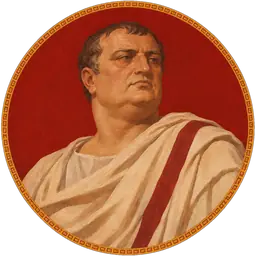
Marcus Licinius Crassus
Marcus Licinius Crassus joined Sulla in the civil war and stood high in his favour.1 Plutarch says he grew rich by buying burning houses and their neighbours cheap with a gang of five hundred slave builders, until most of Rome was his; Cicero records his saying that no fortune was enough for a would-be leader of the state unless its income could keep an army.2 As praetor he crushed Spartacus within six months, though Pompey claimed the credit for ending the war, and the two were then elected consuls together.3 Caesar reconciled him with Pompey, and the three together became an irresistible power in the state.4 Past sixty, he led an army against the Parthians, and in the consulship of Calvinus and Messalla he was defeated and killed by a Parthian at a parley.5 His head was brought to King Orodes while an actor was singing Euripides' Bacchae, and was thrown into the middle of the banquet.6
Open Marcus Licinius Crassus in the atlas
Events
Ties
- defeated Spartacus Appian, Civil Wars 1.14.120
- consul with Pompey Cicero, Against Verres 2.3.123
- Julius Caesar reconciled with Pompey Marcus Licinius Crassus Plutarch, Crassus 14
- Sulla honoured Marcus Licinius Crassus Plutarch, Crassus 6.2
- Surena destroyed Marcus Licinius Crassus Strabo 16.1.23
- Orodes II received the head of Marcus Licinius Crassus Plutarch, Crassus 33.2
- Cassius quaestor of Marcus Licinius Crassus Plutarch, Crassus 18.4
What the sources say
“Marcus Crassus, for example, not long since declared that no amount of wealth was enough for the man who aspired to be the foremost citizen of the state, unless with the income from it he could maintain an army”
ut nuper M. Crassus negabat ullam satis magnam pecuniam esse ei, qui in re publica princeps vellet esse, cuius fructibus exercitum alere non posset
Cicero, On Duties 1.25 · tr. Walter Miller
“Crassus accomplished his task within six months, whence arose a contention for honors between himself and Pompey. Crassus did not dismiss his army, for Pompey did not dismiss his. Both were candidates for the consulship. Crassus had been praetor as the law of Sulla required. Pompey had been neither praetor nor quaestor, and was only thirty-four years old”
καὶ τάδε Κράσσος ἓξ μησὶν ἐργασάμενος ἀμφήριστος ἐκ τοῦδε αὐτίκα μάλα τῇ δόξῃ τῇ Πομπηίου γίνεται. καὶ τὸν στρατὸν οὐ μεθίει, διότι μηδὲ Πομπήιος. ἐς δὲ ὑπατείαν ἄμφω παρήγγελλον, ὁ μὲν ἐστρατηγηκὼς κατὰ τὸν νόμον Σύλλα, ὁ δὲ Πομπήιος οὔτε στρατηγήσας οὔτε ταμιεύσας ἔτος τε ἔχων τέταρτον ἐπὶ τοῖς τριάκοντα
Appian, Civil Wars 1.14.121 · tr. Horace White
“Now when the head of Crassus was brought to the king’s door, the tables had been removed, and a tragic actor, Jason by name, of Tralles, was singing that part of the Bacchae of Euripides where Agave is about to appear. While he was receiving his applause, Sillaces stood at the door of the banqueting-hall, and after a low obeisance, cast the head of Crassus into the centre of the company”
τῆς δὲ κεφαλῆς τοῦ Κράσσου κομισθείσης ἐπὶ θύρας ἀπηρμέναι μὲν ἦσαν αἱ τράπεζαι, τραγῳδιῶν δὲ ὑποκριτὴς Ἰάσων ὄνομα Τραλλιανὸς ᾖδεν Εὐριπίδου Βακχῶν τὰ περὶ τὴν Ἀγαύην. εὐδοκιμοῦντος δʼ αὐτοῦ Σιλλάκης ἐπιστὰς τῷ ἀνδρῶνι καὶ προσκυνήσας προὔβαλεν εἰς μέσον τοῦ Κράσσου τὴν κεφαλήν
Plutarch, Crassus 33.2 · tr. Bernadotte Perrin
First named
The earliest text in the library that names Marcus Licinius Crassus, written about 70 BC (a modern estimate of when it was written):
“Read the letters of Lucius Metellus, which he sent to Cnaeus Pompeius and Marcus Crassus, the consuls, those which he sent to Marcus Mummius, the praetor, those which he sent to the quaestors”
recita litteras L. Metelli, quas ad Cn. Pompeium et M. Crassum consules, quas ad M. Mummium praetorem, quas ad quaestores urbanos misit
Cicero, Against Verres 2.3.123 · tr. Charles Duke Yonge
Found by searching every text in the library for these spellings and reading the earliest hits to rule out namesakes: Κράσσος, Μᾶρκος Κράσσος, Crassus, M. Crassus, Marcus Crassus, Licinius Crassus, Crasso. Texts lost, or not in the library, may name Marcus Licinius Crassus earlier.
The passages behind each sentence
- Plutarch, Crassus 6.2 (tr. Bernadotte Perrin) ↩
- Plutarch, Crassus 2.4 (tr. Bernadotte Perrin); Cicero, On Duties 1.25 (tr. Walter Miller) ↩
- Appian, Civil Wars 1.14.121 (tr. Horace White); Plutarch, Crassus 11.7 (tr. Bernadotte Perrin) ↩
- Plutarch, Crassus 14.2 (tr. Bernadotte Perrin) ↩
- Plutarch, Crassus 17.2 (tr. Bernadotte Perrin); Cassius Dio 40.17.1 (AI translation (Claude)); Plutarch, Crassus 31.5 (tr. Bernadotte Perrin) ↩
- Plutarch, Crassus 33.2 (tr. Bernadotte Perrin) ↩
Cite this page
MLA “Marcus Licinius Crassus.” Atlas of Ancient History, Skirnir Studios, 2026, history.skirnirstudios.com/people/crassus/.
APA Skirnir Studios. (2026). Marcus Licinius Crassus. Atlas of Ancient History. https://history.skirnirstudios.com/people/crassus/
Chicago “Marcus Licinius Crassus.” Atlas of Ancient History. Skirnir Studios, 2026. https://history.skirnirstudios.com/people/crassus/.
The atlas was written by AI from the ancient sources. Where you can, cite the ancient passage itself by its reference (Herodotus 7.228, Livy 22.7.3) and name the translation you read.