Atlas of Ancient History › People › The late Republic
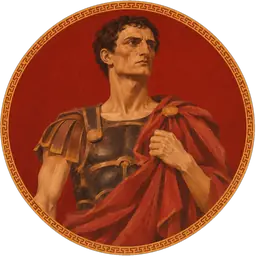
Cassius
Gaius Cassius served as Crassus' quaestor in Parthia and kept advising caution; after the defeat he led five hundred horsemen from Carrhae to safety in Syria.1 Holding Syria with the army in 51 BC, he wrote to the senate that he had finished the Parthian war; Cicero thought his first despatch the more modest.2 A Pompeian who had surrendered his ships to Caesar in the Hellespont, he became, with Brutus, the chief of the conspirators, and it was he who drew Brutus in.3 At Philippi, thinking the battle lost and a friend taken by the enemy, he covered his face and had his freedman Pindarus cut off his head.4
Events
Ties
- led the conspiracy against Julius Caesar Appian, Civil Wars 2.16.111
- drew into the conspiracy Marcus Junius Brutus Plutarch, Brutus 10.3
- quaestor of Marcus Licinius Crassus Plutarch, Crassus 18.4
What the sources say
“Cassius is in the town of Antioch with the whole army”
Cassius in oppido Antiochia est cum omni exercitu
Cicero, Letters to Atticus 5.18.1 · tr. Evelyn Shuckburgh
“Cassius, indeed, went back again to Carrhae, and when his guides, who were Arabs, urged him to wait there until the moon had passed the Scorpion, he said that he feared the Archer even more than the Scorpion, and rode off into Syria with five hundred horsemen”
ἀλλὰ Κάσσιος μὲν ἐπανῆλθεν εἰς Κάρρας πάλιν, καὶ τῶν ὁδηγῶν Ἄραβες δʼ ἦσαν ἀναμένειν κελευόντων ἄχρι ἂν σελήνη παραλλάξῃ τὸν σκορπίον, ἀλλʼ ἔγωγε, εἰπών, ἔτι τοῦτον μᾶλλον φοβοῦμαι τὸν τοξότην, ἀπήλαυνεν εἰς Συρίαν μεθʼ ἱππέων πεντακοσίων
Plutarch, Crassus 29.4 · tr. Bernadotte Perrin
“For Cassius thought that Titinius was actually taken by the enemy, and with the words My love of life has brought me to the pass of seeing a friend seized by the enemy, he withdrew into an empty tent, forcing along with him one of his freedmen, Pindarus … From the Parthians, indeed, he had made his escape; but now, drawing his robes up over his face and laying bare his neck, he offered it to the sword. For his head was found severed from his body”
ἔδοξε γὰρ ὁ Κάσσιος ἀληθῶς ὑπὸ τῶν πολεμίων ἔχεσθαι τὸν Τιτίνιον, καὶ τοῦτο δὴ φήσας, φιλοψυχοῦντεςἀνεμείναμεν ἄνδρα φίλον ἁρπαζόμενον ὑπὸ τῶν πολεμίων ἰδεῖν, ἀπεχώρησεν εἴς τινα σκηνὴν ἔρημον, ἕνα τῶν ἀπελευθέρων ἐφελκυσάμενος, Πίνδαρον, ὃν ἐκ τῶν κατὰ Κράσσον ἀτυχημάτων ἐπὶ ταύτην εἶχε τὴν ἀνάγκην ὑφʼ αὑτοῦ παρεσκευασμένον … ἀλλὰ Πάρθους μὲν διέφυγε, τότε δὲ τὰς χλαμύδας ἐπὶ τὴν κεφαλὴν ἀναγαγὼν καὶ γυμνώσας τὸν τράχηλον ἀποκόψαι παρέσχεν. εὑρέθη γὰρ ἡ κεφαλὴ δίχα τοῦ σώματος
Plutarch, Brutus 43 · tr. Bernadotte Perrin
First named
The earliest text in the library that names Cassius, written about 51 BC (a modern estimate of when it was written):
“Cassius is in the town of Antioch with the whole army”
Cassius in oppido Antiochia est cum omni exercitu
Cicero, Letters to Atticus 5.18.1 · tr. Evelyn Shuckburgh
Found by searching every text in the library for these spellings and reading the earliest hits to rule out namesakes: Κάσσιος, Γάιος Κάσσιος, Cassius, C. Cassius, Gaius Cassius, Cassio, Cassium. Texts lost, or not in the library, may name Cassius earlier.
The passages behind each sentence
- Plutarch, Crassus 18.4 (tr. Bernadotte Perrin); Plutarch, Crassus 29.4 (tr. Bernadotte Perrin) ↩
- Cicero, Letters to Atticus 5.18.1 (tr. Evelyn Shuckburgh); Cicero, Letters to Atticus 5.21.2 (tr. Evelyn Shuckburgh) ↩
- Appian, Civil Wars 2.16.111 (tr. Horace White); Plutarch, Brutus 10.3 (tr. Bernadotte Perrin) ↩
- Plutarch, Brutus 43.8 (tr. Bernadotte Perrin) ↩
Cite this page
MLA “Cassius.” Atlas of Ancient History, Skirnir Studios, 2026, history.skirnirstudios.com/people/cassius/.
APA Skirnir Studios. (2026). Cassius. Atlas of Ancient History. https://history.skirnirstudios.com/people/cassius/
Chicago “Cassius.” Atlas of Ancient History. Skirnir Studios, 2026. https://history.skirnirstudios.com/people/cassius/.
The atlas was written by AI from the ancient sources. Where you can, cite the ancient passage itself by its reference (Herodotus 7.228, Livy 22.7.3) and name the translation you read.