Atlas of Ancient History › People › The late Republic
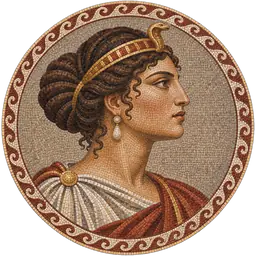
Cleopatra VII
Cleopatra was the elder daughter of Ptolemy Auletes, whose will left the kingdom to his elder son and elder daughter and called on the Roman people to see it carried out.1 Driven out by her brother's friends, she was in arms against him near Pelusium when Pompey came to Egypt; later she had herself carried into the palace to Caesar wrapped in a bedding sack, and won him over.2 After the Alexandrian war Caesar gave the kingdom to her and her younger brother; she bore a son whom the Alexandrians called Caesarion, and Caesar later brought her to Rome and let her give the child his name.3 Plutarch says her voice was sweet and that she spoke to most foreign peoples without an interpreter, and that she learned the Egyptian language, which the kings before her had not troubled to learn.4 Summoned by Antony, she sailed up the Cydnus in a gilded barge with purple sails, and he later proclaimed her queen of Egypt, Cyprus, Libya and Coele Syria, with Caesarion as her fellow ruler.5 After Actium and Antony's death she was found dead on a golden couch, perhaps from an asp; she was thirty-nine and had been queen for twenty-two years.6
Open Cleopatra VII in the atlas
Events
Ties
- Mark Antony lover and ally of Cleopatra VII Plutarch, Antony 85.3
- Julius Caesar lover of Cleopatra VII Plutarch, Caesar 49.2
- mother of Caesarion Plutarch, Antony 81.2
- Ptolemy XII father of Cleopatra VII Strabo 17.1.11
- Augustus led in triumph the image of Cleopatra VII Plutarch, Antony 86.3
- Octavia brought up the children of Cleopatra VII Plutarch, Antony 87.1
What the sources say
“So Cleopatra, taking only Apollodorus the Sicilian from among her friends, embarked in a little skiff and landed at the palace when it was already getting dark; and as it was impossible to escape notice otherwise, she stretched herself at full length inside a bed-sack, while Apollodorus tied the bedsack up with a cord and carried it indoors to Caesar.”
κἀκείνη παραλαβοῦσα τῶν φίλων Ἀπολλόδωρον τὸν Σικελιώτην μόνον, εἰς ἀκάτιον μικρὸν ἐμβᾶσα τοῖς μὲν βασιλείοις προσέσχεν ἤδη συσκοτάζοντος· ἀπόρου δὲ τοῦ λαθεῖν ὄντος ἄλλως, ἡ μὲν εἰς στρωματόδεσμον ἐνδῦσα προτείνει μακρὰν ἑαυτήν, ὁ δὲ Ἀπολλόδωρος ἱμάντι συνδήσας τὸν στρωματόδεσμον εἰσκομίζει διὰ θυρῶν πρὸς τὸν Καίσαρα,
Plutarch, Caesar 49.1 · tr. Bernadotte Perrin
“but above all with Cleopatra, with whom he often feasted until daybreak, and he would have gone through Egypt with her in her state-barge almost to Aethiopia, had not his soldiers refused to follow him. Finally he called her to Rome and did not let her leave until he had ladened her with high honours and rich gifts, and he allowed her to give his name to the child which she bore”
sed maxime Cleopatram, cum qua et conuiuia in primam lucem saepe protraxit et eadem naue thalamego paene Aethiopia tenus Aegyptum penetrauit, nisi exercitus sequi recusasset, quam denique accitam in urbem non nisi maximis honoribus praemiisque auctam remisit filiumque natum appellare nomine suo passus est
Suetonius, Julius 52.1 · tr. John C. Rolfe
“When Cleopatra died she was forty years of age save one, had been queen for two and twenty of these, and had shared her power with Antony more than fourteen”
ἐτελεύτησε δὲ Κλεοπάτρα μὲν ἑνὸς δέοντα τεσσαράκοντα ἔτη βιώσασα, καὶ τούτων δύο καὶ εἴκοσι βασιλεύσασα, συνάρξασα δὲ Ἀντωνίῳ πλείω τῶν δεκατεσσάρων
Plutarch, Antony 86.4 · tr. Bernadotte Perrin
First named
The earliest text in the library that names Cleopatra VII, written about 47 BC (a modern estimate of when it was written):
“There by chance was King Ptolomaeus, a boy in years, waging war with large forces against his sister Cleopatra, whom a few months before he had expelled from the throne by the help of his relations and friends. The camp of Cleopatra was not far distant from his camp”
ibi casu rex erat Ptolomaeus, puer aetate, magnis copiis cum sorore Cleopatra bellum gerens, quam paucis ante mensibus per suos propinquos atque amicos regno expulerat; castraque Cleopatrae non longo spatio ab eius castris distabant
Caesar, Civil War 3.103 · tr. Arthur George Peskett
Found by searching every text in the library for these spellings and reading the earliest hits to rule out namesakes: Κλεοπάτρα, Κλεοπάτραν, Κλεοπάτρας, Cleopatra, Cleopatram, Cleopatrae. Texts lost, or not in the library, may name Cleopatra VII earlier.
The passages behind each sentence
- Caesar, Civil War 3.108 (tr. Arthur George Peskett); Strabo 17.1.11 (tr. Hans Claude Hamilton) ↩
- Caesar, Civil War 3.103 (tr. Arthur George Peskett); Plutarch, Caesar 49.1 (tr. Bernadotte Perrin); Plutarch, Caesar 49.2 (tr. Bernadotte Perrin) ↩
- Alexandrian War 33 (tr. A. G. Way); Plutarch, Caesar 49.5 (tr. Bernadotte Perrin); Suetonius, Julius 52.1 (tr. John C. Rolfe) ↩
- Plutarch, Antony 27.3 (tr. Bernadotte Perrin); Plutarch, Antony 27.4 (tr. Bernadotte Perrin) ↩
- Plutarch, Antony 26.1 (tr. Bernadotte Perrin); Plutarch, Antony 54.4 (tr. Bernadotte Perrin) ↩
- Plutarch, Antony 85.3 (tr. Bernadotte Perrin); Plutarch, Antony 86.1 (tr. Bernadotte Perrin); Plutarch, Antony 86.4 (tr. Bernadotte Perrin) ↩
Cite this page
MLA “Cleopatra VII.” Atlas of Ancient History, Skirnir Studios, 2026, history.skirnirstudios.com/people/cleopatra/.
APA Skirnir Studios. (2026). Cleopatra VII. Atlas of Ancient History. https://history.skirnirstudios.com/people/cleopatra/
Chicago “Cleopatra VII.” Atlas of Ancient History. Skirnir Studios, 2026. https://history.skirnirstudios.com/people/cleopatra/.
The atlas was written by AI from the ancient sources. Where you can, cite the ancient passage itself by its reference (Herodotus 7.228, Livy 22.7.3) and name the translation you read.