Atlas of Ancient History › People › The late Republic
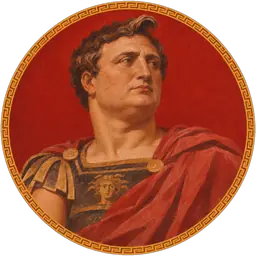
Pompey
Gnaeus Pompeius raised legions in Picenum for Sulla while still very young, and became Sulla's most useful man; Sulla rose for him alone and hailed him as Magnus, 'the Great'.1 When Sulla hesitated to grant him a triumph, Pompey told him that more people worship the rising than the setting sun, and Sulla gave way.2 After the war with Sertorius he was elected consul with Crassus at thirty-four, having held neither the praetorship nor the quaestorship, and he promised to restore the tribunes' powers.3 Given command against the pirates, he cleared the western seas in forty days, and Cicero says that on the forty-ninth day after leaving Brundisium he had added Cilicia and the pirates had been taken or had surrendered.4 He married Caesar's daughter Julia, and in the disorders of 52 BC even his enemy Bibulus proposed that he be made sole consul.5 Beaten by Caesar in the civil war, he fled to Egypt, where the young king's ministers sent Achillas and Septimius, who killed him as he came ashore, one day after his birthday; Plutarch says he had lived fifty-nine years and Appian fifty-eight, so he was born in 107 or 106 BC.6
Events
Ties
- Sulla honoured Pompey Appian, Civil Wars 1.9.80
- Sertorius routed Pompey Plutarch, Sertorius 19.4
- Marcus Licinius Crassus consul with Pompey Cicero, Against Verres 2.3.123
- received the surrender of Tigranes the Great Plutarch, Pompey 33.2
- succeeded in the East Lucullus Plutarch, Pompey 33.4
- Julius Caesar father-in-law of Pompey Plutarch, Pompey 47.6
- told of the rising sun Sulla Plutarch, Pompey 14.3
- Julius Caesar allied with, then fought Pompey Plutarch, Crassus 14
- Varro legate of Pompey Caesar, Civil War 1.38
- hereditary guest-friend of Juba I Caesar, Civil War 2.25.4
- husband of Julia, daughter of Caesar Plutarch, Pompey 47.6
- father of Sextus Pompey Appian, Civil Wars 4.11.83
What the sources say
“Pompey, however, was not cowed, but bade Sulla reflect that more worshipped the rising than the setting sun, intimating that his own power was on the increase, while that of Sulla was on the wane and fading away. Sulla did not hear the words distinctly, but seeing, from their looks and gestures, that those who did hear them were amazed, he asked what it was that had been said. When he learned what it was, he was astounded at the boldness of Pompey, and cried out twice in succession: Let him triumph!”
ὁ δὲ Πομπήϊος οὐχ ὑπέπτηξεν, ἀλλʼ ἐννοεῖν ἐκέλευσε τὸν Σύλλαν ὅτι τὸν ἥλιον ἀνατέλλοντα πλείονες ἢ δυόμενον προσκυνοῦσιν, ὡς αὐτῷ μὲν αὐξανομένης, μειουμένης δὲ καὶ μαραινομένης ἐκείνῳ τῆς δυνάμεως, ταῦτα ὁ Σύλλας οὐκ ἀκριβῶς ἐξακούσας, ὁρῶν δὲ τοὺς ἀκούσαντας ἀπὸ τοῦ προσώπου καὶ τοῦ σχήματος ἐν θαύματι ποιουμένους, ἤρετο τί τὸ λεχθὲν εἴη. πυθόμενος δὲ καὶ καταπλαγεὶς τοῦ Πομπηΐου τὴν τόλμαν ἀνεβόησε δὶς ἐφεξῆς, Θριαμβευσάτω.
Plutarch, Pompey 14.3 · tr. Bernadotte Perrin
“So he went out and met him, and after giving him the warmest welcome, saluted him in a loud voice as Magnus, or The Great, and ordered those who were by to give him this surname”
καὶ προελθὼν ἀπήντησεν αὐτῷ, καὶ δεξιωσάμενος ὡς ἐνῆν προθυμότατα μεγάλῃ φωνῇ Μάγνον ἠσπάσατο, καὶ τοὺς παρόντας οὕτως ἐκέλευσε προσαγορεῦσαι
Plutarch, Pompey 13.4 · tr. Bernadotte Perrin
“but themselves formed a secret plot, and sent Achillas, the king’s prefect, a man of singular audacity, and L. Septimius, a military tribune, to assassinate Pompeius. And he, being courteously addressed by them and being lured forth by some previous knowledge of Septimius, because he had been a centurion under him in the pirate war, embarked in a little boat with a few of his friends, and is thereupon assassinated by Achillas and Septimius”
ipsi clam consilio inito Achillam, praefectum regium, singulari hominem audacia, et L. Septimium tribunum militum ad interficiendum Pompeium miserunt. ab his liberaliter ipse appellatus et quadam notitia Septimi perductus, quod bello praedonum apud eum ordinem duxerat, naviculam parvulam conscendit cum paucis suis; ibi ab Achilla et Septimio interficitur
Caesar, Civil War 3.104 · tr. Arthur George Peskett
“And Pompey, drawing his toga down over his face with both hands, without an act or a word that was unworthy of himself, but with a groan merely, submitted to their blows, being sixty years of age less one, and ending his life only one day after his birth-day.”
δὲ ταῖς χερσὶν ἀμφοτέραις τὴν τήβεννον ἐφελκυσάμενος κατὰ τοῦ προσώπου, μηδὲν εἰπὼν ἀνάξιον ἑαυτοῦ μηδὲ ποιήσας, ἀλλὰ στενάξας μόνον, ἐνεκαρτέρησε ταῖς πληγαῖς, ἑξήκοντα μὲν ἑνὸς δέοντα βεβιωκὼς ἔτη, μιᾷ δʼ ὕστερον ἡμέρᾳ τῆς γενεθλίου τελευτήσας τὸν βίον.
Plutarch, Pompey 79.4 · tr. Bernadotte Perrin
First named
The earliest text in the library that names Pompey, written about 70 BC (a modern estimate of when it was written):
“Today is the fifth of August. You began to assemble at the ninth hour. This day they do not even count. There are ten days between this and the votive games which Cnaeus Pompeius is going to celebrate”
Nonae sunt hodie Sextiles; hora viii convenire coepistis; hunc diem iam ne numerant quidem. decem dies sunt ante ludos votivos, quos Cn. Pompeius facturus est
Cicero, Against Verres 1.1.31 · tr. Charles Duke Yonge
Found by searching every text in the library for these spellings and reading the earliest hits to rule out namesakes: Πομπήιος, Πομπήϊος, Γναῖος Πομπήιος, Pompeius, Pompeio, Pompeium, Pompei, Cn. Pompeius, Pompey, Magnus, Μάγνος. Texts lost, or not in the library, may name Pompey earlier.
The passages behind each sentence
- Appian, Civil Wars 1.9.80 (tr. Horace White); Plutarch, Pompey 13.4 (tr. Bernadotte Perrin) ↩
- Plutarch, Pompey 14.3 (tr. Bernadotte Perrin) ↩
- Appian, Civil Wars 1.14.121 (tr. Horace White); Cicero, Against Verres 1.1.45 (tr. Charles Duke Yonge) ↩
- Plutarch, Pompey 26.4 (tr. Bernadotte Perrin); Cicero, On the Command of Pompey 35 (tr. Charles Duke Yonge) ↩
- Plutarch, Pompey 47.6 (tr. Bernadotte Perrin); Plutarch, Pompey 54.4 (tr. Bernadotte Perrin) ↩
- Caesar, Civil War 3.104 (tr. Arthur George Peskett); Plutarch, Pompey 79.4 (tr. Bernadotte Perrin); Appian, Civil Wars 2.12.86 (tr. Horace White) ↩
Cite this page
MLA “Pompey.” Atlas of Ancient History, Skirnir Studios, 2026, history.skirnirstudios.com/people/pompey/.
APA Skirnir Studios. (2026). Pompey. Atlas of Ancient History. https://history.skirnirstudios.com/people/pompey/
Chicago “Pompey.” Atlas of Ancient History. Skirnir Studios, 2026. https://history.skirnirstudios.com/people/pompey/.
The atlas was written by AI from the ancient sources. Where you can, cite the ancient passage itself by its reference (Herodotus 7.228, Livy 22.7.3) and name the translation you read.