Atlas of Ancient History › People › The late Republic
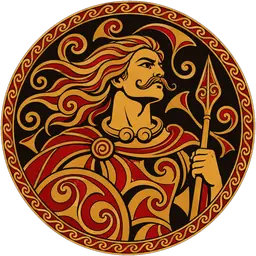
Vercingetorix
Vercingetorix, son of Celtillus, was a young Arvernian of great power whose father had held the leadership of all Gaul and was killed by his own people for aiming at kingship.1 Driven from Gergovia by his uncle and the other chiefs, he raised the poor of the countryside, expelled his opponents and was hailed king by his followers.2 He led the revolt of almost all Gaul against Caesar, until he was shut up in Alesia.3 When the relief army failed, he told the council that he had fought for the common freedom and offered himself to be killed or handed over alive; he was surrendered, and Plutarch says he rode out in his finest armour, circled Caesar, and sat in silence at his feet.4 He was kept in chains and put to death after Caesar's triumph, which Dio tells under 46 BC.5
Open Vercingetorix in the atlas
Events
Ties
- Julius Caesar received the surrender of Vercingetorix Plutarch, Caesar 27.5
What the sources say
“Vercingetorix, having convened a council the following day, declares, "That he had undertaken that war, not on account of his own exigences, but on account of the general freedom; and since he must yield to fortune, he offered himself to them for either purpose, whether they should wish to atone to the Romans by his death, or surrender him alive. Embassadors are sent to Caesar on this subject. He orders their arms to be surrendered, and their chieftains delivered up. He seated himself at the head of the lines in front of the camp, the Gallic chieftains are brought before him. They surrender Vercingetorix, and lay down their arms”
Postero die Vercingetorix concilio convocato id bellum se suscepisse non suarum necessitatium, sed communis libertatis causa demonstrat, et quoniam sit fortunae cedendum, ad utramque rem se illis offerre, seu morte sua Romanis satisfacere seu vivum tradere velint. Mittuntur de his rebus ad Caesarem legati. Iubet arma tradi, principes produci. Ipse in munitione pro castris consedit: eo duces producuntur; Vercingetorix deditur, arma proiciuntur
Caesar, Gallic War 7.89 · tr. William Alexander McDevitte
“And the leader of the whole war, Vergentorix, after putting on his most beautiful armour and decorating his horse, rode out through the gate. He made a circuit round Caesar, who remained seated, and then leaped down from his horse, stripped off his suit of armour, and seating himself at Caesar’s feet remained motionless, until he was delivered up to be kept in custody for the triumph”
ὁ δὲ τοῦ σύμπαντος ἡγεμὼν πολέμου Οὐεργεντόριξ ἀναλαβὼν τῶν ὅπλων τὰ κάλλιστα καὶ κοσμήσας τὸν ἵππον ἐξιππάσατο διὰ τῶν πυλῶν καὶ κύκλῳ περὶ τὸν Καίσαρα καθεζόμενον ἐλάσας, εἶτα ἀφαλόμενος τοῦ ἵππου τὴν μὲν πανοπλίαν ἀπέρριψεν, αὐτὸς δὲ καθίσας ὑπὸ πόδας τοῦ Καίσαρος ἡσυχίαν ἦγεν, ἄχρι οὗ παρεδόθη φρουρησόμενος ἐπὶ τὸν θρίαμβον
Plutarch, Caesar 27.5 · tr. Bernadotte Perrin
“There in like manner, Vercingetorix the son of Celtillus the Arvernian, a young man of the highest power (whose father had held the supremacy of entire Gaul, and had been put to death by his fellow-citizens, for this reason, because he aimed at sovereign power), summoned together his dependents, and easily excited them. On his design being made known, they rush to arms: he is expelled from the town of Gergovia , by his uncle Gobanitio and the rest of the nobles, who were of opinion, that such an enterprise ought not to be hazarded: he did not however desist, but held in the country a levy of the needy and desperate. Having collected such a body of troops, he brings over to his sentiments such of his fellow-citizens as he has access to: he exhorts them to take up arms in behalf of the general freedom, and having assembled great forces he drives from the state his opponents, by whom he had”
Simili ratione ibi Vercingetorix, Celtilli filius, Arvernus, summae potentiae adulescens, cuius pater principatum Galliae totius obtinuerat et ob eam causam, quod regnum appetebat, ab civitate erat interfectus, convocatis suis clientibus facile incendit. Cognito eius consilio ad arma concurritur. Prohibetur ab Gobannitione, patruo suo, reliquisque principibus, qui hanc temptandam fortunam non existimabant; expellitur ex oppido Gergovia; non destitit tamen atque in agris habet dilectum egentium ac perditorum. Hac coacta manu, quoscumque adit ex civitate ad suam sententiam perducit; hortatur ut communis libertatis causa arma capiant, magnisque coactis copiis adversarios suos a quibus paulo ante erat eiectus expellit ex civitate. Rex ab suis appellatur
Caesar, Gallic War 7.4 · tr. William Alexander McDevitte
First named
The earliest text in the library that names Vercingetorix, written about 51 BC (a modern estimate of when it was written):
“There in like manner, Vercingetorix the son of Celtillus the Arvernian, a young man of the highest power (whose father had held the supremacy of entire Gaul, and had been put to death by his fellow-citizens, for this reason, because he aimed at sovereign power), summoned together his dependents, and easily excited them. On his design being made known, they rush to arms: he is expelled from the town of Gergovia , by his uncle Gobanitio and the rest of the nobles, who were of opinion, that such an enterprise ought not to be hazarded: he did not however desist, but held in the country a levy of the needy and desperate. Having collected such a body of troops, he brings over to his sentiments such of his fellow-citizens as he has access to: he exhorts them to take up arms in behalf of the general freedom, and having assembled great forces he drives from the state his opponents, by whom he had”
Simili ratione ibi Vercingetorix, Celtilli filius, Arvernus, summae potentiae adulescens, cuius pater principatum Galliae totius obtinuerat et ob eam causam, quod regnum appetebat, ab civitate erat interfectus, convocatis suis clientibus facile incendit. Cognito eius consilio ad arma concurritur. Prohibetur ab Gobannitione, patruo suo, reliquisque principibus, qui hanc temptandam fortunam non existimabant; expellitur ex oppido Gergovia; non destitit tamen atque in agris habet dilectum egentium ac perditorum. Hac coacta manu, quoscumque adit ex civitate ad suam sententiam perducit; hortatur ut communis libertatis causa arma capiant, magnisque coactis copiis adversarios suos a quibus paulo ante erat eiectus expellit ex civitate. Rex ab suis appellatur
Caesar, Gallic War 7.4 · tr. William Alexander McDevitte
Found by searching every text in the library for these spellings and reading the earliest hits to rule out namesakes: Vercingetorix, Vercingetorigem, Vercingetorigis, Οὐερκιγγετόριξ, Οὐεργεντόριξ, Vergentorix. Texts lost, or not in the library, may name Vercingetorix earlier.
The passages behind each sentence
- Caesar, Gallic War 7.4 (tr. William Alexander McDevitte) ↩
- Caesar, Gallic War 7.4 (tr. William Alexander McDevitte); Cassius Dio 40.33.1 (AI translation (Claude)) ↩
- Plutarch, Caesar 27.5 (tr. Bernadotte Perrin); Caesar, Gallic War 7.89 (tr. William Alexander McDevitte) ↩
- Caesar, Gallic War 7.89 (tr. William Alexander McDevitte); Plutarch, Caesar 27.5 (tr. Bernadotte Perrin) ↩
- Cassius Dio 40.41.3 (AI translation (Claude)); Cassius Dio 43.19.4 (AI translation (Claude)) ↩
Cite this page
MLA “Vercingetorix.” Atlas of Ancient History, Skirnir Studios, 2026, history.skirnirstudios.com/people/vercingetorix/.
APA Skirnir Studios. (2026). Vercingetorix. Atlas of Ancient History. https://history.skirnirstudios.com/people/vercingetorix/
Chicago “Vercingetorix.” Atlas of Ancient History. Skirnir Studios, 2026. https://history.skirnirstudios.com/people/vercingetorix/.
The atlas was written by AI from the ancient sources. Where you can, cite the ancient passage itself by its reference (Herodotus 7.228, Livy 22.7.3) and name the translation you read.