Atlas of Ancient History › People › The late Republic
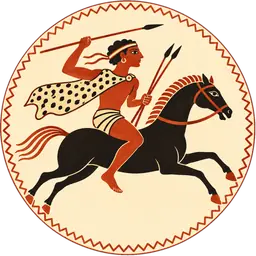
Juba I
In 63 BC Cicero mocked the young Juba, a king's son, as a youth whose purse was as long as his hair.1 When the civil war began in 49 BC the senate proposed that King Juba be named ally and friend of the Roman people, and in Africa his forces destroyed the army of Caesar's legate Curio, who died fighting.2 Juba claimed the surrendered Roman soldiers as his booty and had most of them killed, then rode into Utica and gave orders there before going home to his kingdom.3 In the African war he joined Scipio with some thirty thousand foot, twenty thousand Numidian horse and sixty elephants.4 After Thapsus, shut out by his own towns, he dined with Petreius and fought him with swords so that both should seem to die bravely; he killed Petreius and then had a slave kill him, and Caesar made his kingdom a province.5
Events
Ties
- Pompey hereditary guest-friend of Juba I Caesar, Civil War 2.25.4
- fought against Julius Caesar African War 97
What the sources say
“for there is constantly fluttering before those men's eyes Juba, the king's son, whose purse is every bit as long as his hair”
volitat enim ante oculos istorum Iuba, regis filius, adulescens non minus bene nummatus quam bene capillatus
Cicero, On the Agrarian Law 2.59 · tr. Charles Duke Yonge
“Meanwhile king Juba, outlawed by all his townships, despaired of saving his life. And so finally, after dining with Petreius, he fought a duel with him with swords, so as to create the impression that both had met a gallant death; and the sword of the stronger man, Juba, easily put an end to Petreius, his weaker adversary. Juba then endeavoured to run himself through the chest with his sword; but not being able to do it, he successfully entreated a slave of his to kill him, and so achieved his purpose.”
Rex interim ab omnibus civitatibus exclusus, desperata salute, cum iam cenatus esset cum Petreio, ut per virtutem interfecti esse viderentur, ferro inter se depugnant atque firmior imbecilliorem Iuba Petreium facile ferro consumpsit. Deinde ipse sibi eum conaretur gladio traicere pectus nec posset, precibus a servo suo impetravit ut se interficeret idque obtinuit.
African War 94 · tr. A. G. Way
“On this occasion, too, Juba, a son of the king, a mere infant, was carried along in the triumphal procession, the most fortunate captive ever taken, since from being a Barbarian and a Numidian, he came to be enrolled among the most learned historians of Hellas”
τότε καὶ Ἰόβας υἱὸς ὢν ἐκείνου κομιδῇ νήπιος ἐν τῷ θριάμβῳ παρήχθη, μακαριωτάτην ἁλοὺς ἅλωσιν, ἐκ βαρβάρου καὶ Νομάδος Ἑλλήνων τοῖς πολυμαθεστάτοις ἐναρίθμιος γενέσθαι συγγραφεῦσι
Plutarch, Caesar 55.2 · tr. Bernadotte Perrin
First named
The earliest text in the library that names Juba I, written about 63 BC (a modern estimate of when it was written):
“for there is constantly fluttering before those men's eyes Juba, the king's son, whose purse is every bit as long as his hair”
volitat enim ante oculos istorum Iuba, regis filius, adulescens non minus bene nummatus quam bene capillatus
Cicero, On the Agrarian Law 2.59 · tr. Charles Duke Yonge
Found by searching every text in the library for these spellings and reading the earliest hits to rule out namesakes: Iuba, Iubam, Iubae, Juba, Ἰόβας, Ἰόβᾳ, Ἰούβας. Texts lost, or not in the library, may name Juba I earlier.
The passages behind each sentence
- Cicero, On the Agrarian Law 2.59 (tr. Charles Duke Yonge) ↩
- Caesar, Civil War 1.6 (tr. Arthur George Peskett); Caesar, Civil War 2.42 (tr. Arthur George Peskett) ↩
- Caesar, Civil War 2.44 (tr. Arthur George Peskett) ↩
- Appian, Civil Wars 2.14.96 (tr. Horace White) ↩
- African War 94 (tr. A. G. Way); African War 97 (tr. A. G. Way) ↩
Cite this page
MLA “Juba I.” Atlas of Ancient History, Skirnir Studios, 2026, history.skirnirstudios.com/people/juba-i/.
APA Skirnir Studios. (2026). Juba I. Atlas of Ancient History. https://history.skirnirstudios.com/people/juba-i/
Chicago “Juba I.” Atlas of Ancient History. Skirnir Studios, 2026. https://history.skirnirstudios.com/people/juba-i/.
The atlas was written by AI from the ancient sources. Where you can, cite the ancient passage itself by its reference (Herodotus 7.228, Livy 22.7.3) and name the translation you read.