Atlas of Ancient History › People › The late Republic
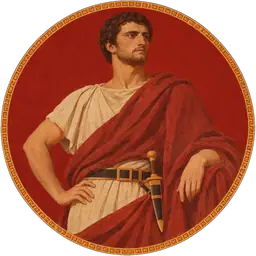
Marcus Junius Brutus
Marcus Brutus claimed descent from Junius Brutus, who drove out the Tarquins; his mother Servilia was Cato's sister, and Cato was later his father-in-law.1 Caesar had been Servilia's lover, and Plutarch says he had some grounds for believing that Brutus, born when that passion was at its height, was his own son.2 He fought for Pompey, but after Pharsalus Caesar pardoned him and made him one of his most honoured companions; yet Caesar said it was the pale, lean men, Brutus and Cassius, that he feared.3 Cassius drew him into the conspiracy, and the two became its chief leaders; some wrote that when Brutus rushed at him, Caesar said 'You too, my child?'.4 After the second battle at Philippi he fell on his sword, or, as some said, his friend Strato held it for him.5
Open Marcus Junius Brutus in the atlas
Events
Ties
- killed Julius Caesar Suetonius, Julius 82.2
- Servilia mother of Marcus Junius Brutus Plutarch, Brutus 2.1
- Cato the Younger uncle and father-in-law of Marcus Junius Brutus Plutarch, Brutus 2.1
- Lucius Junius Brutus claimed ancestor of Marcus Junius Brutus Plutarch, Brutus 1.1
- Julius Caesar pardoned Marcus Junius Brutus Plutarch, Brutus 6
- Cassius drew into the conspiracy Marcus Junius Brutus Plutarch, Brutus 10.3
- husband of Porcia Plutarch, Brutus 13.3
What the sources say
“However, even Caesar was not wholly without suspicion, nor free from the effects of accusations against Brutus, but, while he feared his high spirit, his great repute, and his friends, he had faith in his character … Once, when he was told that Antony and Dolabella were plotting revolution, he said it was not the fat and long-haired fellows that troubled him, but those pale and lean ones; meaning Brutus and Cassius”
οὐμὴν οὐδὲ Καῖσαρ ἀνύποπτος ἦν πάμπαν οὐδʼ ἀδιάβλητος πρὸς αὐτόν, ἀλλὰ τὸ μὲν φρόνημα καὶ τὸ ἀξίωμα καὶ τοὺς φίλους ἐδεδίει τοῦ ἀνδρός, ἐπίστευε δὲ τῷ ἤθει … καὶ πρῶτον μὲν Ἀντωνίου καὶ Δολοβέλλα λεγομένων νεωτερίζειν οὐκ ἔφη τοὺς παχεῖς καὶ κομήτας ἐνοχλεῖν, ἀλλὰ τοὺς ὠχροὺς καὶ ἰσχνοὺς ἐκείνους· Βροῦτον λέγων καὶ Κάσσιον
Plutarch, Brutus 8 · tr. Bernadotte Perrin
“This man he placed nearest to himself, and then, grasping with both hands the hilt of his naked sword, he fell upon it and died … Some, however, say that it was not Brutus himself, but Strato, who at his very urgent request, and with averted eyes, held the sword in front of him, upon which he fell with such force that it passed quite through his breast and brought him instant death”
καὶ τοῦτον ἔγγιστα παραστησάμενος ἑαυτῷ καὶ τὸ ξίφος γυμνὸν ἐπὶ τῆς λαβῆς τοῖς χερσὶν ἀμφοτέραις ἐρείσας καὶ περιπεσών ἐτελεύτησεν … οἱ δέ φασιν οὐκ αὐτὸν, ἀλλὰ τὸν Στράτωνα, πολλὰ πάνυ τοῦ Βρούτου δεηθέντος, ἀποστρέψαντα τὴν ὄψιν ὑποστῆσαι τὸ ξίφος· ἐκεῖνον δὲ ῥύμῃ προσβαλόντα τὸ στέρνον καὶ διώσαντα συντόμως ἀποθανεῖν
Plutarch, Brutus 52 · tr. Bernadotte Perrin
“Caesar caught Casca’s arm and ran it through with his stylus,but as he tried to leap to his feet, he was stopped by another wound. When he saw that he was beset on every side by drawn daggers, he muffled his head in his robe, and at the same time drew down its lap to his feet with his left hand, in order to fall more decently, with the lower part of his body also covered. And in this wise he was stabbed with three and twenty wounds, uttering not a word, but merely a groan at the first stroke, though some have written that when Marcus Brutus rushed at him, he said in Greek, You too, my child”
Caesar Cascae brachium arreptum graphio traiecit conatusque prosilire alio uulnere tardatus est; utque animaduertit undique se strictis pugionibus peti, toga caput obuoluit, simul sinistra manu sinum ad ima crura deduxit, quo honestius caderet etiam inferiore corporis parte uelata. atque ita tribus et uiginti plagis confossus est uno modo ad primum ictum gemitu sine uoce edito, etsi tradiderunt quidam Marco Bruto irruenti dixisse: καὶ σὺ τέκνον
Suetonius, Julius 82.2 · tr. John C. Rolfe
First named
The earliest text in the library that names Marcus Junius Brutus, written about 59 BC (a modern estimate of when it was written):
“there had been a confederacy of young men under the leadership of Curio, to which Paullus had at first belonged, and Q. Caepio (I mean Brutus ) and Lentulus, son of the flamen, with the privity of his father”
tum exposuit manum fuisse iuventutis duce Curione, in qua Paulus initio fuisset et Q. Caepio hic Brutus et Lentulus, flaminis filius, conscio patre
Cicero, Letters to Atticus 2.24.2 · tr. Evelyn Shuckburgh
Found by searching every text in the library for these spellings and reading the earliest hits to rule out namesakes: Βροῦτος, Μᾶρκος Βροῦτος, Brutus, Bruto, Brutum, Bruti, M. Brutus, Marcus Brutus, Caepio Brutus, Q. Caepio. Texts lost, or not in the library, may name Marcus Junius Brutus earlier.
The passages behind each sentence
- Plutarch, Brutus 1.1 (tr. Bernadotte Perrin); Plutarch, Brutus 2.1 (tr. Bernadotte Perrin) ↩
- Plutarch, Brutus 5.2 (tr. Bernadotte Perrin) ↩
- Plutarch, Brutus 6 (tr. Bernadotte Perrin); Plutarch, Brutus 8 (tr. Bernadotte Perrin) ↩
- Plutarch, Brutus 10.3 (tr. Bernadotte Perrin); Appian, Civil Wars 2.16.111 (tr. Horace White); Suetonius, Julius 82.2 (tr. John C. Rolfe) ↩
- Plutarch, Brutus 52 (tr. Bernadotte Perrin); Cassius Dio 47.16.1 (AI translation (Claude)) ↩
Cite this page
MLA “Marcus Junius Brutus.” Atlas of Ancient History, Skirnir Studios, 2026, history.skirnirstudios.com/people/brutus/.
APA Skirnir Studios. (2026). Marcus Junius Brutus. Atlas of Ancient History. https://history.skirnirstudios.com/people/brutus/
Chicago “Marcus Junius Brutus.” Atlas of Ancient History. Skirnir Studios, 2026. https://history.skirnirstudios.com/people/brutus/.
The atlas was written by AI from the ancient sources. Where you can, cite the ancient passage itself by its reference (Herodotus 7.228, Livy 22.7.3) and name the translation you read.