Atlas of Ancient History › People › The late Republic
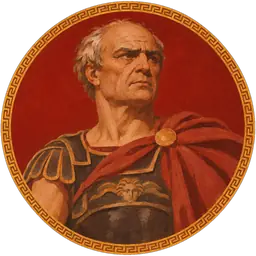
Gaius Marius
Gaius Marius was born of obscure parents near Arpinum and grew up there, training as a soldier rather than in Greek eloquence or city manners.1 He married Julia of the Caesars, the aunt of Julius Caesar, and served as Metellus' legate against Jugurtha until he went home to stand for the consulship.2 As consul he enlisted soldiers not from the property classes, as custom required, but mostly from the poorest citizens, the head count.3 Cicero recalls that Rome rested all its hopes on him, so that the same man fought Jugurtha, the Cimbri and the Teutones; his quaestor Sulla took Jugurtha, and the quarrel over that glory began their feud.4 In his sixth consulship he helped Saturninus drive Metellus into exile, then took up arms against Saturninus under the senate's decree.5 He was the first man elected consul seven times, and died seventeen days into his seventh consulship, aged seventy.6
Open Gaius Marius in the atlas
Events
Ties
- led in triumph Jugurtha Sallust, Jugurtha 114
- legate, then rival of Metellus Numidicus Cicero, On Duties 3.79
- helped drive into exile Metellus Numidicus Appian, Civil Wars 1.4.29
- feuded with Sulla Plutarch, Marius 10.5
- uncle by marriage of Julius Caesar Plutarch, Marius 6.2
- allied with, then put down Saturninus Plutarch, Marius 29.1
- Cinna took Rome with Gaius Marius Appian, Civil Wars 1.8.71
What the sources say
“I will not remind you that it was but lately determined by you and by your ancestors, to rest all the hopes of the empire on Caius Marius, so that the same man conducted the war against Jugurtha, and against the Cimbri, and against”
non commemorabo nuper ita vobis patribusque vestris esse visum ut in uno C. Mario spes imperi poneretur, ut idem cum Iugurtha, idem cum Cimbris, idem cum Teutonis bellum administraret
Cicero, On the Command of Pompey 60 · tr. Charles Duke Yonge
“After having spoken to this effect, Marius, when he found that the minds of the populace were excited, immediately freighted vessels with provisions, pay, arms, and other necessaries, and ordered Aulus Manlius, his lieutenant-general, to set sail with them. He himself, in the mean time, proceeded to enlist soldiers, not after the ancient method, or from the classes, but taking all that were willing to join him, and the greater part from the lowest ranks”
Huiusce modi oratione habita Marius, postquam plebis animos arrectos videt, propere commeatu, stipendio, armis aliisque utilibus nauis onerat, cum his A. Manlium legatum proficisci iubet. Ipse interea milites scribere, non more maiorum neque ex classibus, sed uti libido cuiusque erat, capite censos plerosque
Sallust, Jugurtha 86 · tr. John Selby Watson
“we are told that to the soldier the eyes of Marius seemed to shoot out a strong flame, and that a loud voice issued from the shadows saying: Man, dost thou dare to slay Caius Marius? At once, then, the Barbarian fled from the room, threw his sword down on the ground, and dashed out of doors, with this one cry: I cannot kill Caius Marius”
λέγεται τὰ μὲν ὄμματα τοῦ Μαρίου φλόγα πολλὴν ἐκβάλλοντα τῷ στρατιώτῃ φανῆναι, φωνὴν δὲ μεγάλην ἐκ τοῦ παλισκίου γενέσθαι, σὺ δὴ τολμᾷς, ἄνθρωπε, Γάϊον Μάριον ἀνελεῖν ; ἐξῆλθεν οὖν εὐθὺς ὁ βάρβαρος φυγῇ, καὶ τὸ ξίφος ἐν μέσῳ καταβαλὼν ἐχώρει διὰ θυρῶν, τοῦτο μόνον βοῶν, οὐ δύναμαι Γάϊον Μάριον ἀποκτεῖναι
Plutarch, Marius 39.2 · tr. Bernadotte Perrin
First named
The earliest text in the library that names Gaius Marius, written about 80 BC (a modern estimate of when it was written):
“He, when at the funeral of Caius Marius, had contrived that Quintus Scaevola, the most venerable and accomplished man in our city, should be wounded”
is cum curasset in funere C. Mari ut Q. Scaevola volneraretur
Cicero, Pro Roscio Amerino 33 · tr. Charles Duke Yonge
Found by searching every text in the library for these spellings and reading the earliest hits to rule out namesakes: Μάριος, Μαρίου, Μαρίῳ, Μάριον, Γάιος Μάριος, Marius, Marium, Mario, Marii, C. Marius, Caius Marius, Gaius Marius. Texts lost, or not in the library, may name Gaius Marius earlier.
The passages behind each sentence
- Plutarch, Marius 3.1 (tr. Bernadotte Perrin); Sallust, Jugurtha 63 (tr. John Selby Watson) ↩
- Plutarch, Marius 6.2 (tr. Bernadotte Perrin); Plutarch, Marius 7.1 (tr. Bernadotte Perrin); Sallust, Jugurtha 64 (tr. John Selby Watson); Sallust, Jugurtha 73 (tr. John Selby Watson) ↩
- Sallust, Jugurtha 86 (tr. John Selby Watson); Plutarch, Marius 9.1 (tr. Bernadotte Perrin) ↩
- Cicero, On the Command of Pompey 60 (tr. Charles Duke Yonge); Plutarch, Marius 10.5 (tr. Bernadotte Perrin) ↩
- Appian, Civil Wars 1.4.29 (tr. Horace White); Cicero, Pro Rabirio 20 (tr. Charles Duke Yonge) ↩
- Plutarch, Marius 45.7 (tr. Bernadotte Perrin); Plutarch, Marius 46.5 (tr. Bernadotte Perrin) ↩
Cite this page
MLA “Gaius Marius.” Atlas of Ancient History, Skirnir Studios, 2026, history.skirnirstudios.com/people/marius/.
APA Skirnir Studios. (2026). Gaius Marius. Atlas of Ancient History. https://history.skirnirstudios.com/people/marius/
Chicago “Gaius Marius.” Atlas of Ancient History. Skirnir Studios, 2026. https://history.skirnirstudios.com/people/marius/.
The atlas was written by AI from the ancient sources. Where you can, cite the ancient passage itself by its reference (Herodotus 7.228, Livy 22.7.3) and name the translation you read.