Atlas of Ancient History › People › The late Republic
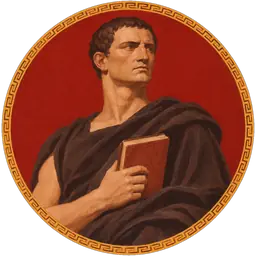
Cato the Younger
Marcus Porcius Cato was the great-grandson of Cato the Censor; left an orphan, he was brought up by his uncle Livius Drusus with his brother Caepio, his sister Porcia and his half-sister Servilia.1 A Stoic who ruled his life by fixed principle, he prosecuted the consul-elect Murena for bribery in 63 BC, and Cicero, defending Murena, answered him with respect.2 Sallust compared him with Caesar: Caesar won glory by giving and pardoning, Cato by his integrity and severity, and he preferred to be good rather than to seem so.3 As tribune he helped Cicero and hailed him father of his country, but Cicero complained to Atticus that Cato spoke as if he lived in Plato's Republic and not in the dregs of Romulus.4 After Caesar's victory in Africa he stayed at Utica, saw the others off by ship, and stabbed himself in his bedroom; when a doctor sewed up the wound he tore it open with his hands and died, at forty-eight.5
Open Cato the Younger in the atlas
Events
Ties
- hailed father of his country Cicero Plutarch, Cicero 23.3
- opposed Julius Caesar Sallust, Catiline 54
- Cato the Elder great-grandfather of Cato the Younger Plutarch, Cato the Younger 1.1
- Marcus Livius Drusus uncle and guardian of Cato the Younger Plutarch, Cato the Younger 1.1
- Servilia half-sister of Cato the Younger Plutarch, Cato the Younger 1.1
- Julius Caesar said he would have spared Cato the Younger Plutarch, Cato the Younger 72
- uncle and father-in-law of Marcus Junius Brutus Plutarch, Brutus 2.1
- advised Ptolemy XII Plutarch, Cato the Younger 35.2
- father of Porcia Plutarch, Brutus 13.3
What the sources say
“Their birth, age, and eloquence, were nearly on an equality; their greatness of mind similar, as was also their reputation, though attained by different means. Cæsar grew eminent by genesroity and munificence; Cato by the integrity of his life. Cæsar was esteemed for his humanity and benevolence; austereness had given dignity to Cato. Cæsar acquired renown by giving, relieving, and pardoning; Cato by bestowing nothing. In Cæsar, there was a refuge for the unfortunate; in Cato, destruction for the bad. In Cæsar, his easiness of temper was admired; in Cato, his firmness. Cæsar, in fine, had applied himself to a life of energy and activity; intent upon the interest of his friends, he was neglectful of his own; he refused nothing to others that was worthy of acceptance, while for himself he desired great power, the command of an army, and a new war in which his talents might be displayed. But Cato's ambition was that of temperance, discretion, and, above all, of austerity; he did not contend in splendor with the rich, or in faction with the seditious, but with the brave in fortitude, with the modest in simplicity, with the temperate in abstinence; he was more desirous to be, than to appear, virtuous”
Igitur iis genus, aetas, eloquentia prope aequalia fuere, magnitudo animi par, item gloria, sed alia alii. Caesar beneficiis ac munificentia magnus habebatur, integritate vitae Cato. Ille mansuetudine et misericordia clarus factus, huic severitas dignitatem addiderat. Caesar dando, sublevando, ignoscundo, Cato nihil largiundo gloriam adeptus est. In altero miseris perfugium erat, in altero malis pernicies. Illius facilitas, huius constantia laudabatur. Postremo Caesar in animum induxerat laborare, vigilare; negotiis amicorum intentus sua neglegere, nihil denegare, quod dono dignum esset; sibi magnum imperium, exercitum, bellum novum exoptabat, ubi virtus enitescere posset. At Catoni studium modestiae, decoris, sed maxume severitatis erat; non divitiis cum divite neque factione cum factioso, sed cum strenuo virtute, cum modesto pudore, cum innocente abstinentia certabat; esse quam videri bonus malebat
Sallust, Catiline 54 · tr. John Selby Watson
“As for our friend Cato, you do not love him more than I do: but after all, with the very best intentions and the most absolute honesty, he sometimes does harm to the Republic. He speaks and votes as though he were in the Republic of Plato, not in the scum of Romulus”
nam Catonem nostrum non tu amas plus quam ego; sed tamen ille optimo animo utens et summa fide nocet interdum rei publicae; dicit enim tamquam in Platonis πολιτείᾳ, non tamquam in Romuli faece sententiam
Cicero, Letters to Atticus 2.1.8 · tr. Evelyn Shuckburgh
“They saw that he was smeared with blood, and that most of his bowels were protruding, but that he still had his eyes open and was alive; and they were terribly shocked. But the physician went to him and tried to replace his bowels, which remained uninjured, and to sew up the wound. Accordingly, when Cato recovered and became aware of this, he pushed the physician away, tore his bowels with his hands, rent the wound still more, and so died.”
ἰδόντες δὲ πεφυρμένον αἵματι καὶ τῶν ἐντέρων τὰ πολλὰ προπεπτωκότα, ζῶντα δʼ αὐτόν ἔτι καὶ βλέποντα, δεινῶς μὲν ἅπαντες ἔσχον, ὁ δὲ ἰατρὸς προσελθὼν ἐπειρᾶτο τῶν ἐντέρων ἀτρώτων διαμεινάντων ταῦτά τε καθιστάναι καὶ τὸ τραῦμα διαρράπτειν. ὡς οὖν ἀνήνεγκεν ὁ Κάτων καὶ συνεφρόνησε, τὸν μὲν ἰατρὸν ἀπεώσατο, ταῖς χερσὶ δὲ τὰ ἔντερα σπαράξας καὶ τὸ τραῦμα ἐπαναρρήξας ἀπέθανεν.
Plutarch, Cato the Younger 70.6 · tr. Bernadotte Perrin
First named
The earliest text in the library that names Cato the Younger, written about 63 BC (a modern estimate of when it was written):
“And first of all I will answer Marcus Cato a man who directs his life by a certain rule and system and who most carefully weighs the motives of every duty about my own duty. Cato says it is not right that I who have been consul and the very passer of the law of bribery and corruption and who behaved so rigorously in my own consulship should take up the cause of Lucius Murena”
et primum M. Catoni vitam ad certam rationis normam derigenti et diligentissime perpendenti momenta officiorum omnium de officio meo respondebo. negat fuisse rectum Cato me et consulem et legis ambitus latorem et tam severe gesto consulatu causam L. Murenae attingere
Cicero, Pro Murena 3 · tr. Charles Duke Yonge
Found by searching every text in the library for these spellings and reading the earliest hits to rule out namesakes: Κάτων, Cato, Catonem, Catoni, Catonis, M. Cato, Marcus Cato. Texts lost, or not in the library, may name Cato the Younger earlier.
The passages behind each sentence
- Plutarch, Cato the Younger 1.1 (tr. Bernadotte Perrin) ↩
- Cicero, Pro Murena 3 (tr. Charles Duke Yonge) ↩
- Sallust, Catiline 54 (tr. John Selby Watson) ↩
- Plutarch, Cicero 23.3 (tr. Bernadotte Perrin); Cicero, Letters to Atticus 2.1.8 (tr. Evelyn Shuckburgh) ↩
- Plutarch, Cato the Younger 72.1 (tr. Bernadotte Perrin); African War 88 (tr. A. G. Way); Plutarch, Cato the Younger 70.6 (tr. Bernadotte Perrin) ↩
Cite this page
MLA “Cato the Younger.” Atlas of Ancient History, Skirnir Studios, 2026, history.skirnirstudios.com/people/cato-younger/.
APA Skirnir Studios. (2026). Cato the Younger. Atlas of Ancient History. https://history.skirnirstudios.com/people/cato-younger/
Chicago “Cato the Younger.” Atlas of Ancient History. Skirnir Studios, 2026. https://history.skirnirstudios.com/people/cato-younger/.
The atlas was written by AI from the ancient sources. Where you can, cite the ancient passage itself by its reference (Herodotus 7.228, Livy 22.7.3) and name the translation you read.