Atlas of Ancient History › People › The early Empire
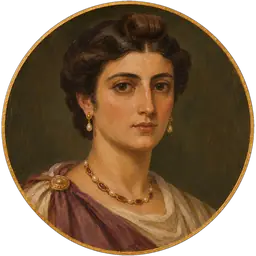
Livia
Livia was a Claudian by birth and a Livia by adoption, and her first marriage, by which she had children, was to Tiberius Nero, who returned to Rome after the peace with Sextus Pompeius.1 Caesar took her from her husband while she was pregnant, so impatient that he would not wait for the birth, and within three months she bore Drusus, the father of the emperor Claudius.2 She bore Augustus no children, though he badly wanted them; one child was born too early.3 Augustus died amid her kisses, saying 'Livia, live mindful of our marriage, and farewell'; Tacitus reports that some suspected her of his death, and that she kept the house at Nola under guard until Tiberius' succession was secure.4 His will named her and Tiberius his heirs and took her into the Julian family with the name Augusta.5 She died in extreme old age in the consulship of Rubellius and Fufius (AD 29), and her great-grandson Gaius, the later emperor, spoke her eulogy; Pliny says she credited her eighty-six years to the wine of Pucinum.6
Events
Ties
- wife of Augustus Tacitus, Annals 5.1
- mother of Drusus the Elder Suetonius, Claudius 1.1
- mother of Tiberius Suetonius, Tiberius 4
- grandmother of Claudius Suetonius, Claudius 1
What the sources say
“IN the consulship of Rubellius and Fufius, both of whom had the surname Geminus, died in an advanced old age Julia Augusta. A Claudia by birth and by adoption a Livia and a Julia, she united the noblest blood of Rome. Her first marriage, by which she had children, was with Tiberius Nero, who, an exile during the Perusian war, returned to Rome when peace had been concluded between Sextus Pompeius and the triumvirs. After this Cæsar, enamoured of her beauty, took her away from her husband, whether against her wish is uncertain. So impatient was he that he brought her to his house actually pregnant, not allowing time for her confinement. She had no subsequent issue, but allied as she was through the marriage of Agrippina and Germanicus to the blood of Augustus, her great-grandchildren were also his. In the purity of her home life she was of the ancient type, but was more gracious than was thought fitting in ladies of former days. An imperious mother and an amiable wife, she was a match for the diplomacy of her husband and the dissimulation of her son”
Rubellio et Fufio consulibus, quorum utrique Geminus cognomentum erat, Iulia Augusta mortem obiit, aetate extrema, nobilitatis per Claudiam familiam et adoptione Liviorum Iuliorumque clarissimae. primum ei matrimonium et liberi fuere cum Tiberio Nerone, qui bello Perusino profugus pace inter Sex. Pompeium ac triumviros pacta in urbem rediit. exim Caesar cupidine formae aufert marito, incertum an invitam, adeo properus ut ne spatio quidem ad enitendum dato penatibus suis gravidam induxerit. nullam posthac subolem edidit sed sanguini Augusti per coniunctionem Agrippinae et Germanici adnexa communis pronepotes habuit. sanctitate domus priscum ad morem, comis ultra quam antiquis feminis probatum, mater impotens, uxor facilis et cum artibus mariti, simulatione filii bene composita
Tacitus, Annals 5.1 · translator not recorded
“just arrived from Rome, concerning Drusus's daughter, who was in a bad state of health, he expired suddenly, amidst the kisses of Livia, and with these words: "Livia! live mindful of our union; and now, farewell”
omnibus deinde dimissis, dum aduenientes ab urbe de Drusi filia aegra interrogat, repente in osculis Liuiae et in hac uoce defecit: 'Liuia, nostri coniugii memor uiue, ac uale
Suetonius, Augustus 99.1 · tr. Alexander Thomson
“For Livia had surrounded the house and its approaches with a strict watch, and favourable bulletins were published from time to time, till, provision having been made for the demands of the crisis, one and the same report told men that Augustus was dead and that Tiberius Nero was master of the State”
acribus namque custodiis domum et vias saepserat Livia, laetique interdum nuntii vulgabantur, donec provisis quae tempus monebat simul excessisse Augustum et rerum potiri Neronem fama eadem tulit
Tacitus, Annals 1.5 · translator not recorded
First named
The earliest text in the library that names Livia, written about 1 BC (a modern estimate of when it was written):
“the portico that bears the name of its founder, Livia”
Porticus auctoris Livia nomen habet:
Ovid, Ars Amatoria 1.72 · AI translation (Claude)
The library's English verse paraphrase leaves this line out.
Found by searching every text in the library for these spellings and reading the earliest hits to rule out namesakes: Livia, Liviae, Liviam, Livia Drusilla, Livia Augusta, Julia Augusta, Iulia Augusta, Augusta, Λιουία, Λιουίας, Λιουίαν, Λιουίᾳ, Λιουία Δρουσίλλα, Λιβία, Λιβίας, Λιβίαν, Ἰουλία. Texts lost, or not in the library, may name Livia earlier.
The passages behind each sentence
- Tacitus, Annals 5.1 (translator not recorded) ↩
- Tacitus, Annals 5.1 (translator not recorded); Suetonius, Claudius 1.1 (tr. Alexander Thomson) ↩
- Suetonius, Augustus 63.1 (tr. Alexander Thomson) ↩
- Suetonius, Augustus 99.1 (tr. Alexander Thomson); Tacitus, Annals 1.5 (translator not recorded) ↩
- Tacitus, Annals 1.8 (translator not recorded) ↩
- Tacitus, Annals 5.1 (translator not recorded); Pliny the Elder, Natural History 14.6 (translator not recorded) ↩
Cite this page
MLA “Livia.” Atlas of Ancient History, Skirnir Studios, 2026, history.skirnirstudios.com/people/livia/.
APA Skirnir Studios. (2026). Livia. Atlas of Ancient History. https://history.skirnirstudios.com/people/livia/
Chicago “Livia.” Atlas of Ancient History. Skirnir Studios, 2026. https://history.skirnirstudios.com/people/livia/.
The atlas was written by AI from the ancient sources. Where you can, cite the ancient passage itself by its reference (Herodotus 7.228, Livy 22.7.3) and name the translation you read.