Atlas of Ancient History › People › The early Empire
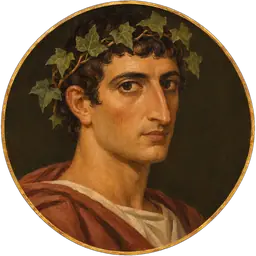
Ovid
Ovid was born at Sulmo, ninety miles from Rome, in the year both consuls fell (43 BC), into an old equestrian family.1 Seneca the Elder heard him declaim as a young man in the school of Arellius Fuscus and found his talent neat, graceful and charming; Ovid himself says he heard Horace recite and only saw Virgil.2 He published the Amores in five books and then cut them to three, and wrote of himself as the playful poet of tender loves.3 When he was about fifty, the anger of the offended prince sent him to Tomis on the Black Sea; he blames 'two charges, a poem and a mistake', and says the edict called him relegated, not exiled, and left him his property.4 From exile he sent the Tristia and the Letters from Pontus to Rome, pleading with Caesar for a milder place; Jerome's Chronicle, written in the fourth century, says he died in exile and was buried near Tomis.5
Ties
- Augustus banished Ovid Ovid, Tristia 2
What the sources say
“I who lie here, the playful poet of tender loves, Naso, perished by my own talent. But you who pass by, whoever you are that have loved, let it not be a burden to say: 'May Naso's bones lie softly.'”
HIC . EGO . QVI. IACEO. TENERORVM. LVSOR. AMORVM. INGENIO. PERUII. NASO . POETA. MEO AT. TIBI. QVI. TRANSIS . NE. SIT . GRAVE. QVISQVIS. AMASTI DICERE. NASONIS . MOLLITER. OSSA . CVBENT
Ovid, Tristia 3.3 · AI translation (Claude)
“and the crowd of the learned knows Naso and dares to count him among men not despised … though two charges ruined me, a poem and a mistake, I must keep silent about the fault of the second deed; for I am not worth so much that I should reopen your wounds, Caesar: it is more than enough that you were pained once.”
turbaque doctorum Nasonem novit et audet non fastiditis adnumerare viris … perdiderint cum me duo crimina, carmen et error, alterius facti culpa silenda milli'. nam non sum tanti, renovem ut tua vulnera. Caesar, quem nimio plus est indoluisse semel
Ovid, Tristia 2 · AI translation (Claude)
“I remember this case being declaimed by Ovidius Naso at the school of the rhetor Arellius Fuscus, whose pupil he was; for he admired Latro, though he followed a different style of speaking. He had a neat, graceful and charming talent.”
Hanc controuersiam memini ab OVIDIO Nasone declamari aput rhetorem Arellium Fuscum cuius auditor fuit; nam Latronis admirator erat, cum diuersum sequeretur dicendi genus. Habebat ille comptum et decens et amabile ingenium
Seneca the Elder, Controversiae 2.2 · AI translation (Claude)
First named
The earliest text in the library that names Ovid, written about 2 BC (a modern estimate of when it was written):
“We who were lately Naso's five little books are now three; the author preferred this work to that. Even if you take no pleasure in reading us, at least with two removed your punishment will be lighter.”
Qui modo Nasonis fueramus quinque libelli, Tres sumus; hoc illi praetulit auctor opus. Ut iam nulla tibi nos sit legisse voluptas, At levior demptis poena duobus erit
Ovid, Amores 1.ep · AI translation (Claude)
The library's English leaves this epigram untranslated.
Found by searching every text in the library for these spellings and reading the earliest hits to rule out namesakes: Ovidius, Ovidi, Ovidio, Ovidium, Ovid, Naso, Nasonis, Nasoni, Nasonem, Nasone, Ovidius Naso, Publius Ovidius Naso. Texts lost, or not in the library, may name Ovid earlier.
The passages behind each sentence
- Ovid, Tristia 4.10 (AI translation (Claude)) ↩
- Seneca the Elder, Controversiae 2.2 (AI translation (Claude)); Ovid, Tristia 4.10 (AI translation (Claude)) ↩
- Ovid, Amores 1.ep (AI translation (Claude)); Ovid, Tristia 3.3 (AI translation (Claude)) ↩
- Ovid, Tristia 4.10 (AI translation (Claude)); Ovid, Tristia 2 (AI translation (Claude)) ↩
- Ovid, Tristia 2 (AI translation (Claude)); Jerome, Chronicle 3411 (AI translation (Claude)) ↩
Cite this page
MLA “Ovid.” Atlas of Ancient History, Skirnir Studios, 2026, history.skirnirstudios.com/people/ovid/.
APA Skirnir Studios. (2026). Ovid. Atlas of Ancient History. https://history.skirnirstudios.com/people/ovid/
Chicago “Ovid.” Atlas of Ancient History. Skirnir Studios, 2026. https://history.skirnirstudios.com/people/ovid/.
The atlas was written by AI from the ancient sources. Where you can, cite the ancient passage itself by its reference (Herodotus 7.228, Livy 22.7.3) and name the translation you read.