Atlas of Ancient History › People › The late Republic
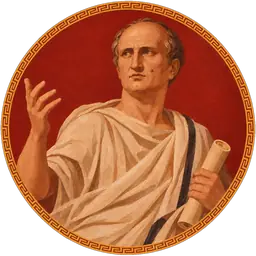
Cicero
Marcus Tullius Cicero was born on 3 January; as a young man he studied with the Academic Philon and the jurist Scaevola and served briefly under Sulla in the Marsian war.1 He made his name by prosecuting Verres for his plundering of Sicily, calling the witnesses at once instead of making long speeches, and Verres was convicted.2 As consul in 63 BC he denounced Catiline in the senate in a speech he afterwards published, and had the conspirators in the city executed, announcing their deaths to the crowd with the word 'they have lived'; Cato hailed him father of his country.3 Clodius, backed by Caesar, prosecuted him for putting citizens to death without trial, and he went into exile; he came home in the sixteenth month, saying that Italy had carried him back to Rome on her shoulders.4 After Caesar's death he attacked Antony in the speeches he called Philippics, and when the triumvirs met at Bononia Octavian gave him up to Antony on the third day.5 Overtaken near his villa at Formiae, he put his neck out of his litter and was killed; his head and hands were set up on the rostra, and Livy wrote that he had lived sixty-three years.6
Events
Ties
- prosecuted Verres Plutarch, Cicero 8.1
- denounced in the senate Catiline Sallust, Catiline 31
- Cato the Younger hailed father of his country Cicero Plutarch, Cicero 23.3
- Clodius drove into exile Cicero Plutarch, Cicero 30.4
- Mark Antony had killed Cicero Plutarch, Cicero 49.1
- Catullus thanked Cicero Catullus lyrics.49
- Augustus let Antony proscribe Cicero Plutarch, Cicero 46.3
- Livy wrote of the death of Cicero Seneca the Elder, Suasoriae 6.17
What the sources say
“It was then that Marcus Tullius, the consul, whether alarmed at his presence, or fired with indignation against him, delivered that splendid speech, so beneficial to the republic, which he afterward wrote and published. When Cicero sat down, Catiline, being prepared to pretend ignorance of the whole matter, entreated, with downcast looks and suppliant voice”
Tum M. Tullius consul, sive praesentiam eius timens sive ira conmotus, orationem habuit luculentam atque utilem rei publicae, quam postea scriptam edidit. Sed ubi ille adsedit Catilina, ut erat paratus ad dissimulanda omnia, demisso voltu, voce supplici postulare a patribus coepit
Sallust, Catiline 31 · tr. John Selby Watson
“Most eloquent of Romulus’ descendancy—as many as there are, who have been, O Marcus Tullius, and who will be after in other years—to you Catullus gives his greatest gratitude, the worst poet of all by as much as you are the best advocate of all.”
Disertissime Romuli nepotum, quot sunt quotque fuere, Marce Tulli, quotque post aliis erunt in annis, gratias tibi maximas Catullus agit pessimus omnium poeta, tanto pessimus omnium poeta quanto tu optimus omnium patronus.
Catullus lyrics.49 · tr. Leonard C. Smithers
“Marcus Cicero had left the city at the coming of the triumvirs, holding it as certain, as it was, that he could no more be snatched from Antony than Cassius and Brutus from Caesar. He fled first to his Tusculan villa, then by cross-country roads to his Formian villa, meaning to take ship from Caieta. Several times he put out to sea, and the contrary winds drove him back, or he himself could not bear the tossing of the ship in the blind rolling swell; at last weariness of flight and of life took him, and returning to his upper villa, which is a little more than a mile from the sea, he said: 'I will die in the fatherland I have often saved.' It is well established that his slaves were bravely and faithfully ready to fight; he himself ordered them to set down the litter and to bear quietly what an unjust fate compelled. As he leaned out of the litter and offered his neck without moving, his head was cut off. Nor was that enough for the brutish cruelty of the soldiers: they cut off his hands too, reproaching them with having written something against Antony. So the head was brought to Antony, and by his order it was set on the rostra between the two hands, where he had been heard as consul, often as a consular, and that very year against Antony, with such admiration for his eloquence as no human voice ever won: men could scarcely raise their eyes for tears to look on the limbs of the murdered citizen.”
Marcus Cicero sub aduentum triumuirorum urbe cesserat pro certo habens id quod erat, non magis se Antonio eripi quam Caesari Cassium et Brutum posse: primo in Tusculanum fugerat, inde transuersis itineribus in Formianum ut ab Caieta nauem conscensurus proficiscitur. unde aliquoties in altum prouectum cum modo uenti aduersi retulissent, modo ipse iactationem nauis caeco uoluente fluctu pati non posset, taedium tandem eum et fugae et uitae cepit, regressusque ad superiorem uillam, quae paulo plus mille passibus a mari abest, “moriar,” inquit, “in patria saepe seruata.” Satis constat seruos fortiter fideliterque paratos fuisse ad dimicandum; ipsum deponi lecticam et quietos pati quod sors iniqua cogeret iussisse. Prominenti ex lectica praebentique inmotam ceruicem caput praecisum est. nec satis stolidae crudelitati militum fuit: manus quoque scripsisse aliquid in Antonium exprobrantes praeciderunt. Ita relatum caput ad Antonium iussuque eius inter duas manus in rostris positum, ubi ille consul, ubi saepe consularis, ubi eo ipso anno aduersus Antonium quanta nulla umquam humana uox cum admiratione eloquentiae auditus fuerat: uix attollentes prae lacrimis oculos homines intueri trucidati membra ciuis poterant
Livy, quoted by Seneca the Elder, Suasoriae 6.17 · AI translation (Claude)
Livy's account (book 120, written under Augustus), quoted word for word by Seneca the Elder, about AD 37.
“When Cicero’s extremities were brought to Rome, it chanced that Antony was conducting an election, but when he heard of their arrival and saw them, he cried out, Now let our proscriptions have an end. Then he ordered the head and hands to be placed over the ships’ beaks on the rostra, a sight that made the Romans shudder; for they thought they saw there, not the face of Cicero, but an image of the soul of Antony.”
τῶν δʼ ἀκρωτηρίων εἰς Ῥώμην κομισθέντων ἔτυχε μὲν ἀρχαιρεσίας τελῶν ὁ Ἀντώνιος, ἀκούσας δὲ καὶ ἰδὼν ἀνεβόησεν ὡς νῦν αἱ προγραφαὶ τέλος ἔχοιεν. τὴν δὲ κεφαλὴν καὶ τάς χεῖρας ἐκέλευσεν ὑπὲρ τῶν ἐμβόλων ἐπὶ τοῦ βήματος θεῖναι, θέαμα Ῥωμαίοις φρικτόν, οὐ τὸ Κικέρωνος ὁρᾶν πρόσωπον οἰομένοις, ἀλλὰ τῆς Ἀντωνίου ψυχῆς εἰκόνα.
Plutarch, Cicero 49.1 · tr. Bernadotte Perrin
First named
The earliest text in the library that names Cicero, written about 70 BC (a modern estimate of when it was written):
“Appoint me, says he, to watch Tullius”
custodem, inquit, Tullio me adponite
Cicero, Divinatio in Caecilium 50 · tr. Charles Duke Yonge
Found by searching every text in the library for these spellings and reading the earliest hits to rule out namesakes: Κικέρων, Κικέρωνος, Cicero, Ciceronis, Ciceroni, Ciceronem, M. Tullius, Marcus Tullius, Tullius, Tullio, Marce Tulli, Marcus Cicero. Texts lost, or not in the library, may name Cicero earlier.
The passages behind each sentence
- Plutarch, Cicero 2.1 (tr. Bernadotte Perrin); Plutarch, Cicero 3.1 (tr. Bernadotte Perrin) ↩
- Plutarch, Cicero 7.4 (tr. Bernadotte Perrin); Plutarch, Cicero 8.1 (tr. Bernadotte Perrin) ↩
- Sallust, Catiline 31 (tr. John Selby Watson); Plutarch, Cicero 22.2 (tr. Bernadotte Perrin); Plutarch, Cicero 23.3 (tr. Bernadotte Perrin) ↩
- Plutarch, Cicero 30.4 (tr. Bernadotte Perrin); Plutarch, Cicero 33.5 (tr. Bernadotte Perrin) ↩
- Plutarch, Cicero 48.4 (tr. Bernadotte Perrin); Plutarch, Cicero 46.3 (tr. Bernadotte Perrin) ↩
- Livy, quoted by Seneca the Elder, Suasoriae 6.17 (AI translation (Claude)); Plutarch, Cicero 49.1 (tr. Bernadotte Perrin); Livy, quoted by Seneca the Elder, Suasoriae 6.22 (AI translation (Claude)) ↩
Cite this page
MLA “Cicero.” Atlas of Ancient History, Skirnir Studios, 2026, history.skirnirstudios.com/people/cicero/.
APA Skirnir Studios. (2026). Cicero. Atlas of Ancient History. https://history.skirnirstudios.com/people/cicero/
Chicago “Cicero.” Atlas of Ancient History. Skirnir Studios, 2026. https://history.skirnirstudios.com/people/cicero/.
The atlas was written by AI from the ancient sources. Where you can, cite the ancient passage itself by its reference (Herodotus 7.228, Livy 22.7.3) and name the translation you read.