Atlas of Ancient History › People › The early Empire
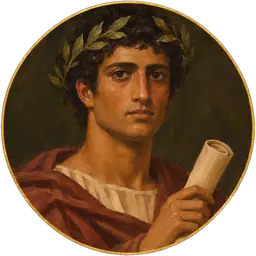
Virgil
Virgil's epitaph, as Jerome gives it, reads: 'Mantua bore me, the Calabrians snatched me away, Parthenope now holds me; I sang of pastures, fields and leaders'.1 Horace calls him the best of men and says that Virgil, and after him Varius, first told Maecenas about Horace.2 At the end of the Georgics he signs his name: he sang of fields, flocks and trees while Caesar thundered in war by the Euphrates, living at Naples, the poet who had once sung 'Tityrus, under the spreading beech'.3 While he was writing the Aeneid, Propertius told Roman and Greek writers to give way: 'something greater than the Iliad is being born'.4 Jerome's Chronicle, written four centuries later from Suetonius, says he died at Brundisium in the consulship of Sentius Saturninus and Lucretius Cinna (19 BC), was buried near Naples, and that Varius and Tucca afterwards corrected the Aeneid on condition that they add nothing.5 Ovid, a younger poet, says he only ever saw Virgil.6
Ties
What the sources say
“So sang I of the tilth of furrowed fields, Of flocks and trees, while Caesar's majesty Launched forth the levin-bolts of war by deep Euphrates, and bare rule o'er willing folk Though vanquished, and essayed the heights of heaven. I Virgil then, of sweet Parthenope The nursling, wooed the flowery walks of peace Inglorious, who erst trilled for shepherd-wights The wanton ditty, and sang in saucy youth Thee, Tityrus, 'neath the spreading beech tree's shade”
Haec super arvorum cultu pecorumque canebam et super arboribus, Caesar dum magnus ad altum fulminat Euphraten bello victorque volentes per populos dat iura viamque adfectat Olympo. Illo Vergilium me tempore dulcis alebat Parthenope studiis florentem ignobilis oti, carmina qui lusi pastorum audaxque iuventa, Tityre, te patulae cecini sub tegmine fagi
Virgil, Georgics 4 · tr. James Rhoades
“Virgil, who can tell of the Actian shores of Phoebus their guardian and of Caesar's brave ships, who now rouses the arms of Trojan Aeneas and the walls he founded on the Lavinian shores. Give way, Roman writers, give way, Greeks! Something greater than the Iliad is being born.”
Actia Vergilium custodis litora Phoebi, Caesaris et fortis dicere posse ratis, qui nunc Aeneae Troiani suscitat arma iactaque Lavinis moenia litoribus. cedite Romani scriptorcs, cedite Grai! nescio quid maius nascitur Iliade
Propertius, Elegies 2.34b · AI translation (Claude)
“for Plotius, and Varius, and Virgil met us at Sinuessa; souls more candid ones than which the world never produced, nor is there a person in the world more bound to them than myself”
Plotius et Varius Sinuessae Vergiliusque occurrunt, animae, qualis neque candidiores terra tulit neque quis me sit devinctior alter
Horace, Satires 1.5 · tr. Christopher Smart
First named
The earliest text in the library that names Virgil, written about 35 BC (a modern estimate of when it was written):
“for Plotius, and Varius, and Virgil met us at Sinuessa; souls more candid ones than which the world never produced, nor is there a person in the world more bound to them than myself”
Plotius et Varius Sinuessae Vergiliusque occurrunt, animae, qualis neque candidiores terra tulit neque quis me sit devinctior alter
Horace, Satires 1.5 · tr. Christopher Smart
Found by searching every text in the library for these spellings and reading the earliest hits to rule out namesakes: Vergilius, Vergili, Vergilio, Vergilium, Virgilius, Virgilii, Virgil, Vergil, Maro, Maronis, Maroni, Marone, Publius Vergilius Maro, Βεργίλιος, Οὐεργίλιος. Texts lost, or not in the library, may name Virgil earlier.
The passages behind each sentence
- Jerome, Chronicle 3358 (AI translation (Claude)) ↩
- Horace, Satires 1.6 (tr. Christopher Smart) ↩
- Virgil, Georgics 4 (tr. James Rhoades) ↩
- Propertius, Elegies 2.34b (AI translation (Claude)) ↩
- Jerome, Chronicle 3358 (AI translation (Claude)); Jerome, Chronicle 3361 (AI translation (Claude)) ↩
- Ovid, Tristia 4.10.51 (AI translation (Claude)) ↩
Cite this page
MLA “Virgil.” Atlas of Ancient History, Skirnir Studios, 2026, history.skirnirstudios.com/people/virgil/.
APA Skirnir Studios. (2026). Virgil. Atlas of Ancient History. https://history.skirnirstudios.com/people/virgil/
Chicago “Virgil.” Atlas of Ancient History. Skirnir Studios, 2026. https://history.skirnirstudios.com/people/virgil/.
The atlas was written by AI from the ancient sources. Where you can, cite the ancient passage itself by its reference (Herodotus 7.228, Livy 22.7.3) and name the translation you read.