Atlas of Ancient History › People › The early Empire
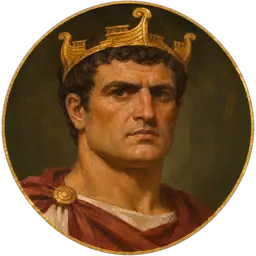
Agrippa
Marcus Vipsanius Agrippa was a close friend of the young Caesar; Nepos says that with his own influence and Caesar's power he could have married anyone, yet chose the daughter of Atticus, a Roman knight, in a match arranged by Antony.1 Tacitus calls him a man of humble birth, a good soldier and the partner of Augustus' victory, and at Actium he commanded Caesar's left wing.2 After the death of Marcellus, Augustus gave him his daughter Julia, persuading his sister Octavia to give up her son-in-law, since Agrippa was then married to one of her daughters, the Marcellas.3 Agrippa and Julia had three sons, Gaius, Lucius and Agrippa, and two daughters, Julia and Agrippina; Augustus adopted Gaius and Lucius.4 In the consulship of Valerius and Sulpicius (12 BC) he came back from Pannonia in winter, fell ill in Campania and died before Augustus could reach him; Augustus laid out his body in the Forum and spoke the eulogy.5 Pliny says he was born feet first and died in his fifty-first year, after a life spent among arms and death, troubled by his wife's adulteries and his father-in-law's heavy yoke.6
Events
Ties
- defeated at Naulochus Sextus Pompey Appian, Civil Wars 5.12.121
- son-in-law and partner in victory of Augustus Tacitus, Annals 1.3
- husband of Julia, daughter of Augustus Suetonius, Augustus 64.1
- fought at Actium against Mark Antony Plutarch, Antony 65.2
- father of Agrippina the Elder Suetonius, Caligula 7
What the sources say
“Not I, but Varius:—he, of Homer's brood A tuneful swan, shall bear you on his wing, Your tale of trophies, won by field or flood, Mighty alike to sing. Not mine such themes, Agrippa; no, nor mine To chant the Wrath that fill'd Pelides' breast, Nor dark Ulysses' wanderings o'er the brine, Nor Pelops' house unblest. Vast were the task, I feeble; inborn shame, And she, who makes the peaceful lyre submit, Forbid me to impair great Caesar's fame And yours by my weak wit”
Scriberis Vario fortis et hostium victor Maeonii carminis alite, quam rem cumque ferox navibus aut equis miles te duce gesserit. nos, Agrippa, neque haec dicere nec gravem Pelidae stomachum cedere nescii nec cursus duplicis per mare Ulixei nec saevam Pelopis domum conamur, tenues grandia, dum pudor inbellisque lyrae Musa potens vetat laudes egregii Caesaris et tuas culpa deterere ingeni
Horace, Odes 1.6 · tr. John Conington
“So Agrippa died, plainly the best man of his time in every way, who used Augustus' friendship for what was most useful both to Augustus himself and to the state. For as much as he surpassed others in excellence, so much did he willingly yield to Augustus.”
Ἀγρίππας μὲν οὖν οὕτω μετήλλαξε, τά τε ἄλλα ἄριστος τῶν καθʼ ἑαυτὸν ἀνθρώπων διαφανῶς γενόμενος, καὶ τῇ τοῦ Αὐγούστου φιλίᾳ πρός τε τὸ αὐτῷ ἐκείνῳ καὶ πρὸς τὸ τῷ κοινῷ συμφορώτατον χρησάμενος. ὅσον τε γὰρ τοὺς ἄλλους ἀρετῇ κατεκράτει, τοσοῦτον ἐκείνου ἐθελοντὴς ἡττᾶτο
Cassius Dio 54.29 · AI translation (Claude)
“In this manner, M. Agrippa is said to have been born; the only instance, almost, of good fortune, out of the number of all those who have come into the world under these circumstances. And yet, even he may be considered to have paid the penalty of the unfavourable omen produced by the unnatural mode of his birth, in the unfortunate weakness of his legs, the misfortunes of his youth, a life spent in the very midst of arms and slaughter, and ever exposed to the approaches of death; in his children, too, who have all proved a very curse to the earth, and more especially, the two Agrippinas, who were the mothers respectively of Caius and of Domitius Nero, so many firebrands hurled among the human race. In addition to all this, we may add the shortness of his life, he being cut off in his fifty-first year, the distress which he experienced from the adulteries of his wife, and the grievous tyranny to which he was subjected by his father-in-law”
qualiter et M. Agrippam ferunt genitum, unico prope felicitatis exemplo in omnibus ad hunc modum genitis. quamquam is quoque adversa pedum valitudine, misera iuventa, exercito aevo inter arma mortesque ac noxia accessu, infelici terris stirpe omni, sed per utrasque Agrippinas maxime, quae Gaium , quae Domitium Neronem principes genuere totidem faces generis humani, praeterea brevitate aevi, quinquagensimo uno raptus anno in tormentis adulteriorum coniugis socerique praegravi servitio
Pliny the Elder, Natural History 7.8.1 · translator not recorded
First named
The earliest text in the library that names Agrippa, written about 34 BC (a modern estimate of when it was written):
“By these means, then, he brought it about that Marcus Vipsanius Agrippa, bound in the closest friendship to the young Caesar, though his own influence and Caesar's power could have won him any match he liked, chose this alliance above all, and preferred the daughter of a Roman knight to marriages with women of noble birth. And the maker of this match (for it must not be hidden) was Mark Antony, triumvir for setting the state in order.”
His igitur rebus effecit ut M. Vipsanius Agrippa, intima familiaritate coniunctus adulescenti Caesari, cum propter suam gratiam et Caesaris potentiam nullius condicionis non haberet potestatem, potissimum eius deligeret affinitatem praeoptaretque equitis Romani filiam generosarum nuptiis. atque harum nuptiarum conciliator fuit (non est enim celandum) M. Antonius, triumvirum rei publicae constituendae
Nepos, Atticus 12.1 · AI translation (Claude)
Found by searching every text in the library for these spellings and reading the earliest hits to rule out namesakes: Agrippa, Agrippae, Agrippam, Marcus Agrippa, M. Agrippa, Vipsanius Agrippa, M. Vipsanius Agrippa, Ἀγρίππας, Ἀγρίππου, Ἀγρίππᾳ, Ἀγρίππαν, Μᾶρκος Ἀγρίππας. Texts lost, or not in the library, may name Agrippa earlier.
The passages behind each sentence
- Nepos, Atticus 12.1 (AI translation (Claude)) ↩
- Tacitus, Annals 1.3 (translator not recorded); Plutarch, Antony 65.2 (tr. Bernadotte Perrin) ↩
- Suetonius, Augustus 63.1 (tr. Alexander Thomson) ↩
- Suetonius, Augustus 64.1 (tr. Alexander Thomson) ↩
- Cassius Dio 54.28 (AI translation (Claude)) ↩
- Pliny the Elder, Natural History 7.8.1 (translator not recorded) ↩
Cite this page
MLA “Agrippa.” Atlas of Ancient History, Skirnir Studios, 2026, history.skirnirstudios.com/people/agrippa/.
APA Skirnir Studios. (2026). Agrippa. Atlas of Ancient History. https://history.skirnirstudios.com/people/agrippa/
Chicago “Agrippa.” Atlas of Ancient History. Skirnir Studios, 2026. https://history.skirnirstudios.com/people/agrippa/.
The atlas was written by AI from the ancient sources. Where you can, cite the ancient passage itself by its reference (Herodotus 7.228, Livy 22.7.3) and name the translation you read.