Atlas of Ancient History › People › The early Empire
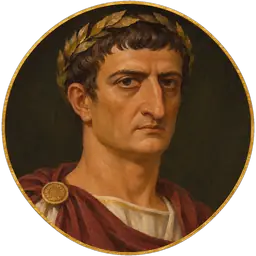
Tiberius
Tiberius was the son of Tiberius Nero, Caesar's quaestor, and Livia; Suetonius, following the public records, says he was born on the Palatine at Rome on 16 November 42 BC, though some writers put his birth a year earlier or later.1 Augustus, who had married his mother, later made him divorce Agrippina, Agrippa's daughter and the granddaughter of Atticus (not the Agrippina who married Germanicus), whom he loved, and marry Augustus' own daughter Julia.2 He restored Armenia to Tigranes, recovered the standards lost by Crassus and fought in the Alps, Pannonia and Germany; after Gaius and Lucius Caesar died within three years, Augustus adopted him, first making him adopt his nephew Germanicus.3 When Augustus died and the senate begged him to rule, he answered that only the mind of the Divine Augustus was equal to such a burden; Tacitus found more grand sentiment than good faith in the words.4 Later he left Rome for Campania and Capri and never lived in the city again; Tacitus, though most writers blamed Sejanus, wondered whether he went to hide his own cruelty and vices.5 He died in Lucullus' old villa at Misenum on 16 March in the consulship of Acerronius and Pontius (AD 37), in his seventy-eighth year; Tacitus says that when he revived, Macro had him smothered under a heap of clothes, and Suetonius reports that some thought Gaius had poisoned him.6
Events
Ties
- Livia mother of Tiberius Suetonius, Tiberius 4
- brother of Drusus the Elder Suetonius, Tiberius 4
- stepson and adopted heir of Augustus Suetonius, Tiberius 21
- husband of Julia, daughter of Augustus Tacitus, Annals 1.53
- adoptive father of Germanicus Tacitus, Annals 1.3
- Agrippina the Elder daughter-in-law and enemy of Tiberius Tacitus, Annals 4.52
- Sejanus praetorian prefect and confidant of Tiberius Tacitus, Annals 4.1
- Caligula successor of Tiberius Philo, Against Flaccus 9
- Pontius Pilate governor of Judaea under Tiberius Josephus, Jewish Antiquities 18.89
What the sources say
“After this all prayers were addressed to Tiberius. He, on his part, urged various considerations, the greatness of the empire, his distrust of himself. "Only," he said, "the intellect of the Divine Augustus was equal to such a burden. Called as he had been by him to share his anxieties, he had learnt by experience how exposed to fortune's caprices was the task of universal rule. Consequently, in a state which had the support of so many great men, they should not put everything on one man, as many, by uniting their efforts would more easily discharge public functions." There was more grand sentiment than good faith in such words. Tiberius's language even in matters which he did not care to conceal, either from nature or habit, was always hesitating and obscure, and now that he was struggling to hide his feelings completely, it was all the more involved in uncertainty and doubt”
Versae inde ad Tiberium preces. et ille varie disserebat de magnitudine imperii sua modestia. solam divi Augusti mentem tantae molis capacem: se in partem curarum ab illo vocatum experiendo didicisse quam arduum, quam subiectum fortunae regendi cuncta onus. proinde in civitate tot inlustribus viris subnixa non ad unum omnia deferrent: plures facilius munia rei publicae sociatis laboribus exsecuturos. plus in oratione tali dignitatis quam fidei erat; Tiberioque etiam in rebus quas non occuleret, seu natura sive adsuetudine, suspensa semper et obscura verba: tunc vero nitenti ut sensus suos penitus abderet, in incertum et ambiguum magis implicabantur
Tacitus, Annals 1.11 · translator not recorded
“I know, it is generally believed, that upon Tiberius's quitting the room, after their private conference, those who were in waiting overheard Augustus say, "Ah! unhappy Roman people, to be ground by the jaws of such a slow devourer”
Scio uulgo persuasum quasi egresso post secretum sermonem Tiberio uox Augusti per cubicularios excepta sit: 'miserum populum R., qui sub tam lentis maxillis erit
Suetonius, Tiberius 21 · tr. Alexander Thomson
“never have the Romans and their allies thrived in such peace and plenty as that which was afforded them by Augustus Caesar, from the time he assumed the absolute authority, and is now being afforded them by his son and successor, Tiberius, who is making Augustus the model of his administration and decrees, as are his children, Germanicus and Drusus, who are assisting their father”
οὐδέποτε γοῦν εὐπορῆσαι τοσαύτης εἰρήνης καὶ ἀφθονίας ἀγαθῶν ὑπῆρξε Ῥωμαίοις καὶ τοῖς συμμάχοις αὐτῶν, ὅσην Καῖσάρ τε ὁ Σεβαστὸς παρέσχεν ἀφʼ οὗ παρέλαβε τὴν ἐξουσίαν αὐτοτελῆ, καὶ νῦν ὁ διαδεξάμενος υἱὸς ἐκεῖνον παρέχει Τιβέριος, κανόνα τῆς διοικήσεως καὶ τῶν προσταγμάτων ποιούμενος ἐκεῖνον, καὶ αὐτὸν οἱ παῖδες αὐτοῦ Γερμανικός τε καὶ Δροῦσος ὑπουργοῦντες τῷ πατρί
Strabo 6.4.2 · tr. Horace Leonard Jones
First named
The earliest text in the library that names Tiberius, written about 19 BC (a modern estimate of when it was written):
“But so that you are not unaware how Rome's affairs stand: the Cantabrian has fallen to the valour of Agrippa, the Armenian to that of Claudius Nero; Phraates, on his knees, has accepted Caesar's law and rule.”
Ne tamen ignores, quo sit Romana loco res, Cantaber Agrippae, Claudi virtute Neronis Armenius cecidit; ius imperiumque Phraates Caesaris accepit genibus minor
Horace, Epistles 1.12 · AI translation (Claude)
Found by searching every text in the library for these spellings and reading the earliest hits to rule out namesakes: Tiberius, Tiberii, Tiberio, Tiberium, Tiberi, Tiberius Caesar, Tiberius Nero, Tiberius Claudius Nero, Claudius Nero, Τιβέριος, Τιβερίου, Τιβερίῳ, Τιβέριον. Texts lost, or not in the library, may name Tiberius earlier.
The passages behind each sentence
- Suetonius, Tiberius 4 (tr. Alexander Thomson); Suetonius, Tiberius 5 (tr. Alexander Thomson) ↩
- Suetonius, Tiberius 7 (tr. Alexander Thomson) ↩
- Suetonius, Tiberius 9 (tr. Alexander Thomson); Suetonius, Tiberius 15 (tr. Alexander Thomson) ↩
- Tacitus, Annals 1.11 (translator not recorded) ↩
- Tacitus, Annals 4.57 (translator not recorded); Suetonius, Tiberius 40 (tr. Alexander Thomson) ↩
- Suetonius, Tiberius 73 (tr. Alexander Thomson); Tacitus, Annals 6.50 (translator not recorded) ↩
Cite this page
MLA “Tiberius.” Atlas of Ancient History, Skirnir Studios, 2026, history.skirnirstudios.com/people/tiberius/.
APA Skirnir Studios. (2026). Tiberius. Atlas of Ancient History. https://history.skirnirstudios.com/people/tiberius/
Chicago “Tiberius.” Atlas of Ancient History. Skirnir Studios, 2026. https://history.skirnirstudios.com/people/tiberius/.
The atlas was written by AI from the ancient sources. Where you can, cite the ancient passage itself by its reference (Herodotus 7.228, Livy 22.7.3) and name the translation you read.