Atlas of Ancient History › People › The early Empire
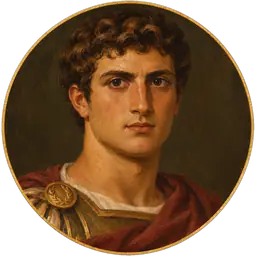
Germanicus
Germanicus, father of the emperor Gaius, was the son of Drusus and the younger Antonia; Augustus gave him the eight legions on the Rhine and had his uncle Tiberius adopt him.1 When Augustus died, the legions in Germany refused Tiberius and offered Germanicus supreme power; he calmed them, and Suetonius could not tell whether loyalty or firmness counted for more.2 Six years after Varus' disaster his army buried the bones of the three legions, and he laid the first sod of the mound himself, which Tiberius did not approve.3 On 26 May in the consulship of Caelius and Pomponius (AD 17) he triumphed over the Cherusci, the Chatti and the Angrivarii; Strabo, writing at the time, says that Arminius' wife Thusnelda and her three-year-old son were led in the procession.4 Sent to settle the East, he defeated the king of Armenia, Suetonius says, and made Cappadocia a province, and in the consulship of Silanus and Norbanus (AD 19) he visited Egypt to see its antiquities.5 He died at Antioch in his thirty-fourth year after a long illness, blaming in his last words the wickedness of Piso and Plancina; some, Tacitus says, likened his death to Alexander's.6
Events
Ties
- Agrippina the Younger daughter of Germanicus Tacitus, Annals 4.75
- Tiberius adoptive father of Germanicus Tacitus, Annals 1.3
- Drusus the Elder father of Germanicus Suetonius, Caligula 1
- father of Caligula Suetonius, Caligula 1
- husband of Agrippina the Elder Suetonius, Caligula 7
- Augustus great-uncle of Germanicus Tacitus, Annals 2.53
- Mark Antony grandfather of Germanicus Tacitus, Annals 2.53
- made war on Arminius Strabo 7.1.4
- Claudius brother of Germanicus Suetonius, Claudius 7
What the sources say
“Some there were who, as they thought of his beauty, his age, and the manner of his death, the vicinity too of the country where he died, likened his end to that of Alexander the Great. Both had a graceful person and were of noble birth; neither had much exceeded thirty years of age, and both fell by the treachery of their own people in strange lands. But Germanicus was gracious to his friends, temperate in his pleasures, the husband of one wife, with only legitimate children. He was too no less a warrior, though rashness he had none, and, though after having cowed Germany by his many victories, he was hindered from crushing it into subjection. Had he had the sole control of affairs, had he possessed the power and title of a king, he would have attained military glory as much more easily as he had excelled Alexander in clemency, in self-restraint, and in all other virtues”
et erant qui formam, aetatem, genus mortis ob propinquitatem etiam locorum in quibus interiit, magni Alexandri fatis adaequarent. nam utrumque corpore decoro, genere insigni, haud multum triginta annos egressum, suorum insidiis externas inter gentis occidisse: sed hunc mitem erga amicos, modicum voluptatum, uno matrimonio, certis liberis egisse, neque minus proeliatorem, etiam si temeritas afuerit praepeditusque sit perculsas tot victoriis Germanias servitio premere. quod si solus arbiter rerum, si iure et nomine regio fuisset, tanto promptius adsecuturum gloriam militiae quantum clementia, temperantia, ceteris bonis artibus praestitisset
Tacitus, Annals 2.73 · translator not recorded
“And so the Roman army now on the spot, six years after the disaster, in grief and anger, began to bury the bones of the three legions, not a soldier knowing whether he was interring the relics of a relative or a stranger, but looking on all as kinsfolk and of their own blood, while their wrath rose higher than ever against the foe. In raising the barrow Cæsar laid the first sod, rendering thus a most welcome honour to the dead, and sharing also in the sorrow of those present. This Tiberius did not approve, either interpreting unfavourably every act of Germanicus, or because he thought that the spectacle of the slain and unburied made the army slow to fight and more afraid of the enemy, and that a general invested with the augurate and its very ancient ceremonies ought not to have polluted himself with funeral rites”
Igitur Romanus qui aderat exercitus sextum post cladis annum trium legionum ossa, nullo noscente alienas reliquias an suorum humo tegeret, omnis ut coniunctos, ut consanguineos, aucta in hostem ira, maesti simul et infensi condebant. primum extruendo tumulo caespitem Caesar posuit, gratissimo munere in defunctos et praesentibus doloris socius. quod Tiberio haud probatum, seu cuncta Germanici in deterius trahenti, sive exercitum imagine caesorum insepultorumque tardatum ad proelia et formidolosiorem hostium credebat; neque imperatorem auguratu et vetustissimis caerimoniis praeditum adtrectare feralia debuisse
Tacitus, Annals 1.62 · translator not recorded
“But they all paid the penalty, and afforded the younger Germanicus a most brilliant triumph—that triumph in which their most famous men and women were led captive, I mean Segimuntus, son of Segestes and chieftain of the Cherusci,and his sister Thusnelda, the wife of Armenius, the man who at the time of the violation of the treaty against Quintilius Varus was commander-in-chief of the Cheruscan army and even to this day is keeping up the war, and Thusnelda’s three-year-old son Thumelicus”
ἔτισαν δὲ δίκας ἅπαντες καὶ παρέσχον τῷ νεωτέρῳ Γερμανικῷ λαμπρότατον θρίαμβον, ἐν ᾧ ἐθριαμβεύθη τῶν ἐπιφανεστάτων ἀνδρῶν σώματα καὶ γυναικῶν, Σεγιμοῦντός τε Σεγέστου υἱός, Χηρούσκων ἡγεμών, καὶ ἀδελφὴ αὐτοῦ, γυνὴ δʼ Ἀρμενίου τοῦ πολεμαρχήσαντος ἐν τοῖς Χηρούσκοις ἐν τῇ πρὸς Ὀυᾶρον Κουιντίλλιον παρασπονδήσει καὶ νῦν ἔτι συνέχοντος τὸν πόλεμον, ὄνομα Θουσνέλδα, καὶ υἱὸς τριετὴς Θουμέλικος
Strabo 7.1.4 · tr. Horace Leonard Jones
First named
The earliest text in the library that names Germanicus, written about AD 13 (a modern estimate of when it was written):
“This same rumour brought word to me, Germanicus, that towns had gone by in the procession under the label of your name, and that neither the bulk of their walls nor their arms nor the cleverness of their site had kept them safe against you.”
pertulit hic idem nobis, Germanice, rumor, oppida sub titulo nominis isse tui. atque ea te contra nec muri mole nec armis nec satis ingenio tuta fuisse loci
Ovid, Letters from Pontus 2.1 · AI translation (Claude)
Found by searching every text in the library for these spellings and reading the earliest hits to rule out namesakes: Germanicus, Germanici, Germanico, Germanicum, Germanice, Germanicus Caesar, Caesar Germanicus, Γερμανικός, Γερμανικοῦ, Γερμανικῷ, Γερμανικόν. Texts lost, or not in the library, may name Germanicus earlier.
The passages behind each sentence
- Suetonius, Caligula 1 (tr. Alexander Thomson); Tacitus, Annals 1.3 (translator not recorded) ↩
- Suetonius, Caligula 1 (tr. Alexander Thomson) ↩
- Tacitus, Annals 1.62 (translator not recorded) ↩
- Tacitus, Annals 2.41 (translator not recorded); Strabo 7.1.4 (tr. Horace Leonard Jones) ↩
- Suetonius, Caligula 1 (tr. Alexander Thomson); Tacitus, Annals 2.59 (translator not recorded) ↩
- Suetonius, Caligula 1 (tr. Alexander Thomson); Tacitus, Annals 2.71 (translator not recorded); Tacitus, Annals 2.73 (translator not recorded) ↩
Cite this page
MLA “Germanicus.” Atlas of Ancient History, Skirnir Studios, 2026, history.skirnirstudios.com/people/germanicus/.
APA Skirnir Studios. (2026). Germanicus. Atlas of Ancient History. https://history.skirnirstudios.com/people/germanicus/
Chicago “Germanicus.” Atlas of Ancient History. Skirnir Studios, 2026. https://history.skirnirstudios.com/people/germanicus/.
The atlas was written by AI from the ancient sources. Where you can, cite the ancient passage itself by its reference (Herodotus 7.228, Livy 22.7.3) and name the translation you read.