Atlas of Ancient History › People › The late Republic
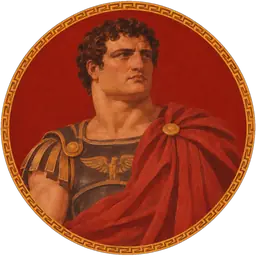
Mark Antony
Marcus Antonius served Caesar in Gaul as legate and then quaestor, and at Alesia he and Trebonius brought help to the lines where they were hard pressed.1 He married Fulvia, the widow of Clodius, a woman who, Plutarch says, wished to rule a ruler and command a commander.2 As consul in 44 BC he offered Caesar a diadem at the Lupercalia, and after the Ides of March he fortified his house and then, as consul, led Caesar's friends, with Lepidus' legion ready to act on his orders.3 Cicero attacked him in the Philippics; Antony joined Octavian and Lepidus at a meeting on an island near Mutina, and as triumvir he had Cicero killed and his head and hands set on the rostra.4 In the East Cleopatra came to him up the Cydnus in a gilded barge; after Fulvia's death he married Octavia, sister of Octavian, but later declared Cleopatra queen of Egypt, Cyprus, Libya and Coele Syria.5 At Actium he left his men fighting and followed Cleopatra's ship, and in Alexandria he ran himself through; Plutarch gives his age as fifty-six or fifty-three.6
Events
Ties
- had killed Cicero Plutarch, Cicero 49.1
- husband of Fulvia Plutarch, Antony 10.3
- lover and ally of Cleopatra VII Plutarch, Antony 85.3
- Augustus triumvir with Mark Antony Appian, Civil Wars 4.1.2
- husband of Octavia Plutarch, Antony 31
- triumvir with Lepidus Appian, Civil Wars 4.1.2
- made peace with Sextus Pompey Plutarch, Antony 32.2
- Agrippa fought at Actium against Mark Antony Plutarch, Antony 65.2
- won the kingship for Herod the Great Josephus, Jewish Antiquities 14.385
- grandfather of Germanicus Tacitus, Annals 2.53
What the sources say
“Antony was one of these runners, but he gave the ancient usages the go-by, and twining a wreath of laurel round a diadem, he ran with it to the rostra, where he was lifted on high by his fellow runners and put it on the head of Caesar, thus intimating that he ought to be king. When Caesar with affected modesty declined the diadem, the people were delighted and clapped their hands.”
ἐν τούτοις ὁ Ἀντώνιος διαθέων τὰ μὲν πάτρια χαίρειν εἴασε, διάδημα δὲ δάφνης στεφάνῳ περιελίξας προσέδραμε τῷ βήματι, καὶ συνεξαρθεὶς ὑπὸ τῶν συνθεόντων ἐπέθηκε τῇ κεφαλῇ τοῦ Καίσαρος, ὡς δὴ βασιλεύειν αὐτῷ προσῆκον. ἐκείνου δὲ θρυπτομένου καὶ διακλίνοντος ἡσθεὶς ὁ δῆμος ἀνεκρότησε·
Plutarch, Antony 12.2 · tr. Bernadotte Perrin
“Now, Antony had a trusty slave named Eros. Him Antony had long before engaged, in case of need, to kill him, and now demanded the fulfilment of his promise. So Eros drew his sword and held it up as though he would smite his master, but then turned his face away and slew himself. And as he fell at his master’s feet Antony said: Well done, Eros! though thou wast not able to do it thyself, thou teachest me what I must do; and running himself through the belly he dropped upon the couch.”
ἦν δέ τις οἰκέτης αὐτοῦ πιστὸς Ἔρως ὄνομα. τοῦτον ἐκ πολλοῦ παρακεκληκώς, εἰ δεήσειεν, ἀνελεῖν αὐτόν, ἀπῄτει τὴν ὑπόσχεσιν. ὁ δὲ σπασάμενος τὸ ξίφος ἀνέσχε μὲν ὡς παίσων ἐκεῖνον, ἀποστρέψας δὲ τὸ πρόσωπον ἑαυτὸν ἀπέκτεινε. πεσόντος δὲ αὐτοῦ πρὸς τοὺς πόδας ὁ Ἀντώνιος εὖγε, εἶπεν, ὦ Ἔρως, ὅτι μὴ δυνηθεὶς αὐτὸς ἐμὲ ποιεῖν ὃ δεῖ διδάσκεις· καὶ παίσας διὰ τῆς κοιλίας ἑαυτὸν ἀφῆκεν εἰς τὸ κλινίδιον.
Plutarch, Antony 76.4 · tr. Bernadotte Perrin
“And lately, when Marcus Antonius had inspired all virtuous men with the very greatest hope of safety, and when he, being a most noble young man, had with the greatest gallantry espoused the cause of the republic, and had that beast almost in his toils”
nuper vero cum M. Antonius summam spem salutis bonis omnibus attulisset gravissimamque adulescens nobilissimus rei publicae partem fortissime suscepisset, atque illam beluam, iudici laqueos declinantem, iam inretitam teneret
Cicero, Pro Milone 40 · tr. Charles Duke Yonge
First named
The earliest text in the library that names Mark Antony, written about 52 BC (a modern estimate of when it was written):
“And lately, when Marcus Antonius had inspired all virtuous men with the very greatest hope of safety, and when he, being a most noble young man, had with the greatest gallantry espoused the cause of the republic, and had that beast almost in his toils”
nuper vero cum M. Antonius summam spem salutis bonis omnibus attulisset gravissimamque adulescens nobilissimus rei publicae partem fortissime suscepisset, atque illam beluam, iudici laqueos declinantem, iam inretitam teneret
Cicero, Pro Milone 40 · tr. Charles Duke Yonge
Found by searching every text in the library for these spellings and reading the earliest hits to rule out namesakes: Ἀντώνιος, Ἀντωνίου, Ἀντωνίῳ, Ἀντώνιον, Antonius, Antonio, Antonium, Antoni, Antony, M. Antonius, Marcus Antonius, Mark Antony. Texts lost, or not in the library, may name Mark Antony earlier.
The passages behind each sentence
- Caesar, Gallic War 7.81 (tr. William Alexander McDevitte); Caesar, Gallic War 8.2 (tr. William Alexander McDevitte) ↩
- Plutarch, Antony 10.3 (tr. Bernadotte Perrin) ↩
- Plutarch, Antony 12.2 (tr. Bernadotte Perrin); Appian, Civil Wars 2.17.118 (tr. Horace White) ↩
- Appian, Civil Wars 4.1.2 (tr. Horace White); Plutarch, Cicero 48.4 (tr. Bernadotte Perrin); Plutarch, Cicero 49.1 (tr. Bernadotte Perrin) ↩
- Plutarch, Antony 26.1 (tr. Bernadotte Perrin); Plutarch, Antony 31.3 (tr. Bernadotte Perrin); Plutarch, Antony 54.4 (tr. Bernadotte Perrin) ↩
- Plutarch, Antony 66.5 (tr. Bernadotte Perrin); Plutarch, Antony 76.4 (tr. Bernadotte Perrin); Plutarch, Antony 86.5 (tr. Bernadotte Perrin) ↩
Cite this page
MLA “Mark Antony.” Atlas of Ancient History, Skirnir Studios, 2026, history.skirnirstudios.com/people/antony/.
APA Skirnir Studios. (2026). Mark Antony. Atlas of Ancient History. https://history.skirnirstudios.com/people/antony/
Chicago “Mark Antony.” Atlas of Ancient History. Skirnir Studios, 2026. https://history.skirnirstudios.com/people/antony/.
The atlas was written by AI from the ancient sources. Where you can, cite the ancient passage itself by its reference (Herodotus 7.228, Livy 22.7.3) and name the translation you read.