Atlas of Ancient History › People › The Hellenistic world
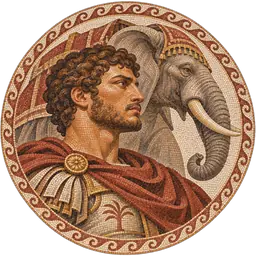
Hannibal
Hannibal, son of Hamilcar, told Antiochus that at nine years old his father had made him swear at the altar never to be a friend of Rome.1 The Carthaginians gave him the command in Spain while still young, for the shrewdness and daring he had shown.2 He beat the consul Scipio at the Rhone, again on the Po at Clastidium, and with his colleague at the Trebia; crossing the Apennines he caught an eye disease and never again saw as well with his right eye; he destroyed Flaminius at Trasimene and both consuls' armies at Cannae, where Paulus was killed.3 Driven from Carthage after the war, he advised Antiochus III against Rome, and Plutarch says he ranked Pyrrhus first among generals, Scipio second and himself third.4 When Flamininus demanded him from King Prusias of Bithynia, he found his house surrounded and took the poison he always carried.5 Nepos says he died in his seventieth year; writers disagreed on the consuls of that year: Atticus named Marcellus and Labeo, Polybius Paulus and Tamphilus, Sulpicius Blitho Cethegus and Tamphilus (183, 182 and 181 BC by modern reckoning).6 Polybius has him tell the Carthaginians, as they debated Scipio's peace terms, that he had left home at nine and come back past forty-five, which puts his birth about 247 BC by modern reckoning; Nepos' seventieth year would make him a few years older.7
Events
Ties
- Hamilcar Barca father of Hannibal Polybius 3.9.6
- Hanno the Great opposed Hannibal Livy 21.3
- Hasdrubal Barca brother of Hannibal Livy 27.49
- Mago brother of Hannibal Polybius 3.114.7
- Fabius Maximus fought a war of delay against Hannibal Polybius 3.89
- faced and killed at Cannae Lucius Aemilius Paullus (consul at Cannae) Livy 22.49
- Terentius Varro led the Roman army against Hannibal Polybius 3.110
- defeated and killed at Trasimene Gaius Flaminius Polybius 3.84
- Scipio Africanus defeated at Zama Hannibal Livy 30.35
- Marcellus the sword, as Fabius was the shield, against Hannibal Plutarch, Marcellus 9
- ranked first among generals Pyrrhus Plutarch, Pyrrhus 8.2
- adviser of Antiochus III Appian, Syrian Wars 2.7
- Flamininus hounded to death Hannibal Plutarch, Titus Flamininus 21.1
What the sources say
“Hannibal then defended himself at great length, but without success, until at last he made the following statement: When my father was about to go on his Iberian expedition I was nine years old: and as he was offering the sacrifice to Zeus I stood near the altar. The sacrifice successfully performed, my father poured the libation and went through the usual ritual. He then bade all the other worshippers stand a little back, and calling me to him asked me affectionately whether I wished to go with him on his expedition. Upon my eagerly assenting, and begging with boyish enthusiasm to be allowed to go, he took me by the right hand and led me up to the altar, and bade me lay my hand upon the victim and swear that I would never be friends with”
ἐν ᾧ καὶ πλείους ἀπολογισμοὺς ποιησάμενος Ἀννίβας τέλος ἐπὶ τὸ τοιοῦτο κατήντησε, δυσχρηστούμενος τοῖς λόγοις. ἔφη γάρ, καθʼ ὃν καιρὸν ὁ πατὴρ αὐτοῦ τὴν εἰς Ἰβηρίαν ἔξοδον μέλλοι στρατεύεσθαι μετὰ τῶν δυνάμεων, ἔτη μὲν ἔχειν ἐννέα, θύοντος δʼ αὐτοῦ τῷ Διὶ παρεστάναι παρὰ τὸν βωμόν. ἐπεὶ δὲ καλλιερήσας κατασπείσαι τοῖς θεοῖς καὶ ποιήσαι τὰ νομιζόμενα, τοὺς μὲν ἄλλους τοὺς περὶ τὴν θυσίαν ἀποστῆναι κελεῦσαι μικρόν, αὐτὸν δὲ προσκαλεσάμενον ἐρέσθαι φιλοφρόνως εἰ βούλεται συνεξορμᾶν ἐπὶ τὴν στρατείαν. ἀσμένως δὲ κατανεύσαντος αὐτοῦ καί τι καὶ προσαξιώσαντος παιδικῶς, λαβόμενον τῆς δεξιᾶς προσαγαγεῖν αὐτὸν πρὸς τὸν βωμὸν καὶ κελεύειν ἁψάμενον τῶν ἱερῶν ὀμνύναι μηδέποτε Ῥωμαίοις εὐνοήσειν
Polybius 3.11 · tr. Evelyn S. Shuckburgh
“Hannibal, son of Hamilcar, a Carthaginian. If it is true, as no one doubts, that the Roman people surpassed all nations in valour, it must not be denied that Hannibal surpassed the other commanders in skill as much as the Roman people excels all nations in courage. For as often as he met it in Italy, he always came off the better.”
Hannibal, Hamilcaris filius, Karthaginiensis. si verum est, quod nemo dubitat, ut populus Romanus omnes gentes virtute superarit, non est infitiandum Hannibalem tanto praestitisse ceteros imperatores prudentia, quanto populus Romanus antecedat fortitudine cunctas nationes. nam quotienscumque cum eo congressus est in Italia, semper discessit superior
Nepos, Hannibal 1.1 · AI translation (Claude)
“When the Roman envoys came there and surrounded his house with a crowd, a slave looking out from the door told Hannibal that more armed men than usual were to be seen. He ordered him to go round all the doors of the building and report quickly whether he was besieged in the same way on every side. When the boy quickly reported what he had seen and showed that all the exits were occupied, he understood that this had not happened by chance, but that he was being sought and must not keep his life any longer. So that he should not give it up at another's will, remembering his former valour, he took the poison which he had always been accustomed to carry with him.”
huc cum legati Romanorum venissent ac multitudine domum eius circumdedissent, puer ab ianua prospiciens Hannibali dixit plures praeter consuetudinem armatos apparere. qui imperavit ei, ut omnes fores aedificii circumiret ac propere sibi nuntiaret, num eodem modo undique obsideretur. puer cum celeriter, quid vidisset, renuntiasset omnesque exitus occupatos ostendisset, sensit id non fortuito factum, sed se peti neque sibi diutius vitam esse retinendam. quam ne alieno arbitrio dimitteret, memor pristinarum virtutum venenum, quod semper secum habere consuerat, sumpsit
Nepos, Hannibal 12.1 · AI translation (Claude)
First named
The earliest text in the library that names Hannibal, written about 150 BC (a modern estimate of when it was written):
“the Carthaginians invested Hannibal with the command in Iberia, in spite of his youth, because of the ability in the conduct of affairs, and the daring spirit which he had displayed”
τὴν δὲ στρατηγίαν οἱ Καρχηδόνιοι τῶν κατὰ τὴν Ἰβηρίαν Ἀννίβᾳ περιέθεσαν, ὄντι νέῳ, διὰ τὴν ὑποφαινομένην ἐκ τῶν πράξεων ἀγχίνοιαν αὐτοῦ καὶ τόλμαν
Polybius 2.36.3 · tr. Evelyn S. Shuckburgh
Found by searching every text in the library for these spellings and reading the earliest hits to rule out namesakes: Ἀννίβας, Hannibal, Annibal. Texts lost, or not in the library, may name Hannibal earlier.
The passages behind each sentence
- Nepos, Hannibal 1.1 (AI translation (Claude)); Polybius 3.11 (tr. Evelyn S. Shuckburgh) ↩
- Polybius 2.36.3 (tr. Evelyn S. Shuckburgh) ↩
- Nepos, Hannibal 4.1 (AI translation (Claude)) ↩
- Appian, Syrian Wars 2.7 (tr. Horace White); Plutarch, Pyrrhus 8.2 (tr. Bernadotte Perrin) ↩
- Plutarch, Titus Flamininus 20.3 (tr. Bernadotte Perrin); Nepos, Hannibal 12.1 (AI translation (Claude)) ↩
- Nepos, Hannibal 13.1 (AI translation (Claude)) ↩
- Polybius 15.19.3 (tr. Evelyn S. Shuckburgh); Nepos, Hannibal 13.1 (AI translation (Claude)) ↩
Cite this page
MLA “Hannibal.” Atlas of Ancient History, Skirnir Studios, 2026, history.skirnirstudios.com/people/hannibal/.
APA Skirnir Studios. (2026). Hannibal. Atlas of Ancient History. https://history.skirnirstudios.com/people/hannibal/
Chicago “Hannibal.” Atlas of Ancient History. Skirnir Studios, 2026. https://history.skirnirstudios.com/people/hannibal/.
The atlas was written by AI from the ancient sources. Where you can, cite the ancient passage itself by its reference (Herodotus 7.228, Livy 22.7.3) and name the translation you read.