Atlas of Ancient History › People › The Hellenistic world
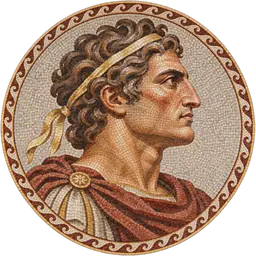
Antiochus III
Antiochus was the younger son of Seleucus Callinicus, and came to the throne after his elder brother Seleucus.1 Uruk scribes dated their tablets by 'Antiochus the king'; one is dated year 99 of the Seleucid era.2 He was beaten by Ptolemy IV at Raphia, but his march into Media, Parthia and Bactria made him secure and won him the name Antiochus the Great.3 He took Coele-Syria from the young Ptolemy, crossed into Thrace and rebuilt Lysimachia, and took Hannibal into his counsels when he planned war with Rome.4 Defeated by the Romans, he accepted Scipio's terms, and the treaty then drawn up at Rome fixed the bounds of his kingdom at the promontories of Calycadnus and Sarpedonium and allowed him only twelve warships.5 Strabo says he was killed by the local people when he tried to plunder the temple of Bel in Elymais.6
Open Antiochus III in the atlas
Events
Ties
- sent back the captured son of Scipio Africanus Livy 37.37
- Ptolemy IV defeated at Raphia Antiochus III Polybius 5.86.7
- Hannibal adviser of Antiochus III Appian, Syrian Wars 2.7
- father of Antiochus IV 1 Maccabees 1.10.1
What the sources say
“ANTIOCHUS (the son of Seleucus and grandson of Antiochus), king of the Syrians, the Babylonians, and other nations, was the sixth in succession from that Seleucus who succeeded Alexander in the government of the Asiatic countries around the Euphrates. He invaded Media and Parthia, and other countries that had revolted from his ancestors, and performed many exploits, from which he was named Antiochus the Great”
Ἀντίοχος ὁ Σελεύκου τοῦ Ἀντιόχου, Σύρων καὶ Βαβυλωνίων καὶ ἑτέρων ἐθνῶν βασιλεύς, ἕκτος δὲ ἀπὸ Σελεύκου τοῦ μετʼ Ἀλέξανδρον Ἀσίας τῆς περὶ Εὐφράτην βεβασιλευκότος, ἐσβαλὼν ἐς Μηδίαν τε καὶ Παρθυηνὴν καὶ ἕτερα ἔθνη ἀφιστάμενα ἔτι πρὸ αὐτοῦ, καὶ πολλὰ καὶ μεγάλα δράσας, καὶ μέγας Ἀντίοχος ἀπὸ τοῦδε κληθείς
Appian, Syrian Wars 1.1 · tr. Horace White
“The boundaries of the dominions of Antiochus were to be the two promontories of Calycadnus and Sarpedonium, beyond which he should not sail for purposes of war. He should have only twelve war-ships”
ὅρον μὲν Ἀντιόχῳ τῆς ἀρχῆς εἶναι δύο ἄκρας, Καλύκαδνόν τε καὶ Σαρπηδόνιον, καὶ τάσδε μὴ παραπλεῖν Ἀντίοχον ἐπὶ πολέμῳ, ναῦς δὲ καταφράκτους ἔχειν δώδεκα μόνας
Appian, Syrian Wars 7.39 · tr. Horace White
“Uruk, Šabaṭu (Month XI), day 13, year 99. Antiochus was king.”
UNUG{ki}{u₂} UNUG{ki} {iti}ZIZ₂ U₄ 13-KAM MU 1.39 {m}an-ti-ʾi-ku-su LUGAL
Uruk tablet colophon (TCL 06, 03) r 43 · tr. the GKAB Project (Philippe Clancier, Eleanor Robson and others) - CC BY-SA 3.0
First named
The earliest text in the library that names Antiochus III, written about 212 BC (a modern estimate of when it was written):
“Uruk, Šabaṭu (Month XI), day 13, year 99. Antiochus was king.”
UNUG{ki}{u₂} UNUG{ki} {iti}ZIZ₂ U₄ 13-KAM MU 1.39 {m}an-ti-ʾi-ku-su LUGAL
Uruk tablet colophon (TCL 06, 03) r 43 · tr. the GKAB Project (Philippe Clancier, Eleanor Robson and others) - CC BY-SA 3.0
Found by searching every text in the library for these spellings and reading the earliest hits to rule out namesakes: Ἀντίοχος, Ἀντίοχος ὁ μέγας, Antiochus the Great, Antiochus, An-ti-ʾu-ku-su. Texts lost, or not in the library, may name Antiochus III earlier.
The passages behind each sentence
- Polybius 5.40.5 (tr. Evelyn S. Shuckburgh) ↩
- Uruk tablet colophon (TCL 06, 03) r 43 (tr. the GKAB Project (Philippe Clancier, Eleanor Robson and others) - CC BY-SA 3.0) ↩
- Polybius 5.86.7 (tr. Evelyn S. Shuckburgh); Polybius 11.34 (tr. Evelyn S. Shuckburgh); Appian, Syrian Wars 1.1 (tr. Horace White) ↩
- Appian, Syrian Wars 1.1 (tr. Horace White); Appian, Syrian Wars 2.7 (tr. Horace White) ↩
- Appian, Syrian Wars 7.38 (tr. Horace White); Appian, Syrian Wars 7.39 (tr. Horace White) ↩
- Strabo 16.1.18 (tr. Hans Claude Hamilton) ↩
Cite this page
MLA “Antiochus III.” Atlas of Ancient History, Skirnir Studios, 2026, history.skirnirstudios.com/people/antiochus-iii/.
APA Skirnir Studios. (2026). Antiochus III. Atlas of Ancient History. https://history.skirnirstudios.com/people/antiochus-iii/
Chicago “Antiochus III.” Atlas of Ancient History. Skirnir Studios, 2026. https://history.skirnirstudios.com/people/antiochus-iii/.
The atlas was written by AI from the ancient sources. Where you can, cite the ancient passage itself by its reference (Herodotus 7.228, Livy 22.7.3) and name the translation you read.