Atlas of Ancient History › People › Rome and Carthage
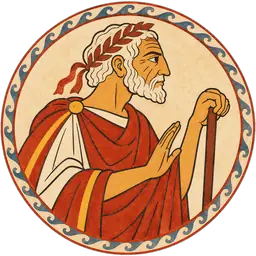
Fabius Maximus
After Trasimene the Romans made Quintus Fabius dictator, a man, Polybius says, of outstanding judgement and good birth, whose family were still called Maximi, 'the Greatest'.1 He resolved not to risk a battle but to keep his army safe, following Hannibal along the high ground and refusing every challenge.2 When his master of horse Minucius was caught in Hannibal's trap, Fabius led out his army in time to save him.3 Ennius wrote of him that one man, by delaying, restored the state, and Cicero, who has the elder Cato praise him, says he recaptured Tarentum and opposed Flaminius' land law.4 In old age he spoke against Scipio's plan to carry the war to Africa, and he died, Livy says, at a great age, having been augur, it was said, for sixty-two years.5
Open Fabius Maximus in the atlas
Ties
- fought a war of delay against Hannibal Polybius 3.89
- opposed the land law of Gaius Flaminius Cicero, On Old Age 11
- the shield, beside Marcellus Plutarch, Marcellus 9
- Cato the Elder served under Fabius Maximus Plutarch, Marcus Cato 2
- Ennius praised in verse Fabius Maximus Cicero, On Old Age 10
What the sources say
“For Fabius, having made up his mind to incur no danger and not to risk a battle, but to make the safety of his men his first and greatest object”
ὁ γὰρ Φάβιος διεγνωκὼς μήτε παραβάλλεσθαι μήτε διακινδυνεύειν, στοχάζεσθαι δὲ πρῶτον καὶ μάλιστα τῆς ἀσφαλείας τῶν ὑποταττομένων
Polybius 3.89 · tr. Evelyn S. Shuckburgh
“The death occurred this year of Quintus Fabius Maximus at a very advanced age, if it be true, as some authorities assert, that he had been augur for sixty-two years. He was a man who deserved the great surname he bore, even if he had been the first to bear it. He surpassed his father in his distinctions, and equalled his grandfather Rullus. Rullus had won more victories and fought greater battles, but his grandson had Hannibal for an opponent and that made up for everything. He was held to be cautious rather than energetic, and though it may be a question whether he was naturally slow in action or whether he adopted these tactics as especially suitable to the character of the war, nothing is more certain that that, as Ennius says, "one man by his slowness restored the State”
eodem anno Q.FabiusMaximus moritur, exactae aetatis si quidem uerum est augurem duos et sexaginta annos fuisse, quod quidam auctores sunt. uir certe fuit dignus tanto cognomine uel si nouum ab eo inciperet. superauit paternos honores, auitos aequauit. pluribus uictoriis et maioribus proeliis auus insignis Rullus; sed omnia aequare unus hostis Hannibal potest. cautior tamen quam promptior hic habitus; et sicut dubites utrum ingenio cunctator fuerit an quia ita bello proprie quod tum gerebatur aptum erat, sic nihil certius est quam unum hominem nobis cunctando rem restituisse, sicut Ennius ait
Livy 30.26 · tr. Rev. Canon Roberts
“I was as fond of Quintus Fabius Maximus, who recovered Tarentum, as if he had been of my own age … Though quite old he waged war like a young man, and by his patient endurance checked the boyish impetuosity of Hannibal. My friend Ennius admirably speaks of him thus: One man's delay alone restored our State”
ego Q. Maximum, eum qui Tarentum recepit, senem adulescens ita dilexi, ut aequalem … hic et bella gerebat ut adulescens, cum plane grandis esset, et Hannibalem iuveniliter exsultantem patientia sua molliebat; de quo praeclare familiaris noster Ennius: unus homo nobis cunctando restituit rem
Cicero, On Old Age 10 · tr. William Armistead Falconer
The library's English numbers this section 14. The last line is quoted from Ennius' Annales.
First named
The earliest text in the library that names Fabius Maximus, written about 150 BC (a modern estimate of when it was written):
“Meanwhile the Romans had appointed Quintus Fabius Dictator, a man distinguished no less for his wisdom than his high birth; as is still commemorated by the fact that the members of his family are even now called Maximi, that is Greatest”
Ῥωμαῖοι δὲ δικτάτορα μὲν κατέστησαν Κόιντον Φάβιον, ἄνδρα καὶ φρονήσει διαφέροντα καὶ πεφυκότα καλῶς
Polybius 3.87.6 · tr. Evelyn S. Shuckburgh
Found by searching every text in the library for these spellings and reading the earliest hits to rule out namesakes: Quintus Fabius Maximus, Fabius Maximus, Fabius, Κόιντος Φάβιος, Φάβιος, Cunctator. Texts lost, or not in the library, may name Fabius Maximus earlier.
The passages behind each sentence
- Polybius 3.87.6 (tr. Evelyn S. Shuckburgh) ↩
- Polybius 3.89 (tr. Evelyn S. Shuckburgh) ↩
- Polybius 3.105 (tr. Evelyn S. Shuckburgh) ↩
- Cicero, On Old Age 10 (tr. William Armistead Falconer); Cicero, On Old Age 11 (tr. William Armistead Falconer) ↩
- Livy 28.40 (tr. Rev. Canon Roberts); Livy 30.26 (tr. Rev. Canon Roberts) ↩
Cite this page
MLA “Fabius Maximus.” Atlas of Ancient History, Skirnir Studios, 2026, history.skirnirstudios.com/people/fabius-maximus/.
APA Skirnir Studios. (2026). Fabius Maximus. Atlas of Ancient History. https://history.skirnirstudios.com/people/fabius-maximus/
Chicago “Fabius Maximus.” Atlas of Ancient History. Skirnir Studios, 2026. https://history.skirnirstudios.com/people/fabius-maximus/.
The atlas was written by AI from the ancient sources. Where you can, cite the ancient passage itself by its reference (Herodotus 7.228, Livy 22.7.3) and name the translation you read.