Atlas of Ancient History › People › Rome and Carthage
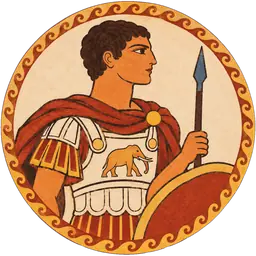
Scipio Africanus
Publius Cornelius Scipio first won fame, Polybius learned from his friend Laelius, by charging the enemy to save his wounded father in the cavalry battle with Hannibal on the Po, when he was only in his seventeenth year.1 When his father and uncle had fallen in Spain and no one dared ask for the command there, he stood for it at about twenty-four and was elected.2 Livy sums up the conquest of Spain as done under his command and auspices; back in Rome as consul he carried the war to Africa against the advice of Fabius Maximus.3 In Africa he burned the winter camps of Syphax and Hasdrubal by night, and in the decisive battle he beat Hannibal, who escaped to Hadrumetum with a few horsemen after a battle whose plan Scipio himself admired.4 Livy says he was the first general to be ennobled with the name of a people he had conquered, Africanus.5 Attacked later by the tribunes, he withdrew to Liternum and lived there without missing Rome, ordering that he be buried there rather than in his ungrateful country; Livy found the year of his death disputed.6
Open Scipio Africanus in the atlas
Events
Ties
- Publius Cornelius Scipio (consul 218) father of Scipio Africanus Livy 26.18
- saved the life of Publius Cornelius Scipio (consul 218) Polybius 10.3
- defeated at Zama Hannibal Livy 30.35
- Lucius Aemilius Paullus (consul at Cannae) father-in-law of Scipio Africanus Plutarch, Aemilius Paulus 2
- dined with and won over Syphax Livy 28.18
- hailed as king Masinissa Livy 30.15.11
- Cato the Elder quarrelled all his life with Scipio Africanus Nepos, Cato 1
- Ennius friend of Scipio Africanus Cicero, For Archias 22
- father of Cornelia, mother of the Gracchi Plutarch, Tiberius Gracchus Tiberius.1
- Antiochus III sent back the captured son of Scipio Africanus Livy 37.37
What the sources say
“He told me that the first brilliant exploit of Publius was when his father fought the cavalry engagement with Hannibal near the Padus. He was then, as it seems, eighteen years old and on his first campaign. His father had given him a squadron of picked cavalry for his protection; but when in the course of the battle he saw his father surrounded by the enemy, with only two or three horsemen near him, and dangerously wounded, he first tried to cheer on his own squadron to go to his father’s assistance”
ἔφη γὰρ πρώτην γεγονέναι Ποπλίου πρᾶξιν ἐπίσημον, καθʼ ὃν καιρὸν ὁ πατὴρ αὐτοῦ τὴν ἱππομαχίαν συνεστήσατο πρὸς Ἀννίβαν περὶ τὸν Πάδον καλούμενον ποταμόν. τότε γάρ, ὡς ἔοικεν, ἑπτακαιδέκατον ἔτος ἔχων καὶ πρῶτον εἰς ὕπαιθρον ἐξεληλυθώς, συστήσαντος αὐτῷ τοῦ πατρὸς διαφερόντων ἱππέων οὐλαμὸν ἀσφαλείας χάριν, συνθεασάμενος ἐν τῷ κινδύνῳ τὸν πατέρα περιειλημμένον ὑπὸ τῶν πολεμίων μετὰ δυεῖν ἢ τριῶν ἱππέων καὶ τετρωμένον ἐπισφαλῶς, τὰς μὲν ἀρχὰς ἐπεβάλετο παρακαλεῖν τοὺς μεθʼ αὑτοῦ βοηθῆσαι τῷ πατρί, τῶν δʼ ἐπὶ ποσὸν κατορρωδούντων διὰ τὸ πλῆθος τῶν περιεστώτων πολεμίων, αὐτὸς εἰσελάσαι παραβόλως δοκεῖ καὶ τολμηρῶς εἰς τοὺς περικεχυμένους
Polybius 10.3 · tr. Evelyn S. Shuckburgh
The Greek says he was in his seventeenth year (ἑπτακαιδέκατον ἔτος ἔχων); Shuckburgh's 'eighteen years old' is a slip.
“As to the sobriquet of Africanus, whether it was conferred upon him by the devotion of his soldiers or by the popular breath, or whether as in the recent instances of Sylla the Fortunate and Pompey the Great it originated in the flattery of his friends, I cannot say for certain. At all events, he was the first commander-in-chief who was ennobled by the name of the people he had conquered”
Africani cognomen militaris prius fauor an popularis aura celebrauerit an, sicuti Felicis Sullae Magnique Pompeii patrum memoria, coeptum ab adsentatione familiari sit parum compertum habeo; primus certe hic imperator nomine uictae ab se gentis est nobilitatus
Livy 30.45 · tr. Rev. Canon Roberts
“After this nothing more was said about proceedings against Scipio. He passed his life at Liternum without any wish to return to the City, and it is said that on his death-bed he gave orders that he should be buried and his monument set up there, so that there might be no funeral rites performed f”
silentium deinde de Africano fuit. vitam Literni egit sine desiderio urbis; morientem rure eo ipso loco sepeliri se iussisse ferunt monumentumque ibi aedificari, ne funus sibi in ingrata patria fieret
Livy 38.53 · tr. Rev. Canon Roberts
First named
The earliest text in the library that names Scipio Africanus, written about 150 BC (a modern estimate of when it was written):
“Being about to narrate the exploits of Publius Scipio in Iberia, and in fact all the achievements in his life, I think it necessary to”
ὅτι μέλλοντες ἱστορεῖν τὰ πραχθέντα Ποπλίῳ κατὰ τὴν Ἰβηρίαν, συλλήβδην δὲ πάσας τὰς κατὰ τὸν βίον ἐπιτελεσθείσας αὐτῷ πράξεις, ἀναγκαῖον ἡγούμεθα τὸ προεπιστῆσαι τοὺς ἀκούοντας ἐπὶ τὴν αἵρεσιν καὶ φύσιν τἀνδρός
Polybius 10.2 · tr. Evelyn S. Shuckburgh
Found by searching every text in the library for these spellings and reading the earliest hits to rule out namesakes: Publius Cornelius Scipio Africanus, Scipio Africanus, Scipio, Africanus, Publius, Πόπλιος Σκιπίων, Σκιπίων, Πόπλιος. Texts lost, or not in the library, may name Scipio Africanus earlier.
The passages behind each sentence
- Polybius 10.3 (tr. Evelyn S. Shuckburgh) ↩
- Livy 26.18 (tr. Rev. Canon Roberts) ↩
- Livy 28.38 (tr. Rev. Canon Roberts); Livy 28.40 (tr. Rev. Canon Roberts) ↩
- Polybius 14.5 (tr. Evelyn S. Shuckburgh); Livy 30.35 (tr. Rev. Canon Roberts) ↩
- Livy 30.45 (tr. Rev. Canon Roberts) ↩
- Livy 38.53 (tr. Rev. Canon Roberts); Livy 39.52 (tr. Rev. Canon Roberts) ↩
Cite this page
MLA “Scipio Africanus.” Atlas of Ancient History, Skirnir Studios, 2026, history.skirnirstudios.com/people/scipio-africanus/.
APA Skirnir Studios. (2026). Scipio Africanus. Atlas of Ancient History. https://history.skirnirstudios.com/people/scipio-africanus/
Chicago “Scipio Africanus.” Atlas of Ancient History. Skirnir Studios, 2026. https://history.skirnirstudios.com/people/scipio-africanus/.
The atlas was written by AI from the ancient sources. Where you can, cite the ancient passage itself by its reference (Herodotus 7.228, Livy 22.7.3) and name the translation you read.