Atlas of Ancient History › People › The Hellenistic world
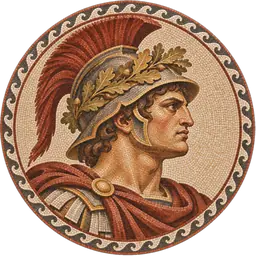
Pyrrhus
Pyrrhus, of the Molossian royal house, was carried off as a baby when his father Aeacides was driven out.1 As a young man he was sent to Ptolemy in Egypt, where he courted Berenice and was given her daughter Antigone as his wife; later Ptolemy restored him to his kingdom.2 When Seleucus, Ptolemy and Lysimachus combined against Demetrius they called on Pyrrhus to invade Macedonia, and Demetrius' army went over to him and proclaimed him king of the Macedonians.3 The Tarentines called him into Italy against Rome; after one costly victory he is said to have told a friend that one more such victory would ruin him.4 He crossed to Sicily against the Carthaginians, but after six years left Italy and Sicily with nothing won, though men thought him the first of the kings of his time in war; Hannibal, Plutarch says, ranked him first of all generals.5 He beat Antigonus Gonatas and dedicated the Gauls' shields to Athena, and he died fighting in the streets of Argos, struck down by a tile thrown from a roof by an old woman whose son he was fighting.6
Events
Ties
- Appius Claudius Caecus spoke against peace with Pyrrhus Plutarch, Pyrrhus 18
- Fabricius envoy to, and refused the gold of Pyrrhus Plutarch, Pyrrhus 20
- Fabricius warned of a plot to poison Pyrrhus Cicero, On Duties 3.86
- Manius Curius Dentatus triumphed over Pyrrhus Cicero, On Old Age 55
- Ptolemy I restored Pyrrhus Pausanias 1.6.8
- defeated Antigonus Gonatas Pausanias 1.13
- took Macedonia from Demetrius the Besieger Plutarch, Pyrrhus 11.6
- Hannibal ranked first among generals Pyrrhus Plutarch, Pyrrhus 8.2
What the sources say
“and we are told that Pyrrhus said to one who was congratulating him on his victory, If we are victorious in one more battle with the Romans, we shall be utterly ruined”
καὶ λέγεται τὸν Πύρρον εἰπεῖν πρός τινα τῶν συνηδομένων αὐτῷ, ἂν ἔτι μίαν μάχην Ῥωμαίους νικήσωμεν, ἀπολούμεθα παντελῶς
Plutarch, Pyrrhus 21.9 · tr. Bernadotte Perrin
“Hannibal, however, declared that the foremost of all generals in experience and ability was Pyrrhus, that Scipio was second, and he himself third”
Ἀννίβας δὲ συμπάντων ἀπέφηνε τῶν στρατηγῶν πρῶτον μὲν ἐμπειρίᾳ καὶ δεινότητι Πύρρον, Σκηπίωνα δὲ δεύτερον, ἑαυτὸν δὲ τρίτον
Plutarch, Pyrrhus 8.2 · tr. Bernadotte Perrin
“His mother, like the rest of the women, was at this moment watching the battle from the house-top, and when she saw that her son was engaged in conflict with Pyrrhus she was filled with distress in view of the danger to him, and lifting up a tile with both her hands threw it at Pyrrhus”
αὕτη τότε θεωμένη τὴν μάχην ὥσπερ αἱ λοιπαὶ γυναῖκες ἀπὸ τοῦ τέγους, ὡς ἐπέγνω συνεστῶτα τῷ Πύρρῳ τὸν υἱόν, ἐκπαθὴς γενομένη πρὸς τὸν κίνδυνον, ἄρασα κεραμίδα ταῖς χερσὶν ἀμφοτέραις ἀφῆκεν ἐπὶ τὸν Πύρρον
Plutarch, Pyrrhus 34.2 · tr. Bernadotte Perrin
“Pyrrhus the Molossian hung these shields taken from the bold Gauls as a gift to Itonian Athena, when he had destroyed all the host of Antigonus. 'Tis no great marvel. The Aeacidae are warriors now, even as they were of old”
τοὺς θυρεοὺς ὁ Μολοσσὸς Ἰτωνίδι δῶρον Ἀθάνᾳ Πύρρος ἀπὸ θρασέων ἐκρέμασεν Γαλατᾶν,πάντα τὸν Ἀντιγόνου καθελὼν στρατόν. οὐ μέγα θαῦμα·αἰχματαὶ καὶ νῦν καὶ πάρος Αἰακίδαι
Pausanias 1.13 · tr. W.H.S. Jones
A dedication epigram of about 274/3 BC, attributed in the Greek Anthology (6.130) to Leonidas of Tarentum, quoted by Pausanias, about AD 160.
First named
The earliest text in the library that names Pyrrhus, written about 274 BC (a modern estimate of when it was written):
“Pyrrhus the Molossian hung these shields taken from the bold Gauls as a gift to Itonian Athena, when he had destroyed all the host of Antigonus. 'Tis no great marvel. The Aeacidae are warriors now, even as they were of old”
τοὺς θυρεοὺς ὁ Μολοσσὸς Ἰτωνίδι δῶρον Ἀθάνᾳ Πύρρος ἀπὸ θρασέων ἐκρέμασεν Γαλατᾶν,πάντα τὸν Ἀντιγόνου καθελὼν στρατόν. οὐ μέγα θαῦμα·αἰχματαὶ καὶ νῦν καὶ πάρος Αἰακίδαι
Pausanias 1.13 · tr. W.H.S. Jones
A dedication epigram of about 274/3 BC, attributed in the Greek Anthology (6.130) to Leonidas of Tarentum, quoted by Pausanias, about AD 160.
Found by searching every text in the library for these spellings and reading the earliest hits to rule out namesakes: Πύρρος, Pyrrhus. Texts lost, or not in the library, may name Pyrrhus earlier.
The passages behind each sentence
- Plutarch, Pyrrhus 2.1 (tr. Bernadotte Perrin) ↩
- Plutarch, Pyrrhus 4.4 (tr. Bernadotte Perrin); Pausanias 1.6.8 (tr. W.H.S. Jones) ↩
- Plutarch, Demetrius 44.1 (tr. Bernadotte Perrin); Plutarch, Pyrrhus 11.6 (tr. Bernadotte Perrin) ↩
- Polybius 1.6.5 (tr. Evelyn S. Shuckburgh); Plutarch, Pyrrhus 21.9 (tr. Bernadotte Perrin) ↩
- Plutarch, Pyrrhus 22.1 (tr. Bernadotte Perrin); Plutarch, Pyrrhus 26.1 (tr. Bernadotte Perrin); Plutarch, Pyrrhus 8.2 (tr. Bernadotte Perrin) ↩
- Pausanias 1.13 (tr. W.H.S. Jones); Plutarch, Pyrrhus 34.2 (tr. Bernadotte Perrin); Plutarch, Pyrrhus 34.2 (tr. Bernadotte Perrin) ↩
Cite this page
MLA “Pyrrhus.” Atlas of Ancient History, Skirnir Studios, 2026, history.skirnirstudios.com/people/pyrrhus/.
APA Skirnir Studios. (2026). Pyrrhus. Atlas of Ancient History. https://history.skirnirstudios.com/people/pyrrhus/
Chicago “Pyrrhus.” Atlas of Ancient History. Skirnir Studios, 2026. https://history.skirnirstudios.com/people/pyrrhus/.
The atlas was written by AI from the ancient sources. Where you can, cite the ancient passage itself by its reference (Herodotus 7.228, Livy 22.7.3) and name the translation you read.