Atlas of Ancient History › People › The early Empire
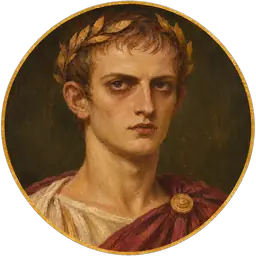
Caligula
Gaius, a son of Germanicus and Agrippina, was born on 31 August in the year his father was consul with Gaius Fonteius Capito (AD 12); Suetonius found his birthplace disputed, and preferred Antium, which the public records named.1 He grew up in his father's camp, where the soldiers nicknamed him Caligula, 'little boot', for the soldier's dress he wore; Seneca says that as emperor he punished a senior centurion for calling him by it.2 Tiberius left him joint heir with his other grandson, Tiberius the son of Drusus, and Philo dates the change in Egypt to the time when Tiberius died and Gaius was declared emperor.3 Suetonius, having told of him as an emperor, tells the rest 'as of a monster': he began to claim divine majesty, and Philo, who went to him on an embassy for the Jews of Alexandria, heard that Gaius had ordered a colossal statue of himself, named for Zeus, to be set up in the inmost shrine of the Temple at Jerusalem.4 On 24 January, after reigning three years, ten months and eight days, he was cut down in a passage of the palace by the tribune Cassius Chaerea and his fellow conspirators, aged twenty-nine; Seneca says Chaerea, whom Gaius had mocked as effeminate, struck the first blow.5
Events
Ties
- Agrippina the Younger sister of Caligula Suetonius, Caligula 7.1
- Germanicus father of Caligula Suetonius, Caligula 1
- Agrippina the Elder mother of Caligula Tacitus, Annals 1.69
- successor of Tiberius Philo, Against Flaccus 9
- Claudius uncle of Caligula Suetonius, Claudius 7
What the sources say
“And there was her little child too, born in the camp, brought up amid the tents of the legions, whom they used to call in soldiers' fashion, Caligula, because he often wore the shoe so called, to win the men's goodwill”
iam infans in castris genitus, in contubernio legionum eductus, quem militari vocabulo Caligulam appellabant, quia plerumque ad concilianda vulgi studia eo tegmine pedum induebatur
Tacitus, Annals 1.41 · translator not recorded
“Yet this same Gaius took everything as an insult, as those who most love to give insults cannot bear to receive them. He was angry with Herennius Macer for greeting him as Gaius, and a senior centurion did not go unpunished for calling him Caligula; for that is what he used to be called, born in the camp and the nursling of the legions, and by no other name was he ever closer to the soldiers; but now, in his tragic boots, he judged 'Caligula' an insult and a disgrace.”
At idem Gaius omnia contumelias putabat, ut sunt ferendarum impatientes faciendarum cupidissimi; iratus fuit Herennio Macro, quod illum Gaium salutaverat, nec impune cessit primipilari, quod Caligulam dixerat; hoc enim in castris natus et alumnus legionum vocari solebat, nullo nomine militibus familiarior umquam factus, sed iam Caligulam convicium et probrum iudicabat cothurnatus
Seneca, On the Constancy of the Wise Man 2.18.4 · AI translation (Claude)
“And he with difficulty, sobbing aloud, and in a broken voice, spoke as follows: "Our temple is destroyed! Caius has ordered a colossal statue of himself to be erected in the holy of holies, having his own name inscribed upon it with the title of Jupiter!”
ὁ δὲ μόλις μὲν ἀναλύζων δὲ ὅμως κεκομμένῳ τῷ πνεύματί φησιν· „οἴχεται ἡμῶν τὸ ἱερόν· ἀνδριάντα κολοσσιαῖον ἐσωτάτω τῶν ἀδύτων ἀνατεθῆναι Γάιος προσέταξε Διὸς ἐπίκλησιν αὐτοῦ.“
Philo, Embassy to Gaius 188 · tr. Charles Duke Yonge
First named
The earliest text in the library that names Caligula, written about AD 40 (a modern estimate of when it was written):
“But in the last year, after Tiberius was dead, and when Caius had succeeded him as emperor”
τῷ δ’ ὑστάτῳ, Τιβερίου μὲν τελευτήσαντος, Γαΐου δ’ ἀποδειχθέντος αὐτοκράτορος
Philo, Against Flaccus 9 · tr. Charles Duke Yonge
Found by searching every text in the library for these spellings and reading the earliest hits to rule out namesakes: Caligula, Caligulae, Caligulam, Gaius, Gaius Caesar, C. Caesar, Caius, Caius Caesar, Γάιος, Γαΐου, Γαΐῳ, Γάιον, Γάιος Καῖσαρ. Texts lost, or not in the library, may name Caligula earlier.
The passages behind each sentence
- Suetonius, Caligula 7 (tr. Alexander Thomson); Suetonius, Caligula 8 (tr. Alexander Thomson) ↩
- Suetonius, Caligula 9 (tr. Alexander Thomson); Seneca, On the Constancy of the Wise Man 2.18.4 (AI translation (Claude)) ↩
- Suetonius, Tiberius 76 (tr. Alexander Thomson); Philo, Against Flaccus 9 (tr. Charles Duke Yonge) ↩
- Suetonius, Caligula 22 (tr. Alexander Thomson); Philo, Embassy to Gaius 188 (tr. Charles Duke Yonge) ↩
- Suetonius, Caligula 58 (tr. Alexander Thomson); Suetonius, Caligula 59 (tr. Alexander Thomson); Seneca, On the Constancy of the Wise Man 2.18.3 (AI translation (Claude)) ↩
Cite this page
MLA “Caligula.” Atlas of Ancient History, Skirnir Studios, 2026, history.skirnirstudios.com/people/caligula/.
APA Skirnir Studios. (2026). Caligula. Atlas of Ancient History. https://history.skirnirstudios.com/people/caligula/
Chicago “Caligula.” Atlas of Ancient History. Skirnir Studios, 2026. https://history.skirnirstudios.com/people/caligula/.
The atlas was written by AI from the ancient sources. Where you can, cite the ancient passage itself by its reference (Herodotus 7.228, Livy 22.7.3) and name the translation you read.