Atlas of Ancient History › People › The early Empire
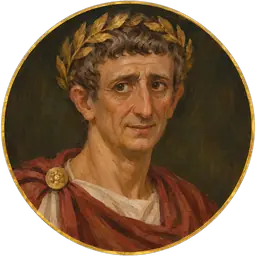
Claudius
Claudius was the son of Drusus, Livia's son, and was born at Lugdunum on 1 August in the consulship of Iullus Antonius and Fabius Africanus (10 BC), on the day the altar of Augustus there was dedicated.1 Ill through childhood and youth, he was thought unfit for any public office, and his mother Antonia called him a monster of a man, begun but never finished by nature.2 When Gaius was murdered he hid behind a curtain in the palace; a common soldier saw his feet, pulled him out and hailed him emperor, and he was carried to the guards' camp, in the fiftieth year of his age.3 He made one expedition, to Britain, where part of the island surrendered within a few days without a battle, and he came back to Rome to celebrate a triumph.4 He had his wife Messalina put to death after she married Gaius Silius, and then married his niece Agrippina, the daughter of his brother Germanicus.5 He died on 13 October in the consulship of Asinius Marcellus and Acilius Aviola (AD 54), in his sixty-fourth year; Suetonius says all agreed he was poisoned but not where or by whom, some saying by Agrippina in a dish of mushrooms, and Tacitus says writers of the time reported the poisoned mushroom.6
Events
Ties
- Agrippina the Younger wife and, Pliny says, poisoner of Claudius Pliny the Elder, Natural History 22.22.16
- adopted Nero Suetonius, Nero 7.1
- Vespasian served in Britain under Claudius Tacitus, Agricola 13
- Drusus the Elder father of Claudius Suetonius, Claudius 1
- Livia grandmother of Claudius Suetonius, Claudius 1
- uncle of Caligula Suetonius, Claudius 7
- brother of Germanicus Suetonius, Claudius 7
- husband of Messalina Pliny the Elder, Natural History 10.172
- Caratacus captive of Claudius Tacitus, Histories 3.45
What the sources say
“His mother, Antonia, frequently called him "an abortion of a man, that had been only begun, but never finished, by nature." And when she would upbraid any one with dulness, she said, "He was a greater fool than her son, Claudius." His grandmother, Augusta, always treated him with the utmost contempt, very rarely spoke to him, and when she did admonish him upon any occasion, it was in writing, very briefly and severely, or by messengers. His sister, Livilla, upon hearing that he was about to be created emperor, openly”
Mater Antonia portentum eum hominis dictitabat, nec absolutum a natura, sed tantum incohatum; ac si quem socordiae argueret, stultiorem aiebat filio suo Claudio. auia Augusta pro despectissimo semper habuit, non affari nisi rarissime, non monere nisi acerbo et breui scripto aut per internuntios solita. soror Liuilla cum audisset quandoque imperaturum, tam iniquam et tam indignam sortem p. R. palam et clare detestata est
Suetonius, Claudius 3 · tr. Alexander Thomson
“Inasmuch as the blessed Claudius murdered his father-in-law Appius Silanus, his two sons-in-law, Pompeius Magnus and L. Silanus, Crassus Frugi his daughter's father-in-law, as like him as two eggs in a basket, Scribonia his daughter's mother-in-law, his wife Messalina, and others too numerous to mention; I propose that strong measures be taken against him, that he be allowed no delay of process, that immediate sentence of banishment be passed on him, that he be deported from heaven within thirty days, and from Olympus within thirty hours”
quando quidem divus Claudius occidit socerum suum Appium Silanum, generos duos Magnum Pompeium et L. Silanum, socerum filiae suae Crassum Frugi, hominem tam similem sibi quam ovo ovum, Scriboniam socrum filiae suae, uxorem suam Messalinam et ceteros quorum numerus iniri non potuit, placet mihi in eum severe animadverti, nec illi rerum iudicandarum vacationem dari, eumque quam primum exportari, et caelo intra triginta dies excedere, Olympo intra diem tertium
Seneca, Apocolocyntosis 11.5 · tr. William Henry Denham Rouse
“and Helicon was put to death by Claudius Germanicus Caesar”
ὁ δὲ Ἑλικὼν ὑπὸ Κλαυδίου Γερμανικοῦ Καίσαρος ἀναιρεθείς
Philo, Embassy to Gaius 206 · tr. Charles Duke Yonge
First named
The earliest text in the library that names Claudius, written about AD 41 (a modern estimate of when it was written):
“and Helicon was put to death by Claudius Germanicus Caesar”
ὁ δὲ Ἑλικὼν ὑπὸ Κλαυδίου Γερμανικοῦ Καίσαρος ἀναιρεθείς
Philo, Embassy to Gaius 206 · tr. Charles Duke Yonge
Found by searching every text in the library for these spellings and reading the earliest hits to rule out namesakes: Claudius, Claudii, Claudio, Claudium, Claudi, Tiberius Claudius, Tiberius Claudius Drusus, Claudius Caesar, Claudius Germanicus, Κλαύδιος, Κλαυδίου, Κλαυδίῳ, Κλαύδιον. Texts lost, or not in the library, may name Claudius earlier.
The passages behind each sentence
- Suetonius, Claudius 1 (tr. Alexander Thomson); Suetonius, Claudius 2 (tr. Alexander Thomson) ↩
- Suetonius, Claudius 2 (tr. Alexander Thomson); Suetonius, Claudius 3 (tr. Alexander Thomson) ↩
- Suetonius, Claudius 10 (tr. Alexander Thomson) ↩
- Suetonius, Claudius 17 (tr. Alexander Thomson) ↩
- Suetonius, Claudius 26 (tr. Alexander Thomson) ↩
- Suetonius, Claudius 44 (tr. Alexander Thomson); Suetonius, Claudius 45 (tr. Alexander Thomson); Tacitus, Annals 12.67 (translator not recorded) ↩
Cite this page
MLA “Claudius.” Atlas of Ancient History, Skirnir Studios, 2026, history.skirnirstudios.com/people/claudius/.
APA Skirnir Studios. (2026). Claudius. Atlas of Ancient History. https://history.skirnirstudios.com/people/claudius/
Chicago “Claudius.” Atlas of Ancient History. Skirnir Studios, 2026. https://history.skirnirstudios.com/people/claudius/.
The atlas was written by AI from the ancient sources. Where you can, cite the ancient passage itself by its reference (Herodotus 7.228, Livy 22.7.3) and name the translation you read.