Atlas of Ancient History › People › The early Empire
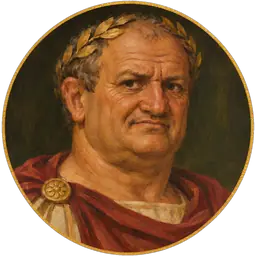
Vespasian
Vespasian was born in the Sabine country in AD 9, in the consulship of Sulpicius Camerinus and Poppaeus Sabinus, five years before Augustus died.1 Under Claudius he commanded a legion in Germany and then in Britain, where he fought thirty battles and brought two strong peoples, more than twenty towns and the Isle of Wight under Roman rule.2 He gave offence by leaving or sleeping while Nero sang in Greece, but after Cestius' defeat Nero put him in charge of the war in Judaea, and Suetonius says the captive Josephus foretold that he would soon be emperor.3 In the civil war of AD 69 the prefect of Egypt, Tiberius Alexander, made his legions swear to Vespasian on 1 July, and the army in Judaea followed; Tacitus says that of all the emperors up to his time he alone was changed for the better by power.4 As emperor he built the Temple of Peace and an amphitheatre in the middle of the city, as he learned Augustus had planned.5 He joked even as death approached, saying 'Alas, I think I am becoming a god', and died in his ninth consulship (AD 79), on 23 June, having said an emperor ought to die standing.6
Events
Ties
- Nero gave the Jewish war to Vespasian Josephus, Jewish War 1.21
- served in Britain under Claudius Tacitus, Agricola 13
- father of Titus Josephus, Jewish War 3.8
- father of Domitian Tacitus, Histories 4.52
- Josephus foretold the rule of Vespasian Suetonius, Vespasian 5.6
- overthrew Vitellius Suetonius, Vitellius 15.1
What the sources say
“they shuddered at the idea of another war, of other massacres. Even about Vespasian there were doubtful rumours, and he, unlike any of his predecessors, was changed for the better by power”
et ut potior utroque Vespasianus, ita bellum aliud atque alias cladis horrebant. et ambigua de Vespasiano fama, solusque omnium ante se principum in melius mutatus est
Tacitus, Histories 1.50 · translator not recorded
“The names of all the consular lieutenants, therefore, being taken into consideration, and one objecting to one, and another to another, for various reasons; at last some of the third legion, which a little before Nero's death had been removed out of Syria into Moesia, extolled Vespasian in high terms; and all the rest assenting, his name was immediately inscribed on their standards. The design was nevertheless quashed for a time, the troops being brought to submit to Vitellius a little longer. However, the fact becoming known, Tiberius Alexander, governor of Egypt, first obliged the legions under his command to swear obedience to Vespasian as their emperor, on the calends [the 1st] of July, which was observed ever after as the day of his accession to the empire”
propositis itaque nominibus legatorum consularium, quot ubique tunc erant, cum ceteros alium alia de causa improbarent et quidam e legione tertia, quae sub exitu Neronis translata ex Syria in Moesiam fuerat, Vespasianum laudibus ferrent, assensere cuncti nomenque eius uexillis omnibus sine mora inscripserunt. et tunc quidem compressa res est reuocatis ad officium numeris parumper. ceterum diuulgato facto Tiberius Alexander praefectus Aegypti primus in uerba Vespasiani legiones adegit Kal. Iul., qui principatus dies in posterum obseruatus est; Iudaicus deinde exercitus V. Idus Iul. apud ipsum iurauit
Suetonius, Vespasian 6.3 · tr. Alexander Thomson
“and how Nero, upon Cestius's defeat, was in fear of the entire event of the war, and thereupon made Vespasian general in this war; and how this Vespasian, with the elder of his sons made an expedition into the country of Judea; what was the number of the Roman army that he made use of; and how many of his auxiliaries were cut off in all Galilee; and how he took some of its cities entirely, and by force, and others of them by treaty, and on terms”
καὶ ὡς Νέρων ἐπὶ τοῖς Κεστίου πταίσμασι δείσας περὶ τῶν ὅλων Οὐεσπασιανὸν ἐφίστησι τῷ πολέμῳ, καὶ ὡς οὗτος μετὰ τοῦ πρεσβυτέρου τῶν παίδων εἰς τὴν Ἰουδαίων χώραν ἐνέβαλεν ὅσῃ τε χρώμενος Ῥωμαίων στρατιᾷ καὶ ὅσοι σύμμαχοι ἐκόπησαν εἰς ὅλην τὴν Γαλιλαίαν, καὶ ὡς τῶν πόλεων αὐτῆς ἃς μὲν ὁλοσχερῶς καὶ κατὰ κράτος ἃς δὲ διʼ ὁμολογίας ἔλαβεν
Josephus, Jewish War 1.21 · tr. William Whiston
First named
The earliest text in the library that names Vespasian, written about AD 75 (a modern estimate of when it was written):
“and how Nero, upon Cestius's defeat, was in fear of the entire event of the war, and thereupon made Vespasian general in this war; and how this Vespasian, with the elder of his sons made an expedition into the country of Judea”
καὶ ὡς Νέρων ἐπὶ τοῖς Κεστίου πταίσμασι δείσας περὶ τῶν ὅλων Οὐεσπασιανὸν ἐφίστησι τῷ πολέμῳ, καὶ ὡς οὗτος μετὰ τοῦ πρεσβυτέρου τῶν παίδων εἰς τὴν Ἰουδαίων χώραν ἐνέβαλεν
Josephus, Jewish War 1.21 · tr. William Whiston
Found by searching every text in the library for these spellings and reading the earliest hits to rule out namesakes: Vespasianus, Vespasiani, Vespasiano, Vespasianum, Vespasian, Flavius Vespasianus, Οὐεσπασιανός, Οὐεσπασιανοῦ, Οὐεσπασιανῷ, Οὐεσπασιανόν. Texts lost, or not in the library, may name Vespasian earlier.
The passages behind each sentence
- Suetonius, Vespasian 2.1 (tr. Alexander Thomson) ↩
- Suetonius, Vespasian 4.1 (tr. Alexander Thomson); Tacitus, Agricola 13 (translator not recorded) ↩
- Suetonius, Vespasian 4.4 (tr. Alexander Thomson); Josephus, Jewish War 1.21 (tr. William Whiston); Suetonius, Vespasian 5.6 (tr. Alexander Thomson) ↩
- Suetonius, Vespasian 6.3 (tr. Alexander Thomson); Tacitus, Histories 1.50 (translator not recorded) ↩
- Suetonius, Vespasian 9.1 (tr. Alexander Thomson) ↩
- Suetonius, Vespasian 23.4 (tr. Alexander Thomson); Suetonius, Vespasian 24.1 (tr. Alexander Thomson) ↩
Cite this page
MLA “Vespasian.” Atlas of Ancient History, Skirnir Studios, 2026, history.skirnirstudios.com/people/vespasian/.
APA Skirnir Studios. (2026). Vespasian. Atlas of Ancient History. https://history.skirnirstudios.com/people/vespasian/
Chicago “Vespasian.” Atlas of Ancient History. Skirnir Studios, 2026. https://history.skirnirstudios.com/people/vespasian/.
The atlas was written by AI from the ancient sources. Where you can, cite the ancient passage itself by its reference (Herodotus 7.228, Livy 22.7.3) and name the translation you read.