Atlas of Ancient History › People › The early Empire
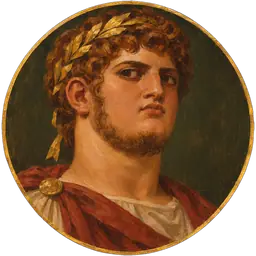
Nero
Nero was born at Antium on 15 December AD 37, nine months after Tiberius died; his father Domitius said nothing but evil could come from himself and Agrippina.1 Claudius adopted him in his eleventh year and gave him Seneca as tutor, and at seventeen, when Claudius' death was made public, the guard hailed him emperor.2 In the consulship of Vipstanus and Fonteius (AD 59) he carried out the long-planned murder of his mother: Tacitus says the assassins struck her down in her villa while she cried 'Strike my womb'.3 When fire swept Rome, Tacitus says it was uncertain whether by chance or by the emperor's guile, while Suetonius says Nero set the city on fire openly.4 To end the rumour that the fire had been ordered, Tacitus says, Nero put the blame on the Christians and had them tortured to death.5 Declared a public enemy by the senate, he stabbed himself in the throat with the help of his secretary Epaphroditus, crying 'What an artist dies in me!', on the anniversary of the day he had had his wife Octavia killed.6
Events
Ties
- had killed his mother Agrippina the Younger Tacitus, Annals 14.1
- Claudius adopted Nero Suetonius, Nero 7.1
- Seneca tutor of Nero Suetonius, Nero 7.1
- Corbulo was murdered under Nero Tacitus, Histories 2.76
- gave the Jewish war to Vespasian Josephus, Jewish War 1.21
- Galba rose against and succeeded Nero Plutarch, Galba 7.2
- Otho friend and rival in love of Nero Suetonius, Otho 3
What the sources say
“I have set out to write about clemency, Nero Caesar, so as to serve in a way as a mirror, and to show you to yourself as one who will come to the greatest pleasure of all.”
Scribere de clementia, Nero Caesar, institui, ut quodam modo speculi vice fungerer et te tibi ostenderem perventurum ad voluptatem maximam omnium
Seneca, On Clemency 1.1.1 · AI translation (Claude)
“Consequently, to get rid of the report, Nero fastened the guilt and inflicted the most exquisite tortures on a class hated for their abominations, called Christians by the populace. Christus, from whom the name had its origin, suffered the extreme penalty during the reign of Tiberius at the hands of one of our procurators, Pontius Pilatus”
ergo abolendo rumori Nero subdidit reos et quaesitissimis poenis adfecit quos per flagitia invisos vulgus Christianos appellabat. auctor nominis eius Christus Tiberio imperitante per procuratorem Pontium Pilatum supplicio adfectus erat
Tacitus, Annals 15.44 · translator not recorded
“I yet live to my shame and disgrace: this is not becoming for Nero: it is not becoming. Thou oughtest in such circumstances to have a good heart: Come, then: courage, man!" The horsemen who had received orders to bring him away alive, were now approaching the house. As soon as he heard them coming, he uttered with a trembling voice the following verse, ἵππων μ' ὠκυπόδων ἀμφὶ κτύποσ οὔατα The noise of swift-heel'd steeds assails my ears; he drove a dagger into his throat, being assisted in the act by Epaphroditus, his secretary”
uiuo deformiter, turpiter—οὐ πρέπειΝέρωνι, οὐ πρέπει—νήφειν δεῖ ἐν τοῖσ τοιούτοισ— ἄγε ἔγειρε σεαυτόν.' iamque equites appropinquabant, quibus praeceptum erat ut uiuum eum adtraherent. quod ut sensit, trepidanter effatus: ἵππων μ' ὠκυπόδων ἀμφὶ κτύποσ οὔατα βάλλει ferrum iugulo adegit iuuante Epaphrodito a libellis
Suetonius, Nero 49 · tr. Alexander Thomson
First named
The earliest text in the library that names Nero, written about AD 54 (a modern estimate of when it was written):
“Then Phoebus says, "O sister Fates! I pray take none away, But suffer this one life to be longer than mortal day.Like me in face and lovely grace, like me in voice and song, He'll bid the laws at length speak out that have been dumb so long, Will give unto the weary world years prosperous and bright.Like as the daystar from on high scatters the stars of night, As, when the stars return again, clear Hesper brings his light, Or as the ruddy dawn drives out the dark, and brings the day, As the bright sun looks on the world, and speeds along its way His rising car from morning's gates: so Caesar doth arise, So Nero shows his face to Rome before the people's eyes; His bright and shining countenance illumines all the air, While down upon his graceful neck fall rippling waves of hair”
Phoebus ait "vincat mortalis tempora vitae ille, mihi similis vultu similisque decore nec cantu nec voce minor. Felicia lassis saecula praestabit legumque silentia rumpet.Qualis discutiens fugientia Lucifer astra aut qualis surgit redeuntibus Hesperus astris,qualis cum primum tenebris Aurora solutis induxit rubicunda diem, Sol aspicit orbem lucidus, et primos a carcere concitat axes:talis Caesar adest, talem iam Roma Neronem aspiciet. Flagrat nitidus fulgore remisso vultus, et adfuso cervix formosa capillo." haec Apollo. At Lachesis, quae et ipsa homini formosissimo faveret, fecit illud plena manu, et Neroni multos annos de suo donat
Seneca, Apocolocyntosis 4.1 · tr. William Henry Denham Rouse
Found by searching every text in the library for these spellings and reading the earliest hits to rule out namesakes: Nero, Neronis, Neroni, Neronem, Nero Caesar, Nero Claudius Caesar, Domitius Nero, Νέρων, Νέρωνος, Νέρωνι, Νέρωνα. Texts lost, or not in the library, may name Nero earlier.
The passages behind each sentence
- Suetonius, Nero 6.1 (tr. Alexander Thomson) ↩
- Suetonius, Nero 7.1 (tr. Alexander Thomson); Suetonius, Nero 8.1 (tr. Alexander Thomson) ↩
- Tacitus, Annals 14.1 (translator not recorded); Tacitus, Annals 14.8 (translator not recorded) ↩
- Tacitus, Annals 15.38 (translator not recorded); Suetonius, Nero 38.1 (tr. Alexander Thomson) ↩
- Tacitus, Annals 15.44 (translator not recorded) ↩
- Suetonius, Nero 49 (tr. Alexander Thomson); Suetonius, Nero 57.1 (tr. Alexander Thomson) ↩
Cite this page
MLA “Nero.” Atlas of Ancient History, Skirnir Studios, 2026, history.skirnirstudios.com/people/nero/.
APA Skirnir Studios. (2026). Nero. Atlas of Ancient History. https://history.skirnirstudios.com/people/nero/
Chicago “Nero.” Atlas of Ancient History. Skirnir Studios, 2026. https://history.skirnirstudios.com/people/nero/.
The atlas was written by AI from the ancient sources. Where you can, cite the ancient passage itself by its reference (Herodotus 7.228, Livy 22.7.3) and name the translation you read.