Atlas of Ancient History › People › The early Empire
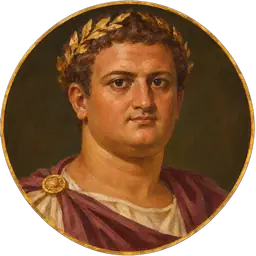
Titus
Titus, who bore his father's name, was born on 30 December, Suetonius says, in the year made famous by the murder of Gaius (AD 41), in a small dark room near the Septizonium; Suetonius' figure for his age at death would put his birth two years earlier.1 He served with his father in the Jewish war, and when Vespasian went to Rome as emperor he sent Titus to take Jerusalem.2 Josephus, who was with him, says Titus told his council he would never burn so great a work as the Temple, but a soldier, without orders, threw fire into it.3 Suetonius says he took Jerusalem on his daughter's birthday after killing twelve of its defenders with as many arrows, and that his soldiers hailed him imperator.4 As emperor he sent Queen Berenice away from Rome against both their wishes, and once, having done nothing for anyone all day, he said at dinner: 'Friends, I have lost a day.'5 His short reign saw the eruption of Vesuvius, a fire at Rome that burned three days and nights, and a great plague, and he died on 13 September AD 81, two years, two months and twenty days after succeeding his father.6
Events
Ties
- Vespasian father of Titus Josephus, Jewish War 3.8
- elder brother of Domitian Tacitus, Histories 4.52
- Josephus honoured by Titus Josephus, Jewish War 3.408
- Pliny the Elder dedicated his Natural History to Titus Pliny the Elder, Natural History 1.praef
What the sources say
“But Titus said, that although the Jews should get upon that holy house, and fight us thence, yet ought we not to revenge ourselves on things that are inanimate, instead of the men themselves; and that he was not in any case for burning down so vast a work as that was, because this would be a mischief to the Romans themselves, as it would be an ornament to their government while it continued”
ὁ δὲ Τίτος οὐδʼ ἂν ἐπιβάντες ἐπʼ αὐτοῦ πολεμῶσιν Ἰουδαῖοι φήσας ἀντὶ τῶν ἀνδρῶν ἀμυνεῖσθαι τὰ ἄψυχα οὐδὲ καταφλέξειν ποτὲ τηλικοῦτον ἔργον· Ῥωμαίων γὰρ ἔσεσθαι τὴν βλάβην, ὥσπερ καὶ κόσμον τῆς ἡγεμονίας αὐτοῦ μένοντος·
Josephus, Jewish War 6.241 · tr. William Whiston
“TITUS, who had the same cognomen with his father, was the darling and the delight of mankind; so much did the natural genius, address, or good fortune he possessed tend to conciliate the favour of all. This was, indeed, extremely difficult, after he became emperor, as before that time, and even during the reign of his father, he lay under public odium and censure”
Titus, cognomine paterno, amor ac deliciae generis humani—tantum illi ad promerendam omnium uoluntatem uel ingenii uel artis uel fortunae superfuit, et, quod difficillimum est, in imperio, quando priuatus atque etiam sub patre principe ne odio quidem, nedum uituperatione publica caruit
Suetonius, Titus 1.1 · tr. Alexander Thomson
“For that it was a seditious temper of our own that destroyed it, and that they were the tyrants among the Jews who brought the Roman power upon us, who unwillingly attacked us, and occasioned the burning of our holy temple, Titus Caesar, who destroyed it, is himself a witness, who, daring the entire war, pitied the people who were kept under by the seditious, and did often voluntarily delay the taking of the city, and allowed time to the siege, in order to let the authors have opportunity for repentance”
ὅτι γὰρ αὐτὴν στάσις οἰκεία καθεῖλεν, καὶ τὰς Ῥωμαίων χεῖρας ἀκούσας καὶ τὸ πῦρ ἐπὶ τὸν ναὸν εἵλκυσαν οἱ Ἰουδαίων τύραννοι, μάρτυς αὐτὸς ὁ πορθήσας Καῖσαρ Τίτος, ἐν παντὶ τῷ πολέμῳ τὸν μὲν δῆμον ἐλεήσας ὑπὸ τῶν στασιαστῶν φρουρούμενον, πολλάκις δὲ ἑκὼν τὴν ἅλωσιν τῆς πόλεως ὑπερτιθέμενος καὶ διδοὺς τῇ πολιορκίᾳ χρόνον εἰς μετάνοιαν τῶν αἰτίων.
Josephus, Jewish War 1.10 · tr. William Whiston
First named
The earliest text in the library that names Titus, written about AD 75 (a modern estimate of when it was written):
“For that it was a seditious temper of our own that destroyed it, and that they were the tyrants among the Jews who brought the Roman power upon us, who unwillingly attacked us, and occasioned the burning of our holy temple, Titus Caesar, who destroyed it, is himself a witness, who, daring the entire war, pitied the people who were kept under by the seditious, and did often voluntarily delay the taking of the city, and allowed time to the siege, in order to let the authors have opportunity for repentance”
ὅτι γὰρ αὐτὴν στάσις οἰκεία καθεῖλεν, καὶ τὰς Ῥωμαίων χεῖρας ἀκούσας καὶ τὸ πῦρ ἐπὶ τὸν ναὸν εἵλκυσαν οἱ Ἰουδαίων τύραννοι, μάρτυς αὐτὸς ὁ πορθήσας Καῖσαρ Τίτος, ἐν παντὶ τῷ πολέμῳ τὸν μὲν δῆμον ἐλεήσας ὑπὸ τῶν στασιαστῶν φρουρούμενον, πολλάκις δὲ ἑκὼν τὴν ἅλωσιν τῆς πόλεως ὑπερτιθέμενος καὶ διδοὺς τῇ πολιορκίᾳ χρόνον εἰς μετάνοιαν τῶν αἰτίων.
Josephus, Jewish War 1.10 · tr. William Whiston
Found by searching every text in the library for these spellings and reading the earliest hits to rule out namesakes: Titus, Titi, Tito, Titum, Titus Caesar, Titus Vespasianus, Τίτος, Τίτου, Τίτῳ, Τίτον. Texts lost, or not in the library, may name Titus earlier.
The passages behind each sentence
- Suetonius, Titus 1.1 (tr. Alexander Thomson); Suetonius, Titus 11.1 (tr. Alexander Thomson) ↩
- Josephus, Jewish War 3.8 (tr. William Whiston); Josephus, Jewish War 4.658 (tr. William Whiston) ↩
- Josephus, Jewish War 6.241 (tr. William Whiston); Josephus, Jewish War 6.252 (tr. William Whiston) ↩
- Suetonius, Titus 5.2 (tr. Alexander Thomson) ↩
- Suetonius, Titus 7.2 (tr. Alexander Thomson); Suetonius, Titus 8.1 (tr. Alexander Thomson) ↩
- Suetonius, Titus 8.3 (tr. Alexander Thomson); Suetonius, Titus 11.1 (tr. Alexander Thomson) ↩
Cite this page
MLA “Titus.” Atlas of Ancient History, Skirnir Studios, 2026, history.skirnirstudios.com/people/titus/.
APA Skirnir Studios. (2026). Titus. Atlas of Ancient History. https://history.skirnirstudios.com/people/titus/
Chicago “Titus.” Atlas of Ancient History. Skirnir Studios, 2026. https://history.skirnirstudios.com/people/titus/.
The atlas was written by AI from the ancient sources. Where you can, cite the ancient passage itself by its reference (Herodotus 7.228, Livy 22.7.3) and name the translation you read.