Atlas of Ancient History › People › The early Empire
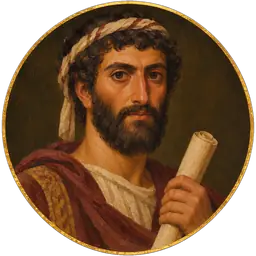
Josephus
Josephus son of Matthias, a priest of Jerusalem, says he was born in the first year of Gaius' reign (AD 37/38) and that he fought against the Romans at first and was afterwards a witness of the war under compulsion.1 When the revolt began the leaders in Jerusalem made him general of both Galilees, and when Jotapata fell to Vespasian he and one companion, by chance or providence, as he says, were the last left alive of those who had agreed to die by lot.2 Brought before Vespasian, he told him that he and his son would be Caesar and emperor, and Suetonius also reports that the captive Josephus foretold Vespasian's rise.3 After the war Titus took him to Rome, where Vespasian lodged him in his own former house, made him a Roman citizen and gave him a pension.4 He presented his Jewish War to Vespasian and Titus, and finished his Jewish Antiquities in the thirteenth year of Domitian (AD 93/94), the fifty-sixth year of his life.5
Events
Ties
What the sources say
“I have proposed to myself, for the sake of such as live under the government of the Romans, to translate those books into the Greek tongue, which I formerly composed in the language of our country, and sent to the Upper Barbarians; Joseph, the son of Matthias, by birth a Hebrew, a priest also, and one who at first fought against the Romans myself, and was forced to be present at what was done afterwards, [am the author of this work”
προυθέμην ἐγὼ τοῖς κατὰ τὴν Ῥωμαίων ἡγεμονίαν Ἑλλάδι γλώσσῃ μεταβαλὼν ἃ τοῖς ἄνω βαρβάροις τῇ πατρίῳ συντάξας ἀνέπεμψα πρότερον ἀφηγήσασθαι Ἰώσηπος Ματθίου παῖς ἐξ Ἱεροσολύμων ἱερεύς, αὐτός τε Ῥωμαίους πολεμήσας τὰ πρῶτα καὶ τοῖς ὕστερον παρατυχὼν ἐξ ἀνάγκης·
Josephus, Jewish War 1.3 · tr. William Whiston
“When Josephus heard him give those orders, he said that he had somewhat in his mind that he would willingly say to himself alone. When therefore they were all ordered to withdraw, excepting Titus and two of their friends, he said, Thou, O Vespasian, thinkest no more than that thou hast taken Josephus himself captive; but I come to thee as a messenger of greater tidings; for had not I been sent by God to thee, I knew what was the law of the Jews in this case? and how it becomes generals to die. Dost thou send me to Nero? For why? Are Nero's successors till they come to thee still alive? Thou, O Vespasian, art Caesar and emperor, thou, and this thy son”
Νέρωνί με πέμπεις· τί γάρ; οἱ μετὰ Νέρωνα μέχρι σοῦ διάδοχοι μενοῦσιν. σὺ Καῖσαρ, Οὐεσπασιανέ, καὶ αὐτοκράτωρ, σὺ καὶ παῖς ὁ σὸς οὗτος.
Josephus, Jewish War 3.401 · tr. William Whiston
Whiston's English begins two sentences before the Greek shown, where Josephus asks to speak with Vespasian alone (3.399-400).
“And when Josephus, one of the noble prisoners, was put in chains, he confidently affirmed that he should be released in a very short time by the same Vespasian, but he would be emperor first”
et unus ex nobilibus captiuis Iosephus, cum coiceretur in uincula, constantissime asseuerauit fore ut ab eodem breui solueretur, uerum iam imperatore
Suetonius, Vespasian 5.6 · tr. Alexander Thomson
First named
The earliest text in the library that names Josephus, written about AD 75 (a modern estimate of when it was written):
“I have proposed to myself, for the sake of such as live under the government of the Romans, to translate those books into the Greek tongue, which I formerly composed in the language of our country, and sent to the Upper Barbarians; Joseph, the son of Matthias, by birth a Hebrew, a priest also, and one who at first fought against the Romans myself, and was forced to be present at what was done afterwards, [am the author of this work”
προυθέμην ἐγὼ τοῖς κατὰ τὴν Ῥωμαίων ἡγεμονίαν Ἑλλάδι γλώσσῃ μεταβαλὼν ἃ τοῖς ἄνω βαρβάροις τῇ πατρίῳ συντάξας ἀνέπεμψα πρότερον ἀφηγήσασθαι Ἰώσηπος Ματθίου παῖς ἐξ Ἱεροσολύμων ἱερεύς, αὐτός τε Ῥωμαίους πολεμήσας τὰ πρῶτα καὶ τοῖς ὕστερον παρατυχὼν ἐξ ἀνάγκης·
Josephus, Jewish War 1.3 · tr. William Whiston
Found by searching every text in the library for these spellings and reading the earliest hits to rule out namesakes: Josephus, Iosephus, Iosepho, Josephum, Joseph, the son of Matthias, Flavius Josephus, Ἰώσηπος, Ἰωσήπου, Ἰωσήπῳ, Ἰώσηπον. Texts lost, or not in the library, may name Josephus earlier.
The passages behind each sentence
- Josephus, Life 5 (tr. William Whiston); Josephus, Jewish War 1.3 (tr. William Whiston) ↩
- Josephus, Jewish War 2.568 (tr. William Whiston); Josephus, Jewish War 3.391 (tr. William Whiston) ↩
- Josephus, Jewish War 3.401 (tr. William Whiston); Suetonius, Vespasian 5.6 (tr. Alexander Thomson) ↩
- Josephus, Life 422 (tr. William Whiston); Josephus, Life 423 (tr. William Whiston) ↩
- Josephus, Against Apion 1.50 (tr. William Whiston); Josephus, Jewish Antiquities 20.267 (tr. William Whiston) ↩
Cite this page
MLA “Josephus.” Atlas of Ancient History, Skirnir Studios, 2026, history.skirnirstudios.com/people/josephus/.
APA Skirnir Studios. (2026). Josephus. Atlas of Ancient History. https://history.skirnirstudios.com/people/josephus/
Chicago “Josephus.” Atlas of Ancient History. Skirnir Studios, 2026. https://history.skirnirstudios.com/people/josephus/.
The atlas was written by AI from the ancient sources. Where you can, cite the ancient passage itself by its reference (Herodotus 7.228, Livy 22.7.3) and name the translation you read.