Atlas of Ancient History › People › Rome and Carthage
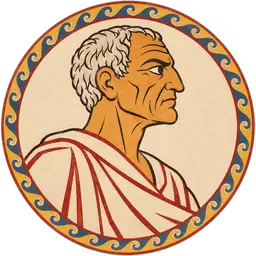
Cato the Elder
Marcus Porcius Cato was born at Tusculum, served his first campaign at seventeen, and was a military tribune in Sicily in the consulship of Fabius and Marcellus.1 In Cicero's dialogue he recalls that as a young man he loved the old Fabius Maximus and served under him at Capua and Tarentum; as quaestor he was given to Scipio Africanus, and Nepos says he disagreed with Scipio all his life.2 Returning from Africa, Nepos says, he brought the poet Ennius from Sardinia to Rome.3 Consul with Lucius Valerius Flaccus, he won a triumph from Spain, and as censor with the same colleague he struck at nobles and curbed luxury; Livy says he outstripped every other candidate, patrician or plebeian.4 He was a farmer, a lawyer, a general, an orator and a writer of seven books of histories; Polybius records his scorn in the senate for 'some old Greek dotards', the Achaean exiles.5 In old age, Plutarch says, he dropped a Libyan fig in the senate to show how near Carthage was and ended every speech, whatever the question, with the words 'Carthage must be destroyed'; he died in the consulship of Lucius Marcius and Manius Manilius, 149 BC.6
Open Cato the Elder in the atlas
Events
Ties
- quarrelled all his life with Scipio Africanus Nepos, Cato 1
- brought to Rome Ennius Nepos, Cato 1
- served under Fabius Maximus Plutarch, Marcus Cato 2
- great-grandfather of Cato the Younger Plutarch, Cato the Younger 1.1
What the sources say
“it is said that Cato contrived to drop a Libyan fig in the Senate, as he shook out the folds of his toga, and then, as the senators admired its size and beauty, said that the country where it grew was only three days’ sail from Rome. And in one thing he was even more savage, namely, in adding to his vote on any question whatsoever these words: In my opinion, Carthage must be destroyed”
πρὸς τούτοις φασὶ τὸν Κάτωνά καὶ σῦκα τῶν Λιβυκῶν ἐπίτηδες ἐκβαλεῖν ἐν τῇ βουλῇ, τὴν τήβεννον ἀναβαλόμενον· εἶτα θαυμασάντων τὸ μέγεθος καὶ τὸ κάλλος εἰπεῖν, ὡς ἡ ταῦτα φέρουσα χώρα τριῶν ἡμερῶν πλοῦν ἀπέχει τῆς Ῥώμης. ἐκεῖνο δʼ ἤδη καὶ βιαιότερον, τὸ περὶ παντὸς οὗ δήποτε πράγματος γνώμην ἀποφαινόμενον προσεπιφωνεῖν οὕτως δοκεῖ δέ μοι καὶ Καρχηδόνα μὴ εἶναι
Plutarch, Marcus Cato 27 · tr. Bernadotte Perrin
“Cato stood up and said: As though we had nothing else to do, we sit here the whole day debating whether some old Greek dotards should be buried by Italian or Achaean undertakers”
ἀναστὰς ὁ Κάτων " ὥσπερ οὐκ ἔχοντεσ" εἶπεν "ὃ πράττωμεν, καθήμεθα τὴν ἡμέραν ὅλην περὶ γεροντίων Γραικῶν ζητοῦντες, πότερον ὑπὸ τῶν παρʼ ἡμῖν ἢ τῶν ἐν Ἀχαΐᾳ νεκροφόρων ἐκκομισθῶσι
Polybius 35.6 · tr. Evelyn S. Shuckburgh
“patricians and plebeians alike, even those belonging to the noblest families, were far outstripped by M. Porcius. This man possessed such ability and force of character that in whatever station he had been born he must have been a fortunate and successful man”
sed omnes patricios plebeiosque nobilissimarum familiarum M.Porcius longe anteibat. in hoc viro tanta vis animi ingeniique fuit, ut, quocumque loco natus esset, fortunam sibi ipse facturus fuisse videretur
Livy 39.40 · tr. Rev. Canon Roberts
First named
The earliest text in the library that names Cato the Elder, written about 140 BC (a modern estimate of when it was written):
“Cato stood up and said: As though we had nothing else to do, we sit here the whole day debating whether some old Greek dotards should be buried by Italian or Achaean undertakers”
ἀναστὰς ὁ Κάτων " ὥσπερ οὐκ ἔχοντεσ" εἶπεν "ὃ πράττωμεν, καθήμεθα τὴν ἡμέραν ὅλην περὶ γεροντίων Γραικῶν ζητοῦντες, πότερον ὑπὸ τῶν παρʼ ἡμῖν ἢ τῶν ἐν Ἀχαΐᾳ νεκροφόρων ἐκκομισθῶσι
Polybius 35.6 · tr. Evelyn S. Shuckburgh
Found by searching every text in the library for these spellings and reading the earliest hits to rule out namesakes: Marcus Porcius Cato, Cato, Porcius, Μάρκος Πόρκιος Κάτων, Κάτων, Πόρκιος. Texts lost, or not in the library, may name Cato the Elder earlier.
The passages behind each sentence
- Nepos, Cato 1 (AI translation (Claude)) ↩
- Cicero, On Old Age 10 (tr. William Armistead Falconer); Nepos, Cato 1 (AI translation (Claude)) ↩
- Nepos, Cato 1 (AI translation (Claude)) ↩
- Nepos, Cato 2.1 (AI translation (Claude)); Livy 39.40 (tr. Rev. Canon Roberts) ↩
- Nepos, Cato 1 (AI translation (Claude)); Polybius 35.6 (tr. Evelyn S. Shuckburgh) ↩
- Plutarch, Marcus Cato 27 (tr. Bernadotte Perrin); Cicero, Brutus 61 (AI translation (Claude)) ↩
Cite this page
MLA “Cato the Elder.” Atlas of Ancient History, Skirnir Studios, 2026, history.skirnirstudios.com/people/cato-elder/.
APA Skirnir Studios. (2026). Cato the Elder. Atlas of Ancient History. https://history.skirnirstudios.com/people/cato-elder/
Chicago “Cato the Elder.” Atlas of Ancient History. Skirnir Studios, 2026. https://history.skirnirstudios.com/people/cato-elder/.
The atlas was written by AI from the ancient sources. Where you can, cite the ancient passage itself by its reference (Herodotus 7.228, Livy 22.7.3) and name the translation you read.