Atlas of Ancient History › People › Rome and Carthage
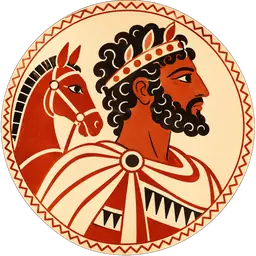
Masinissa
At seventeen Masinissa led the Numidian army that, joined with the Carthaginians, beat Syphax in a great battle; in Spain, then Carthage's ally, he pressed hard on Publius Scipio, the father of Africanus; and at Ilipa he rode with Mago and the Numidian horse against Scipio's camp.1 After the Carthaginians lost Spain he met the Romans secretly and insisted on grasping Scipio's own hand to seal the alliance.2 In Africa Scipio used him as an adviser on the approaches to the enemy camps; later King Syphax was taken alive and brought to Laelius, to Masinissa's delight, and Masinissa married Syphax's wife Sophonisba and, when Scipio claimed her for Rome, sent her poison.3 Scipio hailed him as king before the assembly and gave him a golden crown and an ivory sceptre.4 Polybius talked with him about Hannibal, and records that he reigned more than sixty years, was strong in body to the end, and died at ninety leaving a son four years old.5
Events
Ties
- fought against Publius Cornelius Scipio (consul 218) Livy 25.34
- Scipio Africanus hailed as king Masinissa Livy 30.15.11
- captured Syphax Appian, Punic Wars 5.26
- married, then sent poison to Sophonisba Livy 30.15
- guest-friend of the family of Scipio Aemilianus Cicero, On Old Age 34
- Jugurtha grandson of Masinissa Sallust, Jugurtha 5
What the sources say
“Addressing Masinissa as king and eulogising him in the highest possible terms, he presented him with a golden crown, curule chair, an ivory sceptre and also with a purple-bordere”
ibi Masinissam, primum regem appellatum eximiisque ornatum laudibus, aurea corona aurea patera sella curuli et scipione eburneo toga picta et palmata tunica donat
Livy 30.15.11 · tr. Rev. Canon Roberts
“Massanissa, king of the Numidians in Africa, was the best man of all the kings of our time, and the most completely fortunate; for he reigned more than sixty years in the soundest health and to extreme old age,—for he was ninety when he died … at ninety years old, at which age he died, he left a son only four years old”
ὅτι Μασανάσσης ὁ ἐν Λιβύῃ τῶν Νομάδων βασιλεὺς ἀνὴρ ἦν τῶν καθʼ ἡμᾶς βασιλέων ἄριστος καὶ μακαριώτατος, ὃς ἐβασίλευσεν ἔτη πλείω τῶν ἑξήκονθʼ, ὑγιεινότατος ὢν καὶ πολυχρονιώτατος· ἐνενήκοντα γὰρ ἐτῶν ἐγεγόνει … Μασανάσσην δʼ ἱστορεῖ Πολύβιος ἐνενήκοντα μὲν ἐτῶν ἀποθανεῖν, τετράετες καταλιπόντα παιδάριον ἐξ αὐτοῦ γεγενημένον
Polybius 36.16 · tr. Evelyn S. Shuckburgh
Shuckburgh numbers this passage 37.10.
“your grandfather's friend and host Masinissa, now ninety years old; that when he begins a march on foot, he never mounts a horse, and when he sets out on horseback he never dismounts; that no rain or cold, however great, can induce him to cover his head”
hospes tuus avitus Masinissa quae faciat hodie nonaginta natus annos: cum ingressus iter pedibus sit, in equum omnino non ascendere; cum autem equo, ex equo non descendere; nullo imbri, nullo frigore adduci ut capite operto sit
Cicero, On Old Age 34 · tr. William Armistead Falconer
The library's English numbers this section 35. Cicero's Cato speaks to Scipio Aemilianus.
First named
The earliest text in the library that names Masinissa, written about 150 BC (a modern estimate of when it was written):
“those of Carthage against Massinissa, king of Libya”
Καρχηδόνιοι δὲ τὸν πρὸς Μασαννάσαν
Polybius 3.5.1 · tr. Evelyn S. Shuckburgh
Found by searching every text in the library for these spellings and reading the earliest hits to rule out namesakes: Masinissa, Massinissa, Massanissa, Μασανάσσης, Μασαννάσας, Μασσανάσσης. Texts lost, or not in the library, may name Masinissa earlier.
The passages behind each sentence
- Livy 24.49 (tr. Rev. Canon Roberts); Livy 25.34 (tr. Rev. Canon Roberts); Polybius 11.21 (tr. Evelyn S. Shuckburgh) ↩
- Livy 28.16 (tr. Rev. Canon Roberts); Livy 28.35 (tr. Rev. Canon Roberts) ↩
- Polybius 14.3 (tr. Evelyn S. Shuckburgh); Livy 30.12 (tr. Rev. Canon Roberts); Livy 30.15 (tr. Rev. Canon Roberts) ↩
- Livy 30.15.11 (tr. Rev. Canon Roberts) ↩
- Polybius 9.25 (tr. Evelyn S. Shuckburgh); Polybius 36.16 (tr. Evelyn S. Shuckburgh) ↩
Cite this page
MLA “Masinissa.” Atlas of Ancient History, Skirnir Studios, 2026, history.skirnirstudios.com/people/masinissa/.
APA Skirnir Studios. (2026). Masinissa. Atlas of Ancient History. https://history.skirnirstudios.com/people/masinissa/
Chicago “Masinissa.” Atlas of Ancient History. Skirnir Studios, 2026. https://history.skirnirstudios.com/people/masinissa/.
The atlas was written by AI from the ancient sources. Where you can, cite the ancient passage itself by its reference (Herodotus 7.228, Livy 22.7.3) and name the translation you read.