Atlas of Ancient History › People › The fourth century
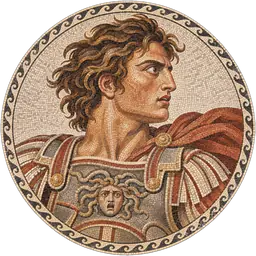
Alexander the Great
Alexander was the son of Philip and Olympias, born, Plutarch says, on the sixth of Hecatombaeon, the day the temple of Artemis at Ephesus burned.1 Philip sent for Aristotle to teach him, and gave them the precinct of the Nymphs at Mieza as their school.2 He became king at twenty after Philip's murder, and when Thebes rebelled he took it, killed more than six thousand and sold the rest, about thirty thousand, into slavery.3 Crossing to Asia, he fought Darius' generals at the river Granicus, and after the battle at Issus he seized the Persians' treasure, baggage, wives and children at Damascus.4 Plutarch puts the great battle against Darius at Gaugamela, after which Alexander was proclaimed king of Asia; Arrian says that as Alexander closed in on Bessus and the men carrying Darius off, two of them wounded him and left him, and he died before Alexander could see him.5 He went on into India and beat King Porus at the Hydaspes, but the struggle with Porus blunted his Macedonians' courage and they would go no further.6 He died at Babylon in the archonship of Hegesias, aged thirty-two years and eight months, having reigned twelve years and eight months, as Arrian reports from Aristobulus.7
Open Alexander the Great in the atlas
Events
Ties
- Philip II father of Alexander the Great Plutarch, Alexander 9.4
- Olympias mother of Alexander the Great Plutarch, Alexander 9.5
- Aristotle teacher of Alexander the Great Plutarch, Alexander 7.3
- visited Diogenes the Cynic Plutarch, Alexander 14.2
- had killed Parmenion Arrian, Anabasis 3.26.4
- Hephaestion friend of Alexander the Great Diodorus 17.37.5
- Cleitus the Black saved the life of Alexander the Great Arrian, Anabasis 1.15.8
- killed Cleitus the Black Plutarch, Alexander 51.5
- arrested Callisthenes Arrian, Anabasis 4.14.3
- Phocion respected by Alexander the Great Plutarch, Phocion 18.1
- had executed Bessus Arrian, Anabasis 4.7.3
- defeated Darius III Arrian, Anabasis 2.11.4
- treated as a mother Sisygambis Diodorus 17.37
- husband of Roxane Arrian, Anabasis 4.19.5
- defeated, then restored Porus Arrian, Anabasis 5.19.3
- Memnon of Rhodes opposed Alexander the Great Arrian, Anabasis 1.12.9
- Ptolemy I historian of Alexander the Great Arrian, Anabasis 1.pr.1
- gave his ring to Perdiccas Nepos, Eumenes 2.1
- honoured above others Craterus Plutarch, Alexander 47.5
- Ptolemy I buried Alexander the Great Diodorus 18.28.3
- Lysimachus bodyguard of Alexander the Great Pausanias 1.9.5
What the sources say
“But since that philosopher took not the slightest notice of Alexander, and continued to enjoy his leisure in the suburb Craneion, Alexander went in person to see him; and he found him lying in the sun. Diogenes raised himself up a little when he saw so many persons coming towards him, and fixed his eyes upon Alexander. And when that monarch addressed him with greetings, and asked if he wanted anything, Yes, said Diogenes, stand a little out of my sun”
ὡς δὲ ἐκεῖνος ἐλάχιστον Ἀλεξάνδρου λόγον ἔχων ἐν τῷ Κρανείῳ σχολὴν ἦγεν, αὐτὸς ἐπορεύετο πρὸς αὐτόν ἔτυχε δὲ κατακείμενος ἐν ἡλίῳ. καὶ μικρὸν μὲν ἀνεκάθισεν, ἀνθρώπων τοσούτων ἐπερχομένων, καὶ διέβλεψεν εἰς τὸν Ἀλέξανδρον. ὡς δὲ ἐκεῖνος ἀσπασάμενος καὶ προσειπὼν αὐτόν ἠρώτησεν εἴ τινος τυγχάνει δεόμενος, μικρὸν εἶπεν, ἀπὸ τοῦ ἡλίου μετάστηθι
Plutarch, Alexander 14.2 · tr. Bernadotte Perrin
“It is said that Alexander was so struck by this, and admired so much the haughtiness and grandeur of the man who had nothing but scorn for him, that he said to his followers, who were laughing and jesting about the philosopher as they went away, But verily, if I were not Alexander, I would be Diogenes.”
πρὸς τοῦτο λέγεται τὸν Ἀλέξανδρον οὕτω διατεθῆναι καὶ θαυμάσαι καταφρονηθέντα τὴν ὑπεροψίαν καὶ τὸ μέγεθος τοῦ ἀνδρός, ὥστε τῶν περὶ αὐτὸν, ὡς ἀπῄεσαν, διαγελώντων καὶ σκωπτόντων, ἀλλὰ μὴν ἐγὼ, εἶπεν, εἰ μὴ Ἀλέξανδρος ἤμην, Διογένης ἂν ἤμην.
Plutarch, Alexander 14.3 · tr. Bernadotte Perrin
“Alexander died in the hundred and fourteenth Olympiad, when Hegesias was archon at Athens. He lived thirty-two years and eight months of his thirty-third year, as Aristobulus says, and reigned twelve years and these eight months.”
ἐτελεύτα μὲν δὴ Ἀλέξανδρος τῇ τετάρτῃ καὶ δεκάτῃ καὶ ἑκατοστῇ Ὀλυμπιάδι ἐπὶ Ἡγησίου ἄρχοντος Ἀθήνησιν· ἐβίω δὲ δύο καὶ τριάκοντα ἔτη καὶ τοῦ τρίτου μῆνας ἐπέλαβεν ὀκτώ, ὡς λέγει Ἀριστόβουλος· ἐβασίλευσε δὲ δώδεκα ἔτη καὶ τοὺς ὀκτὼ τούτους μῆνας
Arrian, Anabasis 7.28.1 · AI translation (Claude)
“Alexander, telling how at a certain banquet of ours he played the cithara, reciting certain passages in which there were thrusts at another boy”
ὑπὲρ τοῦ παιδὸς Ἀλεξάνδρου διεξῄει, ὡς ἔν τῳ πότῳ ἡμῶν κιθαρίζοι καὶ λέγοι ῥήσεις τινὰς καὶ ἀντικρούσεις πρὸς ἕτερον παῖδα
Aeschines, Against Timarchus 168 · tr. Charles Darwin Adams
First named
The earliest text in the library that names Alexander the Great, written about 345 BC (a modern estimate of when it was written):
“Alexander, telling how at a certain banquet of ours he played the cithara, reciting certain passages in which there were thrusts at another boy”
ὑπὲρ τοῦ παιδὸς Ἀλεξάνδρου διεξῄει, ὡς ἔν τῳ πότῳ ἡμῶν κιθαρίζοι καὶ λέγοι ῥήσεις τινὰς καὶ ἀντικρούσεις πρὸς ἕτερον παῖδα
Aeschines, Against Timarchus 168 · tr. Charles Darwin Adams
Found by searching every text in the library for these spellings and reading the earliest hits to rule out namesakes: Ἀλέξανδρος, Alexander, Alexandros. Texts lost, or not in the library, may name Alexander the Great earlier.
The passages behind each sentence
- Plutarch, Alexander 2.1 (tr. Bernadotte Perrin); Plutarch, Alexander 3.3 (tr. Bernadotte Perrin) ↩
- Plutarch, Alexander 7.2 (tr. Bernadotte Perrin); Plutarch, Alexander 7.3 (tr. Bernadotte Perrin) ↩
- Plutarch, Alexander 11.1 (tr. Bernadotte Perrin); Plutarch, Alexander 11.6 (tr. Bernadotte Perrin) ↩
- Plutarch, Alexander 16.1 (tr. Bernadotte Perrin); Plutarch, Alexander 24.1 (tr. Bernadotte Perrin) ↩
- Plutarch, Alexander 31.3 (tr. Bernadotte Perrin); Plutarch, Alexander 34.1 (tr. Bernadotte Perrin); Arrian, Anabasis 3.21.10 (AI translation (Claude)) ↩
- Plutarch, Alexander 60.1 (tr. Bernadotte Perrin); Plutarch, Alexander 62.1 (tr. Bernadotte Perrin) ↩
- Arrian, Anabasis 7.28.1 (AI translation (Claude)) ↩
Cite this page
MLA “Alexander the Great.” Atlas of Ancient History, Skirnir Studios, 2026, history.skirnirstudios.com/people/alexander-great/.
APA Skirnir Studios. (2026). Alexander the Great. Atlas of Ancient History. https://history.skirnirstudios.com/people/alexander-great/
Chicago “Alexander the Great.” Atlas of Ancient History. Skirnir Studios, 2026. https://history.skirnirstudios.com/people/alexander-great/.
The atlas was written by AI from the ancient sources. Where you can, cite the ancient passage itself by its reference (Herodotus 7.228, Livy 22.7.3) and name the translation you read.