Atlas of Ancient History › People › The fourth century
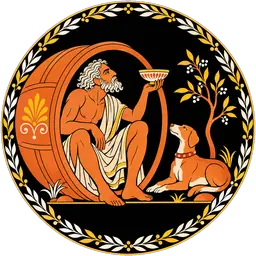
Diogenes the Cynic
Diogenes was the son of Hicesius, a banker of Sinope, and went into exile after the coinage was debased, by his father or by himself, according to different writers.1 At Athens he attached himself to Antisthenes, and when a cottage was slow to come he made his home in a great jar in the Metroon.2 When Plato defined man as a featherless biped, Diogenes is said to have plucked a chicken and brought it to the school.3 At Corinth Alexander came to him as he lay in the sun and asked whether he wanted anything, and he replied, 'Stand a little out of my sun.'4 He was said to have died at Corinth at nearly ninety, and Demetrius of Magnesia says on the same day that Alexander died at Babylon.5
Open Diogenes the Cynic in the atlas
Events
Ties
- Alexander the Great visited Diogenes the Cynic Plutarch, Alexander 14.2
- mocked Plato Diogenes Laertius 6.2.40
What the sources say
“But since that philosopher took not the slightest notice of Alexander, and continued to enjoy his leisure in the suburb Craneion, Alexander went in person to see him; and he found him lying in the sun. Diogenes raised himself up a little when he saw so many persons coming towards him, and fixed his eyes upon Alexander. And when that monarch addressed him with greetings, and asked if he wanted anything, Yes, said Diogenes, stand a little out of my sun”
ὡς δὲ ἐκεῖνος ἐλάχιστον Ἀλεξάνδρου λόγον ἔχων ἐν τῷ Κρανείῳ σχολὴν ἦγεν, αὐτὸς ἐπορεύετο πρὸς αὐτόν ἔτυχε δὲ κατακείμενος ἐν ἡλίῳ. καὶ μικρὸν μὲν ἀνεκάθισεν, ἀνθρώπων τοσούτων ἐπερχομένων, καὶ διέβλεψεν εἰς τὸν Ἀλέξανδρον. ὡς δὲ ἐκεῖνος ἀσπασάμενος καὶ προσειπὼν αὐτόν ἠρώτησεν εἴ τινος τυγχάνει δεόμενος, μικρὸν εἶπεν, ἀπὸ τοῦ ἡλίου μετάστηθι
Plutarch, Alexander 14.2 · tr. Bernadotte Perrin
“When mice crept on to the table he addressed them thus, See now even Diogenes keeps parasites. When Plato styled him a dog, Quite true, he said, for I come back again and again to those who have sold me”
Πρὸς τοὺς ἑρπύσαντας ἐπὶ τὴν τράπεζαν μῦς, ἰδού, φησί, καὶ Διογένης παρασίτους τρέφει. Πλάτωνος εἰπόντος αὐτὸν κύνα, ναί, ἔφη· ἐγὼ γὰρ ἐπανῆλθον ἐπὶ τοὺς πεπρακότας
Diogenes Laertius 6.2.40 · translator not recorded
“But Diogenes, being a Cynic, spoke more freely: when Alexander asked him to say if he needed anything, he said, 'Just now, stand a little out of the sun.' Alexander, of course, had been blocking his sunbathing.”
at vero Diogenes liberius, ut Cynicus, Alexandro roganti, ut diceret, si quid opus esset, nunc quidem paululum inquit a sole. offecerat videlicet apricanti
Cicero, Tusculan Disputations 5.92 · AI translation (Claude)
First named
The earliest text in the library that names Diogenes the Cynic, written about 222 BC (a modern estimate of when it was written):
“For in truth he was rightly named Diogenes, a true-born son of Zeus, a hound of heaven”
ἦς γὰρ ἀλαθέως Διογένης Ζανὸς γόνος οὐράνιός τε κύων
Diogenes Laertius 6.2.77 · translator not recorded
From the meliambics of Cercidas of Megalopolis, as Diogenes Laertius quotes them about AD 230 (6.76-77).
Found by searching every text in the library for these spellings and reading the earliest hits to rule out namesakes: Διογένης, Diogenes. Texts lost, or not in the library, may name Diogenes the Cynic earlier.
The passages behind each sentence
- Diogenes Laertius 6.2.20 (translator not recorded) ↩
- Diogenes Laertius 6.2.21 (translator not recorded); Diogenes Laertius 6.2.23 (translator not recorded) ↩
- Diogenes Laertius 6.2.40 (translator not recorded) ↩
- Plutarch, Alexander 14.2 (tr. Bernadotte Perrin); Diogenes Laertius 6.2.38 (translator not recorded) ↩
- Diogenes Laertius 6.2.76 (translator not recorded); Diogenes Laertius 6.2.79 (translator not recorded) ↩
Cite this page
MLA “Diogenes the Cynic.” Atlas of Ancient History, Skirnir Studios, 2026, history.skirnirstudios.com/people/diogenes/.
APA Skirnir Studios. (2026). Diogenes the Cynic. Atlas of Ancient History. https://history.skirnirstudios.com/people/diogenes/
Chicago “Diogenes the Cynic.” Atlas of Ancient History. Skirnir Studios, 2026. https://history.skirnirstudios.com/people/diogenes/.
The atlas was written by AI from the ancient sources. Where you can, cite the ancient passage itself by its reference (Herodotus 7.228, Livy 22.7.3) and name the translation you read.