Atlas of Ancient History › People › The fourth century
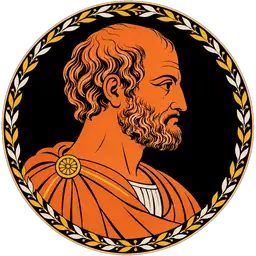
Aristotle
Aristotle son of Nicomachus came from Stagira; his father was physician and friend to King Amyntas of Macedon, and Diogenes Laertius calls him Plato's most genuine pupil.1 He studied with Plato for twenty years, Apollodorus says, and left the Academy while Plato was still alive.2 Philip sent for him to teach Alexander, rebuilt his native Stagira, and gave master and pupil the precinct of the Nymphs at Mieza.3 Back in Athens he taught in the Lyceum for thirteen years, then withdrew to Chalcis, where he died aged about sixty-three in the archonship of Philocles, the year Demosthenes died.4 Arrian says his pupil Callisthenes went with Alexander, and Diogenes Laertius that Aristotle fell out of favour with the king for introducing him.5
Ties
- teacher of Alexander the Great Plutarch, Alexander 7.3
- Plato teacher of Aristotle Diogenes Laertius 5.1.2
- teacher of Callisthenes Arrian, Anabasis 4.10.1
What the sources say
“He seceded from the Academy while Plato was still alive. Hence the remark attributed to the latter: Aristotle spurns me, as colts kick out at the mother who bore them”
Ἀπέστη δὲ Πλάτωνος ἔτι περιόντος· ὥστε φασὶν ἐκεῖνον εἰπεῖν, Ἀριστοτέλης ἡμᾶς ἀπελάκτισε, καθαπερεὶ τὰ πωλάρια γεννηθέντα τὴν μητέρα
Diogenes Laertius 5.1.2 · translator not recorded
“he sent for the most famous and learned of philosophers, Aristotle, and paid him a noble and appropriate tuition-fee. The city of Stageira, that is, of which Aristotle was a native, and which he had himself destroyed, he peopled again, and restored to it those of its citizens who were in exile or slavery.”
μετεπέμψατο τῶν φιλοσόφων τὸν ἐνδοξότατον καὶ λογιώτατον Ἀριστοτέλην, καλὰ καὶ πρέποντα διδασκάλια τελέσας αὐτῷ. τὴν γὰρ Σταγειριτῶν πόλιν, ἐξ ἧς ἦν Ἀριστοτέλης, ἀνάστατον ὑπʼ αὐτοῦ γεγενημένην συνῴκισε πάλιν, καὶ τοὺς διαφυγόντας ἢ δουλεύοντας τῶν πολιτῶν ἀποκατέστησε.
Plutarch, Alexander 7.2 · tr. Bernadotte Perrin
“Well, then, as a place where master and pupil could labour and study, he assigned them the precinct of the nymphs near Mieza, where to this day the visitor is shown the stone seats and shady walks of Aristotle”
σχολὴν μὲν οὖν αὐτοῖς καὶ διατριβὴν τὸ περὶ Μίεζαν Νυμφαῖον ἀπέδειξεν, ὅπου μέχρι νῦν Ἀριστοτέλους ἕδρας τε λιθίνας καὶ ὑποσκίους περιπάτους δεικνύουσιν
Plutarch, Alexander 7.3 · tr. Bernadotte Perrin
First named
The earliest text in the library that names Aristotle, written about 322 BC (a modern estimate of when it was written):
“All will be well; but, in case anything should happen, Aristotle has made these dispositions. Antipater is to be executor”
Ἔσται μὲν εὖ· ἐὰν δέ τι συμβαίνῃ, τάδε διέθετο Ἀριστοτέλης· ἐπίτροπον μὲν εἶναι πάντων καὶ διὰ παντὸς Ἀντίπατρον
Diogenes Laertius 5.1.11 · translator not recorded
Aristotle's will, as Diogenes Laertius quotes it word for word about AD 230 (5.11); Aristotle wrote it before his death, which Diogenes (5.10) puts in the archonship of Philocles.
Found by searching every text in the library for these spellings and reading the earliest hits to rule out namesakes: Ἀριστοτέλης, Aristotle, Aristoteles. Texts lost, or not in the library, may name Aristotle earlier.
The passages behind each sentence
- Diogenes Laertius 5.1.1 (translator not recorded) ↩
- Diogenes Laertius 5.1.9 (translator not recorded); Diogenes Laertius 5.1.2 (translator not recorded) ↩
- Plutarch, Alexander 7.2 (tr. Bernadotte Perrin); Plutarch, Alexander 7.3 (tr. Bernadotte Perrin) ↩
- Diogenes Laertius 5.1.10 (translator not recorded) ↩
- Arrian, Anabasis 4.10.1 (AI translation (Claude)); Diogenes Laertius 5.1.10 (translator not recorded) ↩
Cite this page
MLA “Aristotle.” Atlas of Ancient History, Skirnir Studios, 2026, history.skirnirstudios.com/people/aristotle/.
APA Skirnir Studios. (2026). Aristotle. Atlas of Ancient History. https://history.skirnirstudios.com/people/aristotle/
Chicago “Aristotle.” Atlas of Ancient History. Skirnir Studios, 2026. https://history.skirnirstudios.com/people/aristotle/.
The atlas was written by AI from the ancient sources. Where you can, cite the ancient passage itself by its reference (Herodotus 7.228, Livy 22.7.3) and name the translation you read.