Atlas of Ancient History › People › The early Empire
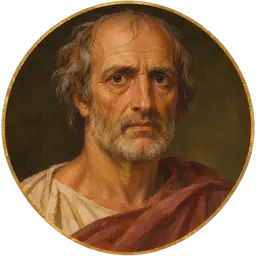
Seneca
Lucius Annaeus Seneca was one of the three sons, Novatus, Seneca and Mela, to whom their father, the elder Seneca, addressed his collection of declamations.1 Agrippina had him recalled from exile and made praetor to tutor her son, and when Claudius adopted Nero the boy was put in Seneca's charge.2 He addressed his treatise On Clemency to the young emperor, and Quintilian says he wrote the letter Nero sent the senate after killing his mother.3 Columella, writing while Seneca still owned them, praised his vineyards at Nomentum and called him a man of outstanding talent and learning.4 Suetonius says Nero drove him to his death although Seneca had often asked leave to retire and offered up his estate; Tacitus puts the order after the conspiracy of Piso in AD 65.5 Tacitus says he left his friends the pattern of his life, opened his veins with his wife Paulina, and dictated to his secretaries to the end.6
Events
Ties
- Agrippina the Younger won the recall from exile of Seneca Tacitus, Annals 12.8
- tutor of Nero Suetonius, Nero 7.1
What the sources say
“Seneca, quite unmoved, asked for tablets on which to inscribe his will, and, on the centurion's refusal, turned to his friends, protesting that as he was forbidden to requite them, he bequeathed to them the only, but still the noblest possession yet remaining to him, the pattern of his life, which, if they remembered, they would win a name for moral worth and steadfast friendship. At the same time he called them back from their tears”
Ille interritus poscit testamenti tabulas; ac denegante centurione conversus ad amicos, quando meritis eorum referre gratiam prohiberetur, quod unum iam et tamen pulcherrimum habeat, imaginem vitae suae relinquere testatur, cuius si memores essent, bonarum artium famam fructum constantis amicitiae laturos. simul lacrimas eorum modo sermone, modo intentior in modum coercentis ad firmitudinem revocat
Tacitus, Annals 15.62 · translator not recorded
“Another type of reflexion may be produced by the doubling of a phrase, as in the letter written by Seneca for Nero to be sent to the senate on the occasion of his mother's death, with a view to creating the impression that he had been in serious danger:— As yet I cannot believe or rejoice that I am safe”
facit quasdam sententias sola geminatio, qualis est Senecae in eo scripto, quod Nero ad senatum misit occisa matre, cum se periclitatum videri vellet: salvum me esse adhuc nec credo nec gaudeo
Quintilian, Institutio Oratoria 8.5.18 · tr. Harold Edgeworth Butler
“in our own times, at any rate, the neighbourhood of Nomentum is illumined by a most distinguished reputation; and especially that part owned by Seneca, a man of outstanding genius and erudition, on whose estates it is learned that every iugerum of vineyard has yielded commonly eight cullei”
his certe temporibus Nomentana regio celeberrima fama est inlustris, et praecipue quam possidet Seneca, vir excellentis ingenii atque doctrinae, cuius in praediis vinearum iugera singula culleos octonos reddidisse plerumque, compertum est
Columella, On Agriculture 3.3.3 · translator not recorded
First named
The earliest text in the library that names Seneca, written about AD 37 (a modern estimate of when it was written):
“Seneca to his sons Novatus, Seneca and Mela, greetings. You ask of me a thing more pleasant to me than easy: you bid me say what I think of the declaimers who fell within my lifetime”
Seneca Nouato, Senecae, Melae filiis salutem. Exigitis rem magis iocundam mihi quam facilem: iubetis enim quid de his declamatoribus sentiam qui in aetatem meam inciderunt indicare
Seneca the Elder, Controversiae 1.pr.1 · AI translation (Claude)
Found by searching every text in the library for these spellings and reading the earliest hits to rule out namesakes: Seneca, Senecae, Senecam, Annaeus Seneca, Annaeo Senecae, L. Annaeus Seneca, Σενέκας, Σενέκα, Σενέκαν. Texts lost, or not in the library, may name Seneca earlier.
The passages behind each sentence
- Seneca the Elder, Controversiae 1.pr.1 (AI translation (Claude)) ↩
- Tacitus, Annals 12.8 (translator not recorded); Suetonius, Nero 7.1 (tr. Alexander Thomson) ↩
- Seneca, On Clemency 1.1.1 (AI translation (Claude)); Quintilian, Institutio Oratoria 8.5.18 (tr. Harold Edgeworth Butler) ↩
- Columella, On Agriculture 3.3.3 (translator not recorded) ↩
- Suetonius, Nero 35.5 (tr. Alexander Thomson); Tacitus, Annals 15.48 (translator not recorded); Tacitus, Annals 15.60 (translator not recorded) ↩
- Tacitus, Annals 15.62 (translator not recorded); Tacitus, Annals 15.63 (translator not recorded) ↩
Cite this page
MLA “Seneca.” Atlas of Ancient History, Skirnir Studios, 2026, history.skirnirstudios.com/people/seneca/.
APA Skirnir Studios. (2026). Seneca. Atlas of Ancient History. https://history.skirnirstudios.com/people/seneca/
Chicago “Seneca.” Atlas of Ancient History. Skirnir Studios, 2026. https://history.skirnirstudios.com/people/seneca/.
The atlas was written by AI from the ancient sources. Where you can, cite the ancient passage itself by its reference (Herodotus 7.228, Livy 22.7.3) and name the translation you read.