Atlas of Ancient History › People › The early Empire
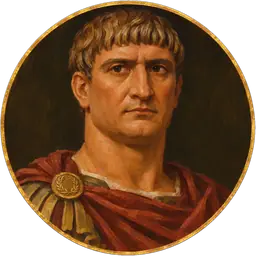
Trajan
Trajan came from Italica in Spain, the town Scipio founded, says Appian, who wrote a generation later; Eutropius, writing in the fourth century, says he was of an Italian family and the son of a man of consular rank, and that Nerva adopted him and left him the empire.1 At the start of his reign Tacitus wrote that Nerva had joined things once irreconcilable, rule and liberty, and that 'Nerva Trajan' was daily adding to the happiness of the times; Martial begged the Rhine to send Trajan back to his peoples and to Rome.2 Pausanias says he added the Getae beyond Thrace to the empire, made war on Osroes, the descendant of Arsaces, and the Parthians, and built baths named after him, a great round theatre, a hippodrome two stades long and the Forum at Rome; Eutropius adds that he overthrew the Dacian leader Decebalus and made a province beyond the Danube.3 In the east, Eutropius says, he took Seleucia, Ctesiphon and Babylon, reached the borders of India and the Red Sea, and made Armenia, Assyria and Mesopotamia into provinces.4 Answering Pliny from Bithynia, he ruled that Christians were not to be hunted out, but punished if accused and convicted, unless they denied it and worshipped the gods, and that anonymous accusations had no place in his age.5 Returning from the Persian war, Eutropius says, he died at Seleucia in Isauria in his sixty-third year, after a reign of nineteen and a half years, and was buried under a column in the forum he had built; the senate went on hailing new emperors as 'luckier than Augustus, better than Trajan'.6
Events
Ties
- Pliny the Younger governor of Bithynia under Trajan Pliny the Younger, Letters 10.18
- defeated Decebalus Zonaras, Epitome of Histories 11.21.3
- Hadrian succeeded Trajan Eutropius (Greek translation) 8.6
- Nerva adoptive father of Trajan Eutropius (Greek translation) 8.1
What the sources say
“and Trajan, dedicated by all the Greeks. This emperor subdued the Getae beyond Thrace, and made war on Osroes the descendant of Arsaces and on the Parthians. Of his architectural achievements the most remarkable are baths called after him, a large circular theater, a building for horse-races which is actually two stades long, and the Forum at Rome, worth seeing not only for its general beauty but especially for its roof made of bronze”
Τραϊανοῦ δὲ οἱ πάντες Ἕλληνες. οὗτος προσεκτήσατο ὁ βασιλεὺς Γέτας τοὺς ὑπὲρ Θρᾴκης Ὀσρόῃ τε τῷ ἀπογόνῳ τῷ Ἀρσάκου καὶ Πάρθοις ἐπολέμησεν· ὁπόσα δὲ ἐς ἔργων ἔχει οἱ κατασκευήν, ἀξιολογώτατά ἐστι λουτρὰ ἐπώνυμα αὐτοῦ καὶ θέατρον μέγα κυκλοτερὲς πανταχόθεν καὶ οἰκοδόμημα ἐς ἵππων δρόμους προῆκον καὶ ἐς δύο σταδίων μῆκος, καὶ ἡ Ῥωμαίων ἀγορὰ κόσμου τε ἕνεκα τοῦ λοιποῦ θέας ἀξία καὶ μάλιστα ἐς τὸν ὄροφον χαλκοῦ πεποιημένον
Pausanias 5.12.6 · tr. W.H.S. Jones
“Trajan to Pliny. … They are not to be hunted out. If they are accused and convicted, they must be punished, but in such a way that whoever denies that he is a Christian and makes it plain by his act, that is, by worshipping our gods, shall be pardoned for his repentance, however suspect he has been in the past. Anonymous accusations, however, must have no place in any charge. For they set the worst of precedents and are not of our age.”
Traianus Plinio … Conquirendi non sunt; si deferantur et arguantur, puniendi sunt, ita tamen ut, qui negaverit se Christianum esse idque re ipsa manifestum fecerit, id est supplicando dis nostris, quamvis suspectus in praeteritum, veniam ex paenitentia impetret. Sine auctore vero propositi libelli in nullo crimine locum habere debent. Nam et pessimi exempli nec nostri saeculi est
Pliny the Younger, Letters 10.97 · AI translation (Claude)
“May the gods give you whatever you deserve, Caesar Trajan, and make lasting what they would grant: you who restore his rights to the robbed patron (he will not be an exile from his own freedmen)”
Di tibi dent quidquid, Caesar Traiane, mereris Et rata perpetuo quae tribuere velint: Qui sua restituis spoliato iura patrono —Libertis exul non erit ille suis
Martial, Epigrams 10.34 · AI translation (Claude)
First named
The earliest text in the library that names Trajan, written about AD 98 (a modern estimate of when it was written):
“Father of the nymphs and of the rivers, Rhine, you who drink the Odrysian frosts: so may you always enjoy clear waters, and may the barbarous wheel of an insolent ox-driver never crush and wear you as it crosses on the ice; so may you get back your golden horns and flow Roman along both banks: the Tiber, your master, asks you to send Trajan back to his peoples and his city.”
Nympharum pater amniumque, Rhene, Quicumque Odrysias bibunt pruinas, Sic semper liquidis fruaris undis, Nec te barbara contumeliosi Calcatum rota conterat bubulci; Sic et cornibus aureis receptis Et Romanus eas utraque ripa: Traianum populis suis et urbi, Thybris te dominus rogat, remittas
Martial, Epigrams 10.7 · AI translation (Claude)
Found by searching every text in the library for these spellings and reading the earliest hits to rule out namesakes: Traianus, Traiani, Traiano, Traianum, Traiane, Trajan, Trajanus, Nerva Traianus, Τραϊανός, Τραϊανοῦ, Τραϊανῷ, Τραϊανόν, Τραιανός. Texts lost, or not in the library, may name Trajan earlier.
The passages behind each sentence
- Appian, Wars in Spain 7.38 (tr. Horace White); Eutropius (Greek translation) 8.1 (AI translation (Claude)); Eutropius (Greek translation) 8.2 (AI translation (Claude)) ↩
- Tacitus, Agricola 3.1 (translator not recorded); Martial, Epigrams 10.7 (AI translation (Claude)) ↩
- Pausanias 5.12.6 (tr. W.H.S. Jones); Eutropius (Greek translation) 8.2 (AI translation (Claude)) ↩
- Eutropius (Greek translation) 8.3 (AI translation (Claude)) ↩
- Pliny the Younger, Letters 10.97 (AI translation (Claude)) ↩
- Eutropius (Greek translation) 8.5 (AI translation (Claude)) ↩
Cite this page
MLA “Trajan.” Atlas of Ancient History, Skirnir Studios, 2026, history.skirnirstudios.com/people/trajan/.
APA Skirnir Studios. (2026). Trajan. Atlas of Ancient History. https://history.skirnirstudios.com/people/trajan/
Chicago “Trajan.” Atlas of Ancient History. Skirnir Studios, 2026. https://history.skirnirstudios.com/people/trajan/.
The atlas was written by AI from the ancient sources. Where you can, cite the ancient passage itself by its reference (Herodotus 7.228, Livy 22.7.3) and name the translation you read.