Atlas of Ancient History › People › The early Empire
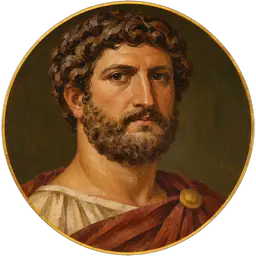
Hadrian
Hadrian, like Trajan, came from Italica in Spain, says Appian, who lived under him; Eutropius, writing in the fourth century, calls him the son of Trajan's cousin and says he took the empire through the efforts of Trajan's wife Plotina, since Trajan had neither wished it nor adopted him.1 Eutropius says he gave up Trajan's provinces beyond the Euphrates and was kept by his friends from abandoning Dacia; he kept the peace, travelled round the whole empire, built much, and was equally brilliant in Latin and in Greek.2 At Athens he dedicated the temple and statue of Olympian Zeus, where every city set up a likeness of him, Pausanias says; Arrian addressed to him his account of a voyage round the Black Sea, recalling that Hadrian too had looked on that sea from Trapezus.3 Appian, writing in his own day, says that Hadrian destroyed Jerusalem once more, as Pompey and Vespasian had.4 The Historia Augusta, written long after and unreliable, says he built a wall eighty miles long across Britain to divide the barbarians from the Romans, and that he wept like a woman for his favourite Antinous, whom he lost while sailing on the Nile.5 He died at Baiae in Campania; the Historia Augusta says he lived sixty-two years and reigned twenty years and eleven months, while Eutropius has him over sixty and reigning twenty-one years and ten months.6
Events
Ties
- succeeded Trajan Eutropius (Greek translation) 8.6
- Antinous favourite of Hadrian Pausanias 8.9.7
- Bar Kokhba rebelled against Hadrian Eusebius, Church History 4.6
- adoptive father of Antoninus Pius Historia Augusta, Antoninus Pius 4.1
What the sources say
“To the Emperor Caesar Trajan Hadrian Augustus, Arrian sends greeting. We came to Trapezus, a Greek city, as the famous Xenophon says, settled by the sea, a colony of Sinope, and we looked gladly on the sea of the Euxine from the very place from which Xenophon, and you too, looked on it.”
Αὐτοκράτορι Καίσαρι Τραϊανῷ Ἀδριανῷ Σεβαστῷ Ἀρριανὸς χαίρειν. ἐς Τραπεζοῦντα ἥκομεν, πόλιν Ἑλληνίδα, ὡς λέγει ὁ Ξενοφῶν ἐκεῖνος, ἐπὶ θαλάσσῃ ᾠκισμένην, Σινωπέων ἄποικον, καὶ τὴν θάλασσαν τὴν τοῦ Εὐξείνου ἄσμενοι κατείδομεν ὅθενπερ καὶ Ξενοφῶν καὶ σύ
Arrian, Voyage round the Black Sea 1.1 · AI translation (Claude)
“Hadrian the Roman emperor dedicated the temple and the statue, one worth seeing, which in size exceeds all other statues save the colossi at Rhodes and Rome, and is made of ivory and gold with an artistic skill which is remarkable when the size is taken into account—before the entrance, I say, stand statues of Hadrian, two of Thasian stone, two of Egyptian. Before the pillars stand bronze statues which the Athenians call “colonies.” The whole circumference of the precincts is about four stades, and they are full of statues; for every city has dedicated a likeness of the emperor Hadrian”
Ἀδριανὸς ὁ Ῥωμαίων βασιλεὺς τόν τε ναὸν ἀνέθηκε καὶ τὸ ἄγαλμα θέας ἄξιον, οὗ μεγέθει μέν, ὅτι μὴ Ῥοδίοις καὶ Ῥωμαίοις εἰσὶν οἱ κολοσσοί, τὰ λοιπὰ ἀγάλματα ὁμοίως ἀπολείπεται, πεποίηται δὲ ἔκ τε ἐλέφαντος καὶ χρυσοῦ καὶ ἔχει τέχνης εὖ πρὸς τὸ μέγεθος ὁρῶσιν—, ἐνταῦθα εἰκόνες Ἀδριανοῦ δύο μέν εἰσι Θασίου λίθου, δύο δὲ Αἰγυπτίου· χαλκαῖ δὲ ἑστᾶσι πρὸ τῶν κιόνων ἃς Ἀθηναῖοι καλοῦσιν ἀποίκους πόλεις. ὁ μὲν δὴ πᾶς περίβολος σταδίων μάλιστα τεσσάρων ἐστίν, ἀνδριάντων δὲ πλήρης· ἀπὸ γὰρ πόλεως ἑκάστης εἰκὼν Ἀδριανοῦ βασιλέως ἀνάκειται
Pausanias 1.18.6 · tr. W.H.S. Jones
“The Jewish nation still resisted, and Pompey conquered them, sent their king, Aristobulus, to Rome, and destroyed their greatest, and to them holiest, city, Jerusalem, as Ptolemy, the first king of Egypt, had formerly done. It was afterward rebuilt and Vespasian destroyed it again, and Hadrian did the same in our time”
ἓν δὲ γένος ἔτι τὸ Ἰουδαίων ἐνιστάμενον ὁ Πομπήιος ἐξεῖλε κατὰ κράτος, καὶ τὸν βασιλέα Ἀριστόβουλον ἔπεμψεν ἐς Ῥώμην, καὶ τὴν μεγίστην πόλιν Ἱεροσόλυμα καὶ ἁγιωτάτην αὐτοῖς κατέσκαψεν, ἣν δὴ καὶ Πτολεμαῖος ὁ πρῶτος Αἰγύπτου βασιλεὺς καθῃρήκει, καὶ Οὐεσπασιανὸς αὖθις οἰκισθεῖσαν κατέσκαψε, καὶ Ἀδριανὸς αὖθις ἐπʼ ἐμοῦ
Appian, Syrian Wars 8.50 · tr. Horace White
First named
The earliest text in the library that names Hadrian, written about AD 131 (a modern estimate of when it was written):
“To the Emperor Caesar Trajan Hadrian Augustus, Arrian sends greeting. We came to Trapezus, a Greek city, as the famous Xenophon says, settled by the sea, a colony of Sinope, and we looked gladly on the sea of the Euxine from the very place from which Xenophon, and you too, looked on it.”
Αὐτοκράτορι Καίσαρι Τραϊανῷ Ἀδριανῷ Σεβαστῷ Ἀρριανὸς χαίρειν. ἐς Τραπεζοῦντα ἥκομεν, πόλιν Ἑλληνίδα, ὡς λέγει ὁ Ξενοφῶν ἐκεῖνος, ἐπὶ θαλάσσῃ ᾠκισμένην, Σινωπέων ἄποικον, καὶ τὴν θάλασσαν τὴν τοῦ Εὐξείνου ἄσμενοι κατείδομεν ὅθενπερ καὶ Ξενοφῶν καὶ σύ
Arrian, Voyage round the Black Sea 1.1 · AI translation (Claude)
Found by searching every text in the library for these spellings and reading the earliest hits to rule out namesakes: Hadrianus, Hadriani, Hadriano, Hadrianum, Hadrian, Adrian, Adrianus, Ἁδριανός, Ἁδριανοῦ, Ἁδριανῷ, Ἁδριανόν, Ἀδριανός, Ἀδριανοῦ, Ἀδριανῷ, Ἀδριανόν. Texts lost, or not in the library, may name Hadrian earlier.
The passages behind each sentence
- Appian, Wars in Spain 7.38 (tr. Horace White); Eutropius (Greek translation) 8.6 (AI translation (Claude)) ↩
- Eutropius (Greek translation) 8.6 (AI translation (Claude)); Eutropius (Greek translation) 8.7 (AI translation (Claude)) ↩
- Pausanias 1.18.6 (tr. W.H.S. Jones); Arrian, Voyage round the Black Sea 1.1 (AI translation (Claude)) ↩
- Appian, Syrian Wars 8.50 (tr. Horace White) ↩
- Historia Augusta, Hadrian 11.1 (AI translation (Claude)); Historia Augusta, Hadrian 14.1 (AI translation (Claude)) ↩
- Historia Augusta, Hadrian 25.1 (AI translation (Claude)); Eutropius (Greek translation) 8.7 (AI translation (Claude)) ↩
Cite this page
MLA “Hadrian.” Atlas of Ancient History, Skirnir Studios, 2026, history.skirnirstudios.com/people/hadrian/.
APA Skirnir Studios. (2026). Hadrian. Atlas of Ancient History. https://history.skirnirstudios.com/people/hadrian/
Chicago “Hadrian.” Atlas of Ancient History. Skirnir Studios, 2026. https://history.skirnirstudios.com/people/hadrian/.
The atlas was written by AI from the ancient sources. Where you can, cite the ancient passage itself by its reference (Herodotus 7.228, Livy 22.7.3) and name the translation you read.