Atlas of Ancient History › People › The Hellenistic world
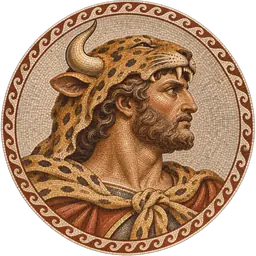
Seleucus I
Seleucus was one of Alexander's Companions: he crossed the river against Porus in the king's own boat and led the phalanx in the battle, and at Susa Alexander married him to the daughter of Spitamenes the Bactrian.1 Nepos says he was one of the two men who killed Perdiccas in Egypt, and in the new division Babylonia was given to him.2 Driven out by Antigonus, he fled to Ptolemy and helped him defeat Demetrius at Gaza.3 He rode back to Babylon with a small force and most of the people came over to him; Uruk scribes dated their documents by 'Seleucus the king'.4 He crossed the Indus and made peace and a marriage alliance with the Indian king Sandrocottus, giving him land for five hundred elephants, and with Lysimachus he defeated and killed Antigonus at Ipsus.5 Having beaten Lysimachus, he crossed into Europe and was murdered near Lysimachia by Ptolemy Ceraunus, whom he had taken in; he was seventy-three.6
Events
Ties
- killed Perdiccas Nepos, Eumenes 5.1
- Ptolemy I fought beside Seleucus I Diodorus 19.85.3
- Ptolemy Ceraunus murdered Seleucus I Appian, Syrian Wars 10.62
- made a treaty and marriage alliance with Sandrocottus (Chandragupta) Strabo 15.2.9
- defeated and killed Lysimachus Appian, Syrian Wars 10.62
- defeated and killed Antigonus the One-Eyed Lucian (attributed), Long Lives 11
- held captive Demetrius the Besieger Plutarch, Demetrius 52
What the sources say
“and with him went Ptolemy, Perdiccas and Lysimachus, the bodyguards, and Seleucus of the Companions, the one who was afterwards king”
καὶ ἅμα αὐτῷ Πτολεμαῖός τε καὶ Περδίκκας καὶ Λυσίμαχος οἱ σωματοφύλακες καὶ Σέλευκος τῶν ἑταίρων, ὁ βασιλεύσας ὕστερον
Arrian, Anabasis 5.13.1 · AI translation (Claude)
“7th day, 9th year, Seleucus the king.”
U₄ 7-KAM₂ MU 9-KAM₂ {m}si-lu-ku LUGAL
Uruk legal text (SpTU 5, 310) r 6' · tr. the GKAB Project (Philippe Clancier, Eleanor Robson and others) - CC BY-SA 3.0
“The last war that he waged was with Lysimachus, for the possession of Phrygia on the Hellespont. Lysimachus was defeated and slain in battle. Then Seleucus crossed the Hellespont in order to possess himself of Lysimacheia, but he was killed by Ptolemy Ceraunus who accompanied him. This Ceraunus was the son of Ptolemy Soter and Euridice, the daughter of Antipater. He had left Egypt from fear, because his father had decided to leave the kingdom to his youngest son. Seleucus had received him as the unfortunate son of his friend, and thus he supported, and took around with himself everywhere, his own murderer”
καὶ πόλεμον τελευταῖον Λυσιμάχῳ περὶ Φρυγίαν τὴν ἐφʼ Ἑλλησπόντῳ πολεμῶν, Λυσιμάχου μὲν ἐκράτει πεσόντος ἐν τῇ μάχῃ, αὐτὸς δὲ τὸν Ἑλλήσποντον ἐπέρα. καὶ ἐς Λυσιμάχειαν ἀναβαίνων κτείνεται. Πτολεμαῖος δʼ αὐτὸν ἑπόμενος ἔκτεινεν, ὅτῳ κεραυνὸς ἐπίκλησις. υἱὸς δʼ ἦν ὁ κεραυνος ὅδε Πτολεμαίου τοῦ σωτῆρος καὶ Εὐρυδίκης τῆς Ἀντιπάτρου· καὶ αὐτὸν ἐκπεσόντα Αἰγύπτου διὰ δέος, ὅτι νεωτάτῳ παιδὶ ὁ Πτολεμαῖος τὴν ἀρχὴν ἐπενόει δοῦναι, ὁ Σέλευκος οἷα φίλου παῖδα ἀτυχοῦντα ὑπεδέξατο, καὶ ἔφερβε καὶ ἐπήγετο πάντῃ φονέα ἑαυτοῦ
Appian, Syrian Wars 10.62 · tr. Horace White
“But Seleucus Nicator gave them to Sandrocottus in consequence of a marriage contract, and received in return five hundred elephants”
ἔδωκε δὲ Σέλευκος ὁ Νικάτωρ Σανδροκόττῳ, συνθέμενος ἐπιγαμίαν καὶ ἀντιλαβὼν ἐλέφαντας πεντακοσίους
Strabo 15.2.9 · tr. Hans Claude Hamilton
First named
The earliest text in the library that names Seleucus I, written about 303 BC (a modern estimate of when it was written):
“7th day, 9th year, Seleucus the king.”
U₄ 7-KAM₂ MU 9-KAM₂ {m}si-lu-ku LUGAL
Uruk legal text (SpTU 5, 310) r 6' · tr. the GKAB Project (Philippe Clancier, Eleanor Robson and others) - CC BY-SA 3.0
Found by searching every text in the library for these spellings and reading the earliest hits to rule out namesakes: Σέλευκος, Seleucus, Si-lu-ku. Texts lost, or not in the library, may name Seleucus I earlier.
The passages behind each sentence
- Arrian, Anabasis 5.13.1 (AI translation (Claude)); Arrian, Anabasis 5.16 (AI translation (Claude)); Arrian, Anabasis 7.4 (AI translation (Claude)) ↩
- Nepos, Eumenes 5.1 (AI translation (Claude)); Diodorus 18.39.6 (AI translation (Claude)) ↩
- Diodorus 19.55.5 (AI translation (Claude)); Diodorus 19.85.3 (AI translation (Claude)) ↩
- Diodorus 19.90.1 (AI translation (Claude)); Diodorus 19.91.1 (AI translation (Claude)); Uruk legal text (SpTU 5, 310) r 6' (tr. the GKAB Project (Philippe Clancier, Eleanor Robson and others) - CC BY-SA 3.0) ↩
- Appian, Syrian Wars 9.55 (tr. Horace White); Strabo 15.2.9 (tr. Hans Claude Hamilton); Appian, Syrian Wars 9.55 (tr. Horace White) ↩
- Appian, Syrian Wars 10.62 (tr. Horace White); Appian, Syrian Wars 10.63 (tr. Horace White) ↩
Cite this page
MLA “Seleucus I.” Atlas of Ancient History, Skirnir Studios, 2026, history.skirnirstudios.com/people/seleucus-i/.
APA Skirnir Studios. (2026). Seleucus I. Atlas of Ancient History. https://history.skirnirstudios.com/people/seleucus-i/
Chicago “Seleucus I.” Atlas of Ancient History. Skirnir Studios, 2026. https://history.skirnirstudios.com/people/seleucus-i/.
The atlas was written by AI from the ancient sources. Where you can, cite the ancient passage itself by its reference (Herodotus 7.228, Livy 22.7.3) and name the translation you read.