Atlas of Ancient History › People › The Hellenistic world
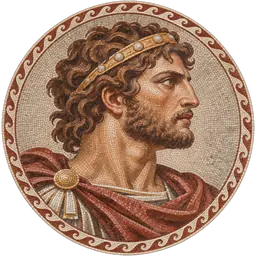
Perseus
Perseus, the son Philip V left, inherited his kingdom and his hatred of the Romans, but Plutarch says he was not equal to the burden, and that avarice was the chief of his faults.1 Beaten at Pydna by Aemilius Paullus, he fled from the field, and when he was finally taken he threw himself at Aemilius' feet with cries that the Roman could not bear to hear.2 He begged not to be led in the triumph, but walked behind his children in a dark robe, dazed by his misfortunes.3 Kept under guard in Italy, he starved himself to death, most writers said, though some told of a stranger end.4
Events
Ties
- Philip V father of Perseus Plutarch, Aemilius Paulus 8
- Aemilius Paullus defeated and led in triumph Perseus Plutarch, Aemilius Paulus 34.3
What the sources say
“The son, however, whom he left, Perseus, along with his father’s kingdom, inherited his hatred of the Romans, but was not equal to the burden because of the littleness and baseness of his character, in which, among all sorts of passions and distempers, avarice was the chief trait”
ὃ δὲ ἀπολειπόμενος υίὸς αὐτοῦ Περσεὺς ἅμα τῇ βασιλείᾳ διεδέξατο τὴν πρὸς Ῥωμαίους ἔχθραν, οὐκ ὢν ἐχέγγυος ἐνεγκεῖν διὰ μικρότητα καὶ μοχθηρίαν ἤθους, ἐν ᾧ παθῶν τε παντοδαπῶν καὶ νοσημάτων ἐνόντων ἐπρώτευεν ἡ φιλαργυρία
Plutarch, Aemilius Paulus 8.10 · tr. Bernadotte Perrin
“Behind the children and their train of attendants walked Perseus himself, clad in a dark robe and wearing the high boots of his country, but the magnitude of his evils made him resemble one who is utterly dumbfounded and bewildered”
αὐτὸς δὲ τῶν τέκνων ὁ Περσεὺς καὶ τῆς περὶ αὐτὰ θεραπείας κατόπιν ἐπορεύετο, φαιὸν μὲν ἱμάτιον ἀμπεχόμενος καὶ κρηπῖδας ἔχων ἐπιχωρίους, ὑπὸ δὲ μεγέθους τῶν κακῶν πάντα θαμβοῦντι καὶ παραπεπληγμένῳ μάλιστα τὸν λογισμὸν ἐοικώς
Plutarch, Aemilius Paulus 34.1 · tr. Bernadotte Perrin
“But for Perseus, although he pitied him for his changed lot and was very eager to help him, he could obtain no other favour than a removal from the prison which the Romans called carcer to a clean place and kindlier treatment; and there, being closely watched, according to most writers the king starved himself to death. But some tell of a very unusual and peculiar way in which he died”
τῷ δὲ Περσεῖ, καίπερ οἰκτείρας τὴν μεταβολὴν καὶ μάλα βοηθῆσαι προθυμηθείς, οὐδὲν εὕρετο πλὴν μεταστάσεως ἐκ τοῦ καλουμένου κάρκερε παρʼ αὐτοῖς εἰς τόπον καθαρὸν καὶ φιλανθρωποτέραν δίαιταν, ὅπου φρουρούμενος, ὡς μὲν οἱ πλεῖστοι γεγράφασιν, ἀπεκαρτέρησεν, ἔνιοι δὲ τῆς τελευτῆς ἴδιόν τινα καὶ παρηλλαγμένον τρόπον ἱστοροῦσι
Plutarch, Aemilius Paulus 37.2 · tr. Bernadotte Perrin
First named
The earliest text in the library that names Perseus, written about 150 BC (a modern estimate of when it was written):
“I mean first, Lucius Aemilius who conquered Perseus, and won the kingdom of Macedonia”
Λεύκιος μὲν γὰρ Αἰμίλιος ὁ Περσέα νικήσας, κύριος γενόμενος τῆς Μακεδόνων βασιλείας
Polybius 18.35 · tr. Evelyn S. Shuckburgh
Found by searching every text in the library for these spellings and reading the earliest hits to rule out namesakes: Περσεύς, Perseus, Perses. Texts lost, or not in the library, may name Perseus earlier.
The passages behind each sentence
Cite this page
MLA “Perseus.” Atlas of Ancient History, Skirnir Studios, 2026, history.skirnirstudios.com/people/perseus/.
APA Skirnir Studios. (2026). Perseus. Atlas of Ancient History. https://history.skirnirstudios.com/people/perseus/
Chicago “Perseus.” Atlas of Ancient History. Skirnir Studios, 2026. https://history.skirnirstudios.com/people/perseus/.
The atlas was written by AI from the ancient sources. Where you can, cite the ancient passage itself by its reference (Herodotus 7.228, Livy 22.7.3) and name the translation you read.