Atlas of Ancient History › People › The late Republic
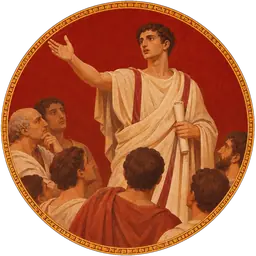
Tiberius Gracchus
Tiberius Gracchus was a son of Tiberius Gracchus and Cornelia, Scipio Africanus' daughter, and served in Africa under the younger Scipio, who had married his sister.1 His brother Gaius wrote that the empty Etruscan countryside, worked by imported slaves, first turned him to the land question, and the people wrote on walls and monuments calling on him to recover the public land for the poor.2 As tribune he proposed again that no one should hold more than 500 iugera of public land, and that the rest should be shared among the poor by three commissioners.3 When his colleague Marcus Octavius vetoed the law, Tiberius had the tribes vote Octavius out of office, and the land law was passed; the first commissioners were Tiberius himself, his father-in-law Appius Claudius and his brother Gaius.4 When he sought to be tribune again, Scipio Nasica led a crowd of senators to the Capitol, where Tiberius and more than three hundred of his followers were clubbed to death, and their bodies were thrown into the river.5 Cicero dates the killing by the consuls Publius Mucius and Lucius Calpurnius (133 BC); he praised both brothers for settling the people on public land, but also held up Nasica's deed as a precedent against Catiline.6
Open Tiberius Gracchus in the atlas
Events
Ties
- Cornelia, mother of the Gracchi mother of Tiberius Gracchus Plutarch, Tiberius Gracchus Tiberius.1.5
- brother of Gaius Gracchus Plutarch, Tiberius Gracchus Tiberius.13.1
- Scipio Aemilianus brother-in-law of Tiberius Gracchus Plutarch, Tiberius Gracchus Tiberius.4.4
- Scipio Aemilianus approved the killing of Tiberius Gracchus Plutarch, Tiberius Gracchus Tiberius.21.4
What the sources say
“for Tiberius, striving to support a measure which was honourable and just with an eloquence that would have adorned even a meaner cause, was formidable and invincible, whenever, with the people crowding around the rostra, he took his stand there and pleaded for the poor. The wild beasts that roam over Italy, he would say, have every one of them a cave or lair to lurk in … but the men who fight and die for Italy enjoy the common air and light, indeed, but nothing else; houseless and homeless they wander about with their wives and children”
ὁ γὰρ Τιβέριος πρὸς καλὴν ὑπόθεσιν καὶ δικαίαν ἀγωνιζόμενος λόγῳ καὶ φαυλότερα κοσμῆσαι δυναμένῳ πράγματα δεινὸς ἦν καὶ ἄμαχος, ὁπότε τοῦ δήμου τῷ βήματι περικεχυμένου καταστὰς λέγοι περὶ τῶν πενήτων, ὡς τὰ μὲν θηρία τὰ τὴν Ἰταλίαν νεμόμενα καὶ φωλεὸν ἔχει καὶ κοιταῖόν ἐστιν αὐτῶν ἑκάστῳ καὶ καταδύσεις … τοῖς δὲ ὑπὲρ τῆς Ἰταλίας μαχομένοις καὶ ἀποθνῄσκουσιν ἀέρος καὶ φωτός, ἄλλου δὲ οὐδενὸς μέτεστιν, ἀλλʼ ἄοικοι καὶ ἀνίδρυτοι μετὰ τέκνων πλανῶνται καὶ γυναικῶν
Plutarch, Tiberius Gracchus Tiberius.9 · tr. Bernadotte Perrin
“So perished on the Capitol, and while still tribune, Gracchus, the son of the Gracchus who was twice consul, and of Cornelia, daughter of that Scipio who subjugated Carthage. He lost his life in consequence of a most excellent design, which, however, he pursued in too violent a manner”
οὕτω μὲν δὴ Γράκχος, ὁ Γράκχου τοῦ δὶς ὑπατεύσαντος καὶ Κορνηλίας τῆς Σκιπίωνος τοῦ Καρχηδονίους τὴν ἡγεμονίαν ἀφελομένου παῖς, ἀρίστου βουλεύματος ἕνεκα, βιαίως αὐτῷ προσιών, ἀνῄρητο ἔτι δημαρχῶν ἐν τῷ Καπιτωλίῳ
Appian, Civil Wars 1.2.17 · tr. Horace White
“What? Did not that most illustrious man, Publius Scipio, the Pontifex Maximus, in his capacity of a private citizen, put to death Tiberius Gracchus, though but slightly undermining the constitution? And shall we, who are the consuls, tolerate Catiline, openly desirous to destroy the whole world with fire and slaughter”
an vero vir amplissimus, P. Scipio, pontifex maximus, Ti. Gracchum mediocriter labefactantem statum rei publicae privatus interfecit: Catilinam orbem terrae caede atque incendiis vastare cupientem nos consules perferemus
Cicero, Against Catiline 1.3 · tr. Charles Duke Yonge
First named
The earliest text in the library that names Tiberius Gracchus, written about 88 BC (a modern estimate of when it was written):
“This did not escape that Cato of ours, nor Laelius, nor, to speak truly, their pupil Africanus, nor the Gracchi, grandsons of Africanus”
quod nostrum illum non fugit Catonem neque Laelium neque eorum, ut vere dicam, discipulum Africanum neque Gracchos Africani nepotes
Cicero, De Inventione 1.5 · AI translation (Claude)
Found by searching every text in the library for these spellings and reading the earliest hits to rule out namesakes: Τιβέριος Γράκχος, Τιβέριος, Γράκχος, Tiberius Gracchus, Ti. Gracchus, Gracchus, Gracchi. Texts lost, or not in the library, may name Tiberius Gracchus earlier.
The passages behind each sentence
- Appian, Civil Wars 1.2.17 (tr. Horace White); Plutarch, Tiberius Gracchus Tiberius.1.5 (tr. Bernadotte Perrin); Plutarch, Tiberius Gracchus Tiberius.4.4 (tr. Bernadotte Perrin) ↩
- Plutarch, Tiberius Gracchus Tiberius.8.7 (tr. Bernadotte Perrin) ↩
- Appian, Civil Wars 1.1.9 (tr. Horace White) ↩
- Appian, Civil Wars 1.1.12 (tr. Horace White); Plutarch, Tiberius Gracchus Tiberius.13.1 (tr. Bernadotte Perrin); Appian, Civil Wars 1.1.13 (tr. Horace White) ↩
- Plutarch, Tiberius Gracchus Tiberius.19.3 (tr. Bernadotte Perrin); Plutarch, Tiberius Gracchus Tiberius.19.6 (tr. Bernadotte Perrin); Plutarch, Tiberius Gracchus Tiberius.20.2 (tr. Bernadotte Perrin) ↩
- Cicero, Against Verres 2.4.108 (tr. Charles Duke Yonge); Cicero, On the Agrarian Law 2.10 (tr. Charles Duke Yonge); Cicero, Against Catiline 1.3 (tr. Charles Duke Yonge) ↩
Cite this page
MLA “Tiberius Gracchus.” Atlas of Ancient History, Skirnir Studios, 2026, history.skirnirstudios.com/people/tiberius-gracchus/.
APA Skirnir Studios. (2026). Tiberius Gracchus. Atlas of Ancient History. https://history.skirnirstudios.com/people/tiberius-gracchus/
Chicago “Tiberius Gracchus.” Atlas of Ancient History. Skirnir Studios, 2026. https://history.skirnirstudios.com/people/tiberius-gracchus/.
The atlas was written by AI from the ancient sources. Where you can, cite the ancient passage itself by its reference (Herodotus 7.228, Livy 22.7.3) and name the translation you read.