Atlas of Ancient History › People › Archaic Greece and Persia
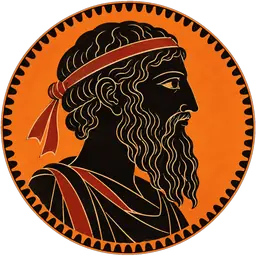
Pythagoras
Heraclitus of Ephesus wrote that Pythagoras son of Mnesarchus pursued inquiry more than any other man, then made a wisdom of his own from the writings he gathered: 'much learning, bad craft'.1 Herodotus calls him one of the greatest Greek teachers, and heard from the Greeks of the Hellespont that the Thracian Salmoxis had once been his slave on Samos.2 Diogenes Laertius says he left Samos because of the tyranny of Polycrates and sailed to Croton in Italy, where he gave laws to the Italian Greeks and his followers, about three hundred of them, ran the city's affairs.3 The poet Xenophanes wrote of his belief that souls pass from body to body: passing a puppy that was being beaten, Pythagoras is said to have cried out that it held the soul of a friend whose voice he knew.4 Plato says he was especially loved for the way of life he taught, which his followers still called Pythagorean, and Aristotle that the Greeks of Italy honoured him.5 Accounts of his death disagree: some said he was cut down at Croton after refusing to cross a field of beans, Dicaearchus that he starved himself in the temple of the Muses at Metapontum; Diogenes says he flourished in the 60th Olympiad.6
Events
Ties
- Milon of Croton companion of Pythagoras Strabo 6.1.12
- left Samos under the tyranny of Polycrates Strabo 14.1.16
What the sources say
“Pythagoras son of Mnesarchus practised inquiry most of all men, and choosing out these writings he made a wisdom of his own: much learning, bad craft.”
Πυθαγόρης Μνησάρχου ἱστορίην ἤσκησεν ἀνθρώπων μάλιστα πάντων καὶ ἐκλεξάμενος ταύτας τὰς συγ γραφὰς ἐποιήσατο ἑαυτοῦ σοφίην, πολυμαθείην, κακοτε χνίην
Heraclitus, fragment 129 · AI translation (Claude)
Preserved by Diogenes Laertius (8.6).
“Xenophanes confirms the statement about his having been different people at different times in the elegiacs beginning: Now other thoughts, another path, I show. What he says of him is as follows: They say that, passing a belaboured whelp, He, full of pity, spake these words of dole: Stay, smite not ! ’Tis a friend, a human soul; I knew him straight whenas I heard him yelp”
Ξενοφάνης ἐν ἐλεγείᾳ προσμαρτυρεῖ, ἧς ἀρχή, νῦν αὖτʼ ἄλλον ἔπειμι λόγον, δείξω δὲ κέλευθον. ὃ δὲ περὶ αὐτοῦ φησιν, οὕτως ἔχει· καί ποτέ μιν στυφελιζομένου σκύλακος παριόντα φασὶν ἐποικτῖραι καὶ τόδε φάσθαι ἔπος· παῦσαι μηδὲ ῥάπιζʼ, ἐπεὶ ἦ φίλου ἀνέρος ἐστὶ ψυχή, τὴν ἔγνων φθεγξαμένης ἀΐων
Diogenes Laertius 8.1.36 · translator not recorded
“then, after being freed and gaining great wealth, he returned to his own country. Now the Thracians were a poor and backward people, but this Salmoxis knew Ionian ways and a more advanced way of life than the Thracian; for he had consorted with Greeks, and moreover with one of the greatest Greek teachers, Pythagoras;”
ἐνθεῦτεν δὲ αὐτὸν γενόμενον ἐλεύθερον χρήματα κτήσασθαι μεγάλα, κτησάμενον δὲ ἀπελθεῖν ἐς τὴν ἑωυτοῦ. ἅτε δὲ κακοβίων τε ἐόντων τῶν Θρηίκων καὶ ὑπαφρονεστέρων, τὸν Σάλμοξιν τοῦτον ἐπιστάμενον δίαιτάν τε Ἰάδα καὶ ἤθεα βαθύτερα ἢ κατὰ Θρήικας, οἷα Ἕλλησι τε ὁμιλήσαντα καὶ Ἑλλήνων οὐ τῷ ἀσθενεστάτῳ σοφιστῇ Πυθαγόρῃ,
Herodotus 4.95.2 · tr. A. D. Godley
First named
The earliest text in the library that names Pythagoras, written about 500 BC (a modern estimate of when it was written):
“Much learning does not teach understanding; otherwise it would have taught Hesiod and Pythagoras, and Xenophanes and Hecataeus too.”
πολυμαθίη νόον ἔχειν οὐ διδάσκει· Ἡσίοδον γὰρ ἂν ἐδίδαξε καὶ Πυθαγόρην αὖτίς τε Ξενοφάνεά τε καὶ Ἑκαταῖον
Heraclitus, fragment 40 · AI translation (Claude)
Heraclitus' own words. Quoted by Diogenes Laertius, Lives of the Philosophers, about AD 230.
Found by searching every text in the library for these spellings and reading the earliest hits to rule out namesakes: Πυθαγόρας, Πυθαγόρης, Pythagoras. Texts lost, or not in the library, may name Pythagoras earlier.
The passages behind each sentence
- Heraclitus, fragment 129 (AI translation (Claude)); Heraclitus, fragment 40 (AI translation (Claude)) ↩
- Herodotus 4.95.1 (tr. A. D. Godley); Herodotus 4.95.2 (tr. A. D. Godley) ↩
- Diogenes Laertius 8.1.3.1 (translator not recorded) ↩
- Diogenes Laertius 8.1.36 (translator not recorded) ↩
- Plato, Republic 10.600 (tr. Paul Shorey); Aristotle, Rhetoric 2.23.11 (tr. John Henry Freese) ↩
- Diogenes Laertius 8.1.39.1 (translator not recorded); Diogenes Laertius 8.1.40.1 (translator not recorded); Diogenes Laertius 8.1.45.2 (translator not recorded) ↩
Cite this page
MLA “Pythagoras.” Atlas of Ancient History, Skirnir Studios, 2026, history.skirnirstudios.com/people/pythagoras/.
APA Skirnir Studios. (2026). Pythagoras. Atlas of Ancient History. https://history.skirnirstudios.com/people/pythagoras/
Chicago “Pythagoras.” Atlas of Ancient History. Skirnir Studios, 2026. https://history.skirnirstudios.com/people/pythagoras/.
The atlas was written by AI from the ancient sources. Where you can, cite the ancient passage itself by its reference (Herodotus 7.228, Livy 22.7.3) and name the translation you read.