Atlas of Ancient History › People › The Hellenistic world
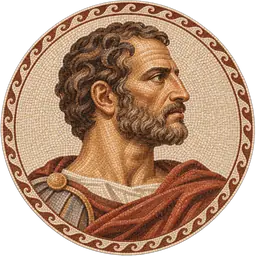
Polybius
Polybius, son of the Achaean general Lycortas of Megalopolis, carried the urn of Philopoemen in his funeral procession as a young man.1 The Achaeans chose him, though still under the legal age, as an envoy to Ptolemy with his father Lycortas and Aratus' son.2 Among the Achaeans held at Rome, he stayed in the city at the request of Aemilius Paullus' sons Fabius and Scipio, and his friendship with Scipio, which began with the loan of some books, became famous.3 He was with Scipio at the fall of Carthage, and Appian says Polybius wrote down Scipio's tears and his words about Rome's own future as he heard them.4 After the sack of Corinth he persuaded Mummius and the commissioners to leave the statues of Philopoemen standing; at Megalopolis a relief of him carried verses saying he had wandered over every land and sea and calmed Rome's anger against the Greeks.5 He died at eighty-two after a fall from his horse while riding in from his farm, according to the treatise on long lives.6
Events
Ties
- carried the urn of Philopoemen Plutarch, Philopoemen 21
- friend and teacher of Scipio Aemilianus Appian, Punic Wars 19.132
What the sources say
“I promised then that I would relate the origin and manner of the rise and unusually early glory of Scipio’s reputation in Rome; and also how it came about that Polybius became so attached to and intimate with him”
προϋπεσχόμην γὰρ διηγήσασθαι διὰ τί καὶ πῶς ἐπὶ τοσοῦτο προέκοψε καὶ θᾶττον ἢ καθῆκεν ἐξέλαμψεν ἡ τοῦ Σκιπίωνος ἐν τῇ Ῥώμῃ δόξα, σὺν δὲ τούτῳ πῶς ἐπὶ τοσοῦτον αὐξηθῆναι συνέβη τῷ Πολυβίῳ τὴν πρὸς τὸν προειρημένον φιλίαν καὶ συνήθειαν
Polybius 31.23 · tr. Evelyn S. Shuckburgh
“is the figure of a man carved in relief on a slab, Polybius, the son of Lycortas. Elegiac verses are inscribed upon it saying that he roamed over every land and every sea, and that he became the ally of the Itomans and stayed their wrath against the Greek nation”
ἀνὴρ ἐπειργασμένος ἐπὶ στήλῃ, Πολύβιος Λυκόρτα· γέγραπται δὲ καὶ ἐλεγεῖα ἐπʼ αὐτῷ λέγοντα ὡς ἐπὶ γῆν καὶ θάλασσαν πᾶσαν πλανηθείη, καὶ ὅτι σύμμαχος γένοιτο Ῥωμαίων καὶ παύσειεν αὐτοὺς ὀργῆς τῆς ἐς τὸ Ἑλληνικόν
Pausanias 8.30.8 · tr. W.H.S. Jones
The library's copy of this translation reads 'Itomans' here, an import fault: the Greek has Ῥωμαίων, 'Romans'.
“Polybius,son of Lycortas, of Megalopolis, while coming in from his farm to the city, was thrown from his horse, fell ill as a result of it, and died at eighty-two”
Πολύβιος δὲ ὁ Λυκόρτα Μεγαλοπολίτης ἀγρόθεν ἀνελθὼν ἀφʼ ἵππου κατέπεσεν καὶ ἐκ τούτου νοσήσας ἀπέθανεν ἐτῶν δύο καὶ ὀγδοήκοντα
Lucian (attributed), Long Lives 22 · tr. Austin Morris Harmon
First named
The earliest text in the library that names Polybius, written about 150 BC (a modern estimate of when it was written):
“they selected Lycortas, Polybius, and Aratus, son of Aratus of Sicyon”
ταῦτα δὲ βουλευσάμενοι προεχειρίσαντο πρεσβευτὰς Λυκόρταν καὶ Πολύβιον καὶ σὺν τούτοις Ἄρατον, υἱὸν Ἀράτου τοῦ Σικυωνίου
Polybius 24.6.3 · tr. Evelyn S. Shuckburgh
Found by searching every text in the library for these spellings and reading the earliest hits to rule out namesakes: Πολύβιος, Polybius. Texts lost, or not in the library, may name Polybius earlier.
The passages behind each sentence
- Plutarch, Philopoemen 21 (tr. Bernadotte Perrin); Pausanias 8.30.8 (tr. W.H.S. Jones) ↩
- Polybius 24.6.3 (tr. Evelyn S. Shuckburgh) ↩
- Polybius 31.23 (tr. Evelyn S. Shuckburgh); Polybius 31.23 (tr. Evelyn S. Shuckburgh) ↩
- Appian, Punic Wars 19.132 (translator not recorded) ↩
- Polybius 39.3 (tr. Evelyn S. Shuckburgh); Pausanias 8.30.8 (tr. W.H.S. Jones) ↩
- Lucian (attributed), Long Lives 22 (tr. Austin Morris Harmon) ↩
Cite this page
MLA “Polybius.” Atlas of Ancient History, Skirnir Studios, 2026, history.skirnirstudios.com/people/polybius/.
APA Skirnir Studios. (2026). Polybius. Atlas of Ancient History. https://history.skirnirstudios.com/people/polybius/
Chicago “Polybius.” Atlas of Ancient History. Skirnir Studios, 2026. https://history.skirnirstudios.com/people/polybius/.
The atlas was written by AI from the ancient sources. Where you can, cite the ancient passage itself by its reference (Herodotus 7.228, Livy 22.7.3) and name the translation you read.