Atlas of Ancient History › People › The Persian Wars
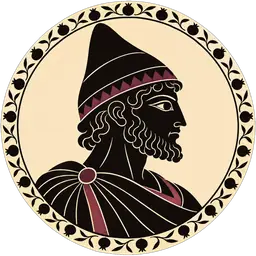
Pausanias
Son of Cleombrotus and nephew of Leonidas.1 As guardian of Leonidas's young son Pleistarchus he led out the Spartan army, and he commanded the Greeks at Plataea, where, in Herodotus's words, he won the most glorious of all the victories we know.2 Thucydides says he later intrigued with the Persian king, hoping to rule all Greece.3 When the ephors moved to arrest him, he took refuge in a small room of the temple of the goddess of the Brazen House, and they walled him in and starved him.4 They carried him out just before he died.5
Events
Ties
- defeated Mardonius Herodotus 9.64.1
- Cleombrotus father of Pausanias Herodotus 9.10.2
- Amompharetus defied Pausanias Herodotus 9.55.2
- Cimon drove from Byzantium Pausanias Plutarch, Cimon 6.5
- father of Pleistoanax Thucydides 1.107.2
What the sources say
“On that day the Spartans, as the oracle had foretold, gained from Mardonius their full measure of vengeance for the slaying of Leonidas, and the most glorious of victories of all which we know was won by Pausanias, the son of Cleombrotus, who was the son of Anaxandrides.”
ἐνθαῦτα ἥ τε δίκη τοῦ Λεωνίδεω κατὰ τὸ χρηστήριον τοῖσι Σπαρτιήτῃσι ἐκ Μαρδονίου ἐπετελέετο, καὶ νίκην ἀναιρέεται καλλίστην ἁπασέων τῶν ἡμεῖς ἴδμεν Παυσανίης ὁ Κλεομβρότου τοῦ Ἀναξανδρίδεω·
Herodotus 9.64.1 · tr. A. D. Godley
First named
The earliest text in the library that names Pausanias, written about 430 BC (a modern estimate of when it was written):
“In this region is a bronze vessel, as much as six times greater than the cauldron dedicated by Pausanias son of Cleombrotus at the entrance of the Pontus.”
ἐν τούτῳ τῷ χώρῳ κέεται χαλκήιον, μεγάθει καὶ ἑξαπλήσιον τοῦ ἐπὶ στόματι τοῦ Πόντου κρητῆρος, τὸν Παυσανίης ὁ Κλεομβρότου ἀνέθηκε.
Herodotus 4.81.3 · tr. A. D. Godley
Found by searching every text in the library for these spellings and reading the earliest hits to rule out namesakes: Παυσανίης, Παυσανίας, Pausanias. Texts lost, or not in the library, may name Pausanias earlier.
The passages behind each sentence
- Herodotus 9.10 (tr. A. D. Godley); Herodotus 8.71.1 (tr. A. D. Godley) ↩
- Herodotus 9.10 (tr. A. D. Godley); Thucydides 1.130.1 (tr. Richard Crawley); Herodotus 9.64.1 (tr. A. D. Godley) ↩
- Thucydides 1.128.3 (tr. Richard Crawley); Thucydides 1.128.7 (tr. Richard Crawley) ↩
- Thucydides 1.134.1 (tr. Richard Crawley); Thucydides 1.134.2 (tr. Richard Crawley) ↩
- Thucydides 1.134.3 (tr. Richard Crawley) ↩
Cite this page
MLA “Pausanias.” Atlas of Ancient History, Skirnir Studios, 2026, history.skirnirstudios.com/people/pausanias/.
APA Skirnir Studios. (2026). Pausanias. Atlas of Ancient History. https://history.skirnirstudios.com/people/pausanias/
Chicago “Pausanias.” Atlas of Ancient History. Skirnir Studios, 2026. https://history.skirnirstudios.com/people/pausanias/.
The atlas was written by AI from the ancient sources. Where you can, cite the ancient passage itself by its reference (Herodotus 7.228, Livy 22.7.3) and name the translation you read.