Atlas of Ancient History › People › The early Empire
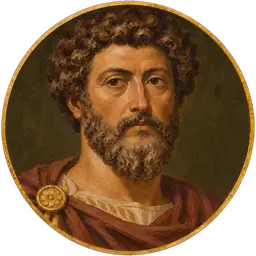
Marcus Aurelius
The Historia Augusta, a late and unreliable source, says Marcus was born at Rome and that Hadrian, who brought him up, called him Verissimus; Justin Martyr addressed his Apology to Antoninus Pius and 'to Verissimus his son, the philosopher'.1 After Antoninus he reigned together with Lucius Verus, says Eutropius, writing in the fourth century, the first time Rome had two emperors at once.2 He fought the Marcomanni and Quadi on the Danube in person: Lucian tells how a false prophet had two lions thrown into the river to win victory, and the Romans then lost about twenty thousand men, and Pausanias says this second Antoninus punished the Germans and the Sarmatians for starting the war.3 He kept a notebook in Greek, To Himself, whose first two books end 'among the Quadi on the Granua' and 'at Carnuntum'; in it he wrote that as Antoninus his city and fatherland was Rome, as a man the world.4 Eutropius says a plague after one victory destroyed almost the whole army, that he sold the palace furnishings rather than raise new taxes for the war, and that he triumphed at Rome with his son Commodus, whom he had made Caesar.5 Herodian says that, old and worn out by toil and cares, he fell gravely ill among the Pannonians and died, mourned by soldiers and people alike; Eutropius puts his death in the eighteenth year of his reign and the sixty-first of his life, and he was deified.6 The Historia Augusta gives the same two figures, but neither fits the years shown here: from his accession in 161 the eighteenth year of his reign is 178 or 179, and from its own date for his birth, 26 April 121, the sixty-first year of his life is 181 or 182; the year 180 is reckoned instead from the length of Commodus' reign, which Zonaras gives.7
Open Marcus Aurelius in the atlas
Events
Ties
- Antoninus Pius adoptive father of Marcus Aurelius Justin Martyr, First Apology 1.1
- father of Commodus Galen, On Prognosis 9.1
- Galen physician to Marcus Aurelius Galen, On Prognosis 9.1
What the sources say
“My nature is rational and civic. My city and fatherland, as Antoninus, is Rome; as a man, the world. So the things that benefit these cities are the only goods for me.”
ἡ δὲ ἐμὴ φύσις λογικὴ καὶ πολιτική. Πόλις καὶ πατρὶς ὡς μὲν Ἀντωνίνῳ μοι ἡ Ῥώμη, ὡς δὲ ἀνθρώπῳ ὁ κόσμος. τὰ ταῖς πόλεσιν οὖν ταύταις ὠφέλιμα μόνα ἐστί μοι ἀγαθά
Marcus Aurelius, Meditations 6.44.2 · AI translation (Claude)
“he published an oracle at the height of the war in Germany, when the late Emperor Marcus himself had at last come to grips with the Marcomanni and Quadi. The oracle recommended that two lions be cast into the Danube alive, together with a quantity of perfumes and magnificent offerings … But when all this had been done as he had directed, the lions swam across to the enemy territory and the barbarians slaughtered them with clubs, thinking them some kind of foreign dogs or wolves; and “amain” that tremendous disaster befel our side, in which a matter of twenty thousand were wiped”
διαπέμπεται χρησμὸν τοῦ ἐν Γερμανίᾳ πολέμου ἀκμάζοντος, ὅτε θεὸς Μάρκος ἤδη τοῖς Μαρκομάνοις καὶ Κουάδοις συνεπλέκετο. ἠξίου δὲ ὁ χρησμὸς δύο λέοντας ἐμβληθῆναι ζῶντας εἰς τὸν Ἴστρον μετὰ πολλῶν ἀρωμάτων καὶ θυσιῶν μεγαλοπρεπῶν … γενομένων δὲ τούτων ὡς προσέταξεν, τοὺς μὲν λέοντας ἐκνηξαμένους εἰς τὴν πολεμίαν οἱ βάρβαροι ξύλοις κατειργάσαντο ὥς τινας κύνας ἢ λύκους ξενικούς· αὐτίκα δὲ τὸ μέγιστον τραῦμα τοῖς ἡμετέροις ἐγένετο, δισμυρίων που σχεδὸν ἀθρόων ἀπολομένων
Lucian, Alexander 48.1 · tr. Austin Morris Harmon
Harmon's English in the library goes on 'wiped [out ata blow', an import fault, so the cut stops at 'wiped'.
“When Marcus died and the news spread, the whole army present and the common people alike were gripped by grief, and there was no one under Roman rule who received such news without tears; all, as if with one voice, called him a good father, a fine emperor, a noble general, a wise and orderly ruler; and no one lied.”
τελευτήσαντος δὲ Μάρκου, ἐπειδὴ διεφοίτησεν ἡ φήμη, πᾶν τε τὸ παρὸν στρατιωτικὸν καὶ τὸ δημῶδες πλῆθος ὁμοίως πένθει κατείχετο, οὐδέ τις ἦν ἀνθρώπων τῶν ὑπὸ τὴν Ῥωμαίων ἀρχὴν ὃς ἀδακρυτὶ τοιαύτην ἀγγελίαν ἐδέχετο: πάντες δ’ ὥσπερ ἐκ μιᾶς φωνῆς, οἳ μὲν πατέρα χρηστόν, οἳ δ’ ἀγαθὸν βασιλέα, γενναῖον δὲ ἕτεροι στρατηγόν, οἳ δὲ σώφρονα καὶ κόσμιον ἄρχοντα ἀνεκάλουν, καὶ οὐδεὶς ἐψεύδετο
Herodian 1.4.8 · AI translation (Claude)
First named
The earliest text in the library that names Marcus Aurelius, written about AD 153 (a modern estimate of when it was written):
“To the Emperor Titus Aelius Hadrianus Antoninus Pius Caesar Augustus, and to Verissimus his son, the philosopher, and to Lucius, son by nature of a philosopher Caesar and by adoption of Pius, a lover of learning”
Αὐτοκράτορι Τίτῳ Αἰλίῳ Ἀδριανῷ Ἀντωνίνῳ Εὐσεβεῖ Καίσαρι Σεβαστῷ καὶ Οὐηρισσίμῳ υἱῷ Φιλισόφῳ, καὶ Λουκίῳ Φιλοσόφου Καίσαρος φύσει υἱῷ καὶ Εὐσεβοῦς εἰσποιητῷ, ἐραστῇ παιδείας
Justin Martyr, First Apology 1.1 · AI translation (Claude)
Found by searching every text in the library for these spellings and reading the earliest hits to rule out namesakes: Marcus Aurelius, Marcus Antoninus, Marcus, Marci, Marco, Marcum, Μάρκος, Μάρκου, Μάρκῳ, Μάρκον, Μάρκῳ Αὐρηλίῳ Ἀντωνίνῳ, Antoninus, Ἀντωνῖνος, Ἀντωνίνου, Ἀντωνίνῳ, Verissimus, Οὐηρίσσιμος, Οὐηρισσίμῳ, Annius Verus. Texts lost, or not in the library, may name Marcus Aurelius earlier.
The passages behind each sentence
- Historia Augusta, Marcus 4.1 (AI translation (Claude)); Justin Martyr, First Apology 1.1 (AI translation (Claude)) ↩
- Eutropius (Greek translation) 8.9 (AI translation (Claude)) ↩
- Lucian, Alexander 48.1 (tr. Austin Morris Harmon); Pausanias 8.43.6 (tr. W.H.S. Jones) ↩
- Marcus Aurelius, Meditations 1.17.9 (AI translation (Claude)); Marcus Aurelius, Meditations 2.17.2 (AI translation (Claude)); Marcus Aurelius, Meditations 6.44.2 (AI translation (Claude)) ↩
- Eutropius (Greek translation) 8.12 (AI translation (Claude)); Eutropius (Greek translation) 8.13 (AI translation (Claude)) ↩
- Herodian 1.3.1 (AI translation (Claude)); Herodian 1.4.8 (AI translation (Claude)); Eutropius (Greek translation) 8.14 (AI translation (Claude)) ↩
- Historia Augusta, Marcus 18.1 (AI translation (Claude)); Historia Augusta, Marcus 1.1 (AI translation (Claude)); Zonaras 12.5.3 (AI translation (Claude)) ↩
Cite this page
MLA “Marcus Aurelius.” Atlas of Ancient History, Skirnir Studios, 2026, history.skirnirstudios.com/people/marcus-aurelius/.
APA Skirnir Studios. (2026). Marcus Aurelius. Atlas of Ancient History. https://history.skirnirstudios.com/people/marcus-aurelius/
Chicago “Marcus Aurelius.” Atlas of Ancient History. Skirnir Studios, 2026. https://history.skirnirstudios.com/people/marcus-aurelius/.
The atlas was written by AI from the ancient sources. Where you can, cite the ancient passage itself by its reference (Herodotus 7.228, Livy 22.7.3) and name the translation you read.