Atlas of Ancient History › People › The early Empire
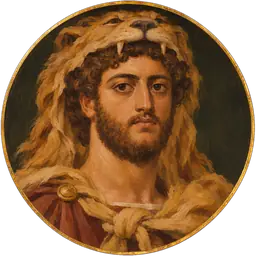
Commodus
Commodus was the son of Marcus Aurelius; the Historia Augusta, a late and unreliable source, says he was born at Lanuvium with a twin brother, and Galen says Marcus left the boy in Rome in his care while he fought the Germans.1 Marcus made him Caesar and triumphed with him at Rome, says Eutropius, writing in the fourth century, and Athenagoras addressed his plea for the Christians to the emperors Marcus Aurelius Antoninus and Lucius Aurelius Commodus together.2 Herodian says that Marcus, falling gravely ill among the Pannonians, feared that his son, just entering youth, would turn from good learning to drink and revelry once he had power; after his father's death Commodus went to the camp, sacrificed and addressed the soldiers.3 In time, Herodian says, he gave up his father's name and had himself called Hercules, son of Zeus, renamed the months of the year after his own titles, and fought naked as a gladiator in the amphitheatre, a grim sight to the people.4 When he planned to go out at the New Year festival from the gladiators' barracks, in arms, instead of from the palace in purple, his mistress Marcia gave him poison, and when he vomited it the plotters had a young athlete named Narcissus strangle him.5 He had reigned thirteen years after his father's death, Herodian says: the best-born of all emperors before him and the handsomest man of his time, second to none in skill of aim and hand, had he not shamed these gifts with disgraceful pursuits.6
Events
Ties
- Marcus Aurelius father of Commodus Galen, On Prognosis 9.1
- Galen physician to Commodus Galen, On Prognosis 9.1
What the sources say
“He went so far in madness and drunken folly that first he refused his father's name, and instead of Commodus, son of Marcus, ordered himself to be called Hercules and son of Zeus; and putting off the dress of the Romans and of an emperor he wore a lion's skin and carried a club in his hands”
ἐς τοσοῦτόν τε μανίας καὶ παροινίας προυχώρησεν ὡς πρῶτον μὲν τὴν πατρῴαν προσηγορίαν παραιτήσασθαι, ἀντὶ δὲ Κομμόδου καὶ Μάρκου υἱοῦ Ἡρακλέα τε καὶ Διὸς υἱὸν αὑτὸν κελεύσας καλεῖσθαι, ἀποδυσάμενός τε τὸ Ῥωμαίων καὶ βασίλειον σχῆμα λεοντῆν ἐπεστρώννυτο, καὶ ῥόπαλον μετὰ χεῖρας φέρων
Herodian 1.14.8 · AI translation (Claude)
“Such was the end of Commodus' life, after he had reigned thirteen years since his father's death: the best-born of the emperors before him, the handsomest man of his time and the best proportioned in body; and if anything must be said of his courage too, second to none in sureness of aim and skill of hand, had he not disgraced these gifts by shameful pursuits, as was said before.”
τοιούτῳ μὲν τέλει τοῦ βίου ὁ Κόμμοδος ἐχρήσατο, βασιλεύσας ἔτη τρισκαίδεκα μετὰ τὴν τοῦ πατρὸς τελευτήν, εὐγενέστατός τε τῶν πρὸ αὐτοῦ γενομένων βασιλέων, κάλλει τε τῶν καθ̓ ἑαυτὸν ἀνθρώπων εὐπρεπέστατος αὐταρκέστατός τε συμμετρίᾳ σώματος, εἰ δέ τι δεῖ καὶ περὶ ἀνδρείας εἰπεῖν, οὐδενὸς ἥττων εὐστοχίᾳ τε καὶ εὐχειρίᾳ, εἰ μὴ τὴν τούτων εὐμοιρίαν αἰσχροῖς ἐπιτηδεύμασι κατῄσχυνεν, ὡς προείρηται.
Herodian 1.17.12 · AI translation (Claude)
“To the Emperors Marcus Aurelius Antoninus and Lucius Aurelius Commodus, conquerors of Armenia and of the Sarmatians, and, greatest of all, philosophers.”
Αὐτοκράτορσιν Μάρκῳ Αὐρηλίῳ Ἀντωνίνῳ καὶ Λουκίῳ Αὐρηλίῳ Κομμόδῳ, Ἀρμενιακοῖς, Σαρματικοῖς, τὸ δὲ μέγιστον Φιλοσόφοις
Athenagoras, Plea for the Christians opener · AI translation (Claude)
First named
The earliest text in the library that names Commodus, written about AD 177 (a modern estimate of when it was written):
“To the Emperors Marcus Aurelius Antoninus and Lucius Aurelius Commodus, conquerors of Armenia and of the Sarmatians, and, greatest of all, philosophers.”
Αὐτοκράτορσιν Μάρκῳ Αὐρηλίῳ Ἀντωνίνῳ καὶ Λουκίῳ Αὐρηλίῳ Κομμόδῳ, Ἀρμενιακοῖς, Σαρματικοῖς, τὸ δὲ μέγιστον Φιλοσόφοις
Athenagoras, Plea for the Christians opener · AI translation (Claude)
Found by searching every text in the library for these spellings and reading the earliest hits to rule out namesakes: Commodus, Commodi, Commodo, Commodum, Commodus Antoninus, Κόμμοδος, Κομμόδου, Κομμόδῳ, Κόμμοδον, Κόμοδος, Κομόδου, Κομόδῳ, Λούκιος Αὐρήλιος Κόμμοδος. Texts lost, or not in the library, may name Commodus earlier.
The passages behind each sentence
- Historia Augusta, Commodus 1.1 (AI translation (Claude)); Galen, On Prognosis 9.1 (AI translation (Claude)) ↩
- Eutropius (Greek translation) 8.13 (AI translation (Claude)); Athenagoras, Plea for the Christians opener (AI translation (Claude)) ↩
- Herodian 1.3.1 (AI translation (Claude)); Herodian 1.5.2 (AI translation (Claude)) ↩
- Herodian 1.14.8 (AI translation (Claude)); Herodian 1.14.9 (AI translation (Claude)); Herodian 1.15.7 (AI translation (Claude)) ↩
- Herodian 1.16.3 (AI translation (Claude)); Herodian 1.17.8 (AI translation (Claude)); Herodian 1.17.11 (AI translation (Claude)) ↩
- Herodian 1.17.12 (AI translation (Claude)) ↩
Cite this page
MLA “Commodus.” Atlas of Ancient History, Skirnir Studios, 2026, history.skirnirstudios.com/people/commodus/.
APA Skirnir Studios. (2026). Commodus. Atlas of Ancient History. https://history.skirnirstudios.com/people/commodus/
Chicago “Commodus.” Atlas of Ancient History. Skirnir Studios, 2026. https://history.skirnirstudios.com/people/commodus/.
The atlas was written by AI from the ancient sources. Where you can, cite the ancient passage itself by its reference (Herodotus 7.228, Livy 22.7.3) and name the translation you read.