Atlas of Ancient History › People › The fourth century
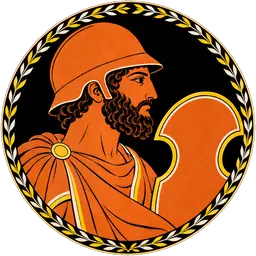
Epaminondas
Epaminondas son of Polymnis came of a good Theban family that had been left poor, and Nepos says the Pythagorean Lysis of Tarentum was his teacher in philosophy.1 He and Pelopidas were close friends; most people, Plutarch says, dated the friendship to a battle at Mantinea, fought on Sparta's side, where Epaminondas stood over the wounded Pelopidas and would not leave him.2 At Leuctra he used a formation of his own devising and won the famous victory over the Spartans.3 Afterwards he led the Thebans and their allies against Sparta itself and persuaded the Arcadians and the other allies to refound Messene, which the Spartans had kept desolate for many years.4 Put on trial for his life for keeping his command beyond the legal term, he asked only, Nepos says, that his tomb should record that he had forced the Thebans to beat the Spartans at Leuctra, and everyone laughed, and no juror dared vote on him at all.5 At Mantinea he was struck in the chest and the spearhead broke off in the wound; told that the Boeotians had won, he ordered it drawn out and died, and Xenophon says that once he had fallen his men could make no use of their victory.6
Events
Ties
What the sources say
“Now the fact that Epaminondas himself entertained such thoughts, seems to me to be in no wise remarkable, — for such thoughts are natural to ambitious men; but that he had brought his army to such a point that the troops flinched from no toil, whether by night or by day, and shrank from no peril, and although the provisions they had were scanty, were nevertheless willing to be obedient, this seems to me to be more remarkable.”
τὸ μὲν οὖν αὐτὸν τοιαῦτα διανοεῖσθαι οὐ πάνυ μοι δοκεῖ θαυμαστὸν εἶναι· φιλοτίμων γὰρ ἀνδρῶν τὰ τοιαῦτα διανοήματα· τὸ μέντοι τὸ στράτευμα παρεσκευακέναι ὡς πόνον τε μηδένα ἀποκάμνειν μήτε νυκτὸς μήτε ἡμέρας, κινδύνου τε μηδενὸς ἀφίστασθαι, σπάνιά τε τἀπιτήδεια ἔχοντας ὅμως πείθεσθαι ἐθέλειν, ταῦτά μοι δοκεῖ θαυμαστότερα εἶναι.
Xenophon, Hellenica 7.5.19 · tr. Carleton L. Brownson
“and when someone said, weeping, 'You die childless, Epaminondas,' he said, 'No, by Zeus, I leave two daughters, the victory at Leuctra and the one at Mantinea.'”
καί τινος εἰπόντος ὅτι τελευτᾷς ἄτεκνος, Ἐπαμεινώνδα, καὶ δακρύσαντος, μὰ Δία μέν, φησίν, ἀλλὰ καταλείπω δύο θυγατέρας, τήν τε ἐν Λεύκτροις νίκην καὶ τὴν ἐν Μαντινείᾳ
Diodorus 15.87.6 · AI translation (Claude)
“But Epaminondas, realizing that he had received a mortal wound and that he would die at once if he drew out the iron that had stayed in his body from the spear shaft, kept it there until word came that the Boeotians had won. When he heard this he said, 'I have lived enough, for I die unconquered.' Then the iron was drawn out and he died at once.”
at Epaminondas, cum animadverteret mortiferum se vulnus accepisse simulque, si ferrum, quod ex hastili in corpore remanserat, extraxisset, animam statim emissurum, usque eo retinuit, quoad renuntiatum est vicisse Boeotos. id postquam audivit, satis' inquit 'vixi: invictus enim morior.' tum ferro extracto confestim exanimatus est
Nepos, Epaminondas 9.1 · AI translation (Claude)
First named
The earliest text in the library that names Epaminondas, written about 355 BC (a modern estimate of when it was written):
“Epaminondas, on the other hand, wishing to bring over the Achaeans to the side of the Thebans, in order that the Arcadians and the other allies might be more inclined to give heed to them, decided that he must march forth against Achaea. He therefore persuaded Peisias, the Argive, who held the position of general at Argos, to occupy Oneum in advance. And Peisias, after he had learned that the guard over Oneum was being maintained carelessly by Naucles, who commanded the mercenary troops of the Lacedaemonians, and by Timomachus, the Athenian, did indeed seize the hill above Cenchreae by night with two thousand hoplites, having provisions for seven days.”
αὖθις δʼ Ἐπαμεινώνδας, βουληθεὶς τοὺς Ἀχαιοὺς προσαγαγέσθαι, ὅπως μᾶλλον σφίσι καὶ οἱ Ἀρκάδες καὶ οἱ ἄλλοι σύμμαχοι προσέχοιεν τὸν νοῦν, ἔγνω ἐκστρατευτέον εἶναι ἐπὶ τὴν Ἀχαΐαν. Πεισίαν οὖν τὸν Ἀργεῖον στρατηγοῦντα ἐν τῷ Ἄργει πείθει προκαταλαβεῖν τὸ Ὄνειον. καὶ ὁ Πεισίας μέντοι καταμαθὼν ἀμελουμένην τὴν τοῦ Ὀνείου φυλακὴν ὑπό τε Ναυκλέους, ὃς ἦρχε τοῦ ξενικοῦ τῶν Λακεδαιμονίων, καὶ ὑπὸ Τιμομάχου τοῦ Ἀθηναίου, καταλαμβάνει νύκτωρ μετὰ δισχιλίων ὁπλιτῶν τὸν ὑπὲρ Κεγχρειῶν λόφον, ἔχων ἑπτὰ ἡμερῶν τὰ ἐπιτήδεια.
Xenophon, Hellenica 7.1.41 · tr. Carleton L. Brownson
Found by searching every text in the library for these spellings and reading the earliest hits to rule out namesakes: Ἐπαμεινώνδας, Ἐπαμινώνδας, Epaminondas, Epameinondas. Texts lost, or not in the library, may name Epaminondas earlier.
The passages behind each sentence
- Nepos, Epaminondas 1.1 (AI translation (Claude)); Nepos, Epaminondas 2.1 (AI translation (Claude)) ↩
- Plutarch, Pelopidas 4.4 (tr. Bernadotte Perrin); Plutarch, Pelopidas 4.5 (tr. Bernadotte Perrin) ↩
- Diodorus 15.55.1 (AI translation (Claude)) ↩
- Diodorus 15.66.1 (AI translation (Claude)); Diodorus 15.65.4 (AI translation (Claude)) ↩
- Nepos, Epaminondas 7.1 (AI translation (Claude)); Nepos, Epaminondas 8.1 (AI translation (Claude)) ↩
- Diodorus 15.87.1 (AI translation (Claude)); Diodorus 15.87.6 (AI translation (Claude)); Xenophon, Hellenica 7.5.25 (tr. Carleton L. Brownson) ↩
Cite this page
MLA “Epaminondas.” Atlas of Ancient History, Skirnir Studios, 2026, history.skirnirstudios.com/people/epaminondas/.
APA Skirnir Studios. (2026). Epaminondas. Atlas of Ancient History. https://history.skirnirstudios.com/people/epaminondas/
Chicago “Epaminondas.” Atlas of Ancient History. Skirnir Studios, 2026. https://history.skirnirstudios.com/people/epaminondas/.
The atlas was written by AI from the ancient sources. Where you can, cite the ancient passage itself by its reference (Herodotus 7.228, Livy 22.7.3) and name the translation you read.