Atlas of Ancient History › People › The fourth century
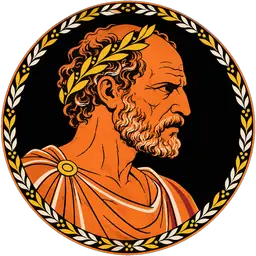
Demosthenes
Demosthenes was the son of a well-off Athenian of the same name, nicknamed the Cutler for his workshop of sword-making slaves; left fatherless at seven, he was cheated by his guardians and later sued them.1 His first speeches in the assembly were jeered for their style and his weak voice, and Demetrius of Phalerum heard from him in old age how he trained his tongue by speaking with pebbles in his mouth.2 The Lives of the Ten Orators says he was thirty-seven when he persuaded the Athenians to send help to Olynthus, then hard pressed by Philip, but in his speech against Meidias, made after the Athenians had given money for Olynthus, he says he is thirty-two.3 At Chaeronea, Plutarch says, he left his post, threw away his shield and ran.4 Ctesiphon's proposal to crown him came to trial in the archonship of Aristophon, and Aeschines, who prosecuted, failed to win a fifth of the votes.5 Condemned over the money of Harpalus and fined, he escaped into exile.6 After Alexander's death Antipater's men found him in the temple of Poseidon at Calauria, where he took poison, and he died on the sixteenth of Pyanepsion.7
Events
Ties
What the sources say
“For his bodily deficiencies he adopted the exercises which I shall describe, as Demetrius the Phalerian tells us, who says he heard about them from Demosthenes himself, now grown old. The indistinctness and lisping in his speech he used to correct and drive away by taking pebbles in his mouth and then reciting speeches.”
τοῖς δὲ σωματικοῖς ἐλαττώμασι τοιαύτην ἐπῆγεν ἄσκησιν, ὡς ὁ Φαληρεύς Δημήτριος ἱστορεῖ, λέγων αὐτοῦ Δημοσθένους ἀκούειν πρεσβύτου γεγονότος, τὴν μὲν ἀσάφειαν καὶ τραυλότητα τῆς γλώττης ἐκβιάζεσθαι καὶ διαρθροῦν εἰς τὸ στόμα ψήφους λαμβάνοντα καὶ ῥήσεις ἅμα λέγοντα,
Plutarch, Demosthenes 11.1 · tr. Bernadotte Perrin
“And Demosthenes, who held the other orators in great contempt, when Phocion rose to speak, was wont to say quietly to his friends: Here comes the pruning-knife of my speeches. But perhaps this must be referred to Phocion’s character; since a word or a nod merely from a good man is of more convincing weight than any number of elaborate periods.”
ὁ δὲ Δημοσθένης τῶν μὲν ἄλλων κατεφρόνει πολὺ ῥητόρων, ἀνισταμένου δὲ Φωκίωνος εἰώθει λέγειν ἀτρέμα πρὸς τοὺς φίλους, ἡ τῶν ἐμῶν λόγων κοπὶς πάρεστιν. ἀλλὰ τοῦτο μὲν ἴσως πρὸς τὸ ἦθος ἀνοιστέον ἐπεὶ καὶ ῥῆμα καὶ νεῦμα μόνον ἀνδρὸς ἀγαθοῦ μυρίοις ἐνθυμήμασι καὶ περιόδοις ἀντίρροπον ἔχει πίστιν.
Plutarch, Phocion 5.4 · tr. Bernadotte Perrin
“Moreover, on learning that Demosthenes had taken sanctuary in the temple of Poseidon at Calauria, Archias sailed across to the island in small boats, and after landing with Thracian spear-men tried to persuade the fugitive to leave the temple and go with him to Antipater, assuring him that he would suffer no harsh treatment.”
τὸν δὲ Δημοσθένην πυθόμενος ἱκέτην ἐν Καλαυρείᾳ ἐν τῷ ἱερῷ Ποσειδῶνος καθέζεσθαι, διαπλεύσας ὑπηρετικοῖς καὶ ἀποβὰς μετὰ Θρᾳκῶν δορυφόρων ἔπειθεν ἀναστάντα βαδίζειν μετʼ αὐτοῦ πρὸς Ἀντίπατρον ὡς δυσχερὲς πεισόμενον οὐδέν.
Plutarch, Demosthenes 29.1 · tr. Bernadotte Perrin
First named
The earliest text in the library that names Demosthenes, written about 362 BC (a modern estimate of when it was written):
“Demosthenes makes the following charges against Aphobus. Aphobus has in his possession moneys of mine, received by him in his capacity as guardian, as follows: eighty minae, which he received as the marriage-portion of my mother in accordance with the terms of my father’s will”
τάδʼ ἐγκαλεῖ Δημοσθένης Ἀφόβῳ· ἔχει μου χρήματʼ Ἄφοβος ἀπʼ ἐπιτροπῆς ἐχόμενα, ὀγδοήκοντα μὲν μνᾶς, ἣν ἔλαβεν προῖκα τῆς μητρὸς κατὰ τὴν διαθήκην τοῦ πατρός
Demosthenes, Against Aphobus III 31 · tr. Augustus Taber Murray
Found by searching every text in the library for these spellings and reading the earliest hits to rule out namesakes: Δημοσθένης, Demosthenes. Texts lost, or not in the library, may name Demosthenes earlier.
The passages behind each sentence
- Plutarch, Demosthenes 4.1 (tr. Bernadotte Perrin); Plutarch, Demosthenes 4.2 (tr. Bernadotte Perrin); Demosthenes, Against Aphobus III 31 (tr. Augustus Taber Murray) ↩
- Plutarch, Demosthenes 6.3 (tr. Bernadotte Perrin); Plutarch, Demosthenes 11.1 (tr. Bernadotte Perrin) ↩
- Plutarch (attributed), Lives of the Ten Orators 8 (tr. Harold North Fowler); Demosthenes, Against Meidias 154 (tr. James Herbert Vince); Demosthenes, Against Meidias 161 (tr. James Herbert Vince) ↩
- Plutarch, Demosthenes 20.2 (tr. Bernadotte Perrin) ↩
- Plutarch, Demosthenes 24.2 (tr. Bernadotte Perrin) ↩
- Plutarch, Demosthenes 26.1 (tr. Bernadotte Perrin); Plutarch, Demosthenes 26.2 (tr. Bernadotte Perrin) ↩
- Plutarch, Demosthenes 29.1 (tr. Bernadotte Perrin); Plutarch, Demosthenes 29.4 (tr. Bernadotte Perrin); Plutarch, Demosthenes 30.4 (tr. Bernadotte Perrin) ↩
Cite this page
MLA “Demosthenes.” Atlas of Ancient History, Skirnir Studios, 2026, history.skirnirstudios.com/people/demosthenes/.
APA Skirnir Studios. (2026). Demosthenes. Atlas of Ancient History. https://history.skirnirstudios.com/people/demosthenes/
Chicago “Demosthenes.” Atlas of Ancient History. Skirnir Studios, 2026. https://history.skirnirstudios.com/people/demosthenes/.
The atlas was written by AI from the ancient sources. Where you can, cite the ancient passage itself by its reference (Herodotus 7.228, Livy 22.7.3) and name the translation you read.