Atlas of Ancient History › People › The Athenian age
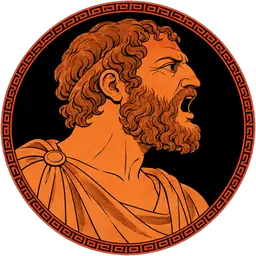
Cleon
Cleon son of Cleaenetus was, Thucydides says, the most violent man at Athens and by far the most persuasive with the people.1 The Constitution of the Athenians makes him the leader of the people after Pericles died, and the first to shout and use abuse on the speaker's platform.2 He had carried the motion to put the men of Mytilene to death, and he spoke for it again when the Athenians reconsidered.3 When Spartans were cut off on Sphacteria, he taunted Nicias that real generals would take the island, was forced to take the command himself, and promised to bring the Spartans back alive or kill them within twenty days.4 With Demosthenes he took the island, and he brought the prisoners to Athens within the twenty days, as he had promised.5 He was killed in the battle at Amphipolis, running away as Thucydides tells it, though Diodorus has him fall fighting, like Brasidas; Thucydides says that with him and Brasidas dead, the two chief opponents of peace were gone.6
Events
Ties
- Aristophanes mocked Cleon Plutarch, Nicias 4.6
- rival of Nicias Thucydides 4.28.1
- commanded with Demosthenes the general Thucydides 4.37.1
- succeeded Pericles Aristotle, Constitution of the Athenians 28.3
- Cleophon succeeded Cleon Aristotle, Constitution of the Athenians 28.3
- Brasidas defeated Cleon Diodorus 12.74.2
What the sources say
“Cleon, son of Cleaenetus, the same who had carried the former motion of putting the Mitylenians to death, the most violent man at Athens, and at that time by far the most powerful with the commons”
Κλέων ὁ Κλεαινέτου, ὅσπερ καὶ τὴν προτέραν ἐνενικήκει ὥστε ἀποκτεῖναι, ὢν καὶ ἐς τὰ ἄλλα βιαιότατος τῶν πολιτῶν τῷ τε δήμῳ παρὰ πολὺ ἐν τῷ τότε πιθανώτατος
Thucydides 3.36.6 · tr. Richard Crawley
“and crazy as Cleon's promise was, he fulfilled it, by bringing the men to Athens within the twenty days as he had pledged himself to do”
καὶ τοῦ Κλέωνος καίπερ μανιώδης οὖσα ἡ ὑπόσχεσις ἀπέβη· ἐντὸς γὰρ εἴκοσιν ἡμερῶν ἤγαγε τοὺς ἄνδρας, ὥσπερ ὑπέστη
Thucydides 4.39.3 · tr. Richard Crawley
“though Cleon, who from the first had no thought of fighting, at once fled and was overtaken and slain by a Myrcinian targeteer”
καὶ ὁ μὲν Κλέων, ὡς τὸ πρῶτον οὐ διενοεῖτο μένειν, εὐθὺς φεύγων καὶ καταληφθεὶς ὑπὸ Μυρκινίου πελταστοῦ ἀποθνῄσκει
Thucydides 5.10.9 · tr. Richard Crawley
“at the five talents that Cleon disgorged.”
τοῖς πέντε ταλάντοις οἷς Κλέων ἐξήμεσεν.
Aristophanes, Acharnians 6 · AI translation (Claude)
First named
The earliest text in the library that names Cleon, written about 425 BC (a modern estimate of when it was written):
“at the five talents that Cleon disgorged.”
τοῖς πέντε ταλάντοις οἷς Κλέων ἐξήμεσεν.
Aristophanes, Acharnians 6 · AI translation (Claude)
Found by searching every text in the library for these spellings and reading the earliest hits to rule out namesakes: Κλέων, Κλέωνος, Κλέωνα, Cleon. Texts lost, or not in the library, may name Cleon earlier.
The passages behind each sentence
- Thucydides 3.36.6 (tr. Richard Crawley) ↩
- Aristotle, Constitution of the Athenians 28.3 (AI translation (Claude)) ↩
- Thucydides 3.36.6 (tr. Richard Crawley) ↩
- Thucydides 4.27.5 (tr. Richard Crawley); Thucydides 4.28.4 (tr. Richard Crawley) ↩
- Thucydides 4.37.1 (tr. Richard Crawley); Thucydides 4.39.3 (tr. Richard Crawley) ↩
- Thucydides 5.10.9 (tr. Richard Crawley); Thucydides 5.16.1 (tr. Richard Crawley); Diodorus 12.74 (AI translation (Claude)) ↩
Cite this page
MLA “Cleon.” Atlas of Ancient History, Skirnir Studios, 2026, history.skirnirstudios.com/people/cleon/.
APA Skirnir Studios. (2026). Cleon. Atlas of Ancient History. https://history.skirnirstudios.com/people/cleon/
Chicago “Cleon.” Atlas of Ancient History. Skirnir Studios, 2026. https://history.skirnirstudios.com/people/cleon/.
The atlas was written by AI from the ancient sources. Where you can, cite the ancient passage itself by its reference (Herodotus 7.228, Livy 22.7.3) and name the translation you read.