Atlas of Ancient History › People › Archaic Greece and Persia
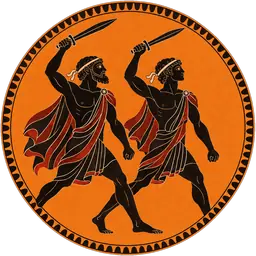
Aristogeiton
Aristogeiton was an Athenian citizen of the middle rank, of the Gephyraean clan, and the lover of Harmodius.1 Thucydides says his fear that the powerful Hipparchus would take Harmodius by force drove him to plot the overthrow of the tyranny.2 With Harmodius he killed Hipparchus at the Panathenaea; he escaped through the crowd but was caught later and, Thucydides says, put to death 'in no merciful way'.3 Aristotle's Constitution of the Athenians adds that under torture he named many friends of the tyrants, and that he provoked Hippias into killing him by taunting him for giving his right hand to his brother's murderer.4 In Aristophanes' Lysistrata a chorus of old Athenian men vows to carry a sword in a myrtle branch and stand armed in the market-place beside Aristogeiton.5
Open Aristogeiton in the atlas
Events
Ties
- killed Hipparchus Thucydides 6.57.3
- lover of Harmodius Thucydides 6.54.2
- Hippias had killed Aristogeiton Aristotle, Constitution of the Athenians 18
What the sources say
“Solicited without success by Hipparchus, son of Pisistratus, Harmodius told Aristogiton, and the enraged lover, afraid that the powerful Hipparchus might take Harmodius by force, immediately formed a design, such as his condition in life permitted, for overthrowing the tyranny.”
πειραθεὶς δὲ ὁ Ἁρμόδιος ὑπὸ Ἱππάρχου τοῦ Πεισιστράτου καὶ οὐ πεισθεὶς καταγορεύει τῷ Ἀριστογείτονι. ὁ δὲ ἐρωτικῶς περιαλγήσας καὶ φοβηθεὶς τὴν Ἱππάρχου δύναμιν μὴ βίᾳ προσαγάγηται αὐτόν, ἐπιβουλεύει εὐθὺς ὡς ἀπὸ τῆς ὑπαρχούσης ἀξιώσεως κατάλυσιν τῇ τυραννίδι.
Thucydides 6.54.3 · tr. Richard Crawley
“Aristogeiton died later, after he had been seized and tortured for a long time. Under compulsion he accused many who were by birth among the notables and were friends of the tyrants. … And at last, since he could not get himself killed whatever he did, he promised to inform against many others, and persuaded Hippias to give him his right hand as a pledge; when he had taken it, he reproached him with having given his right hand to his brother's murderer, and so provoked Hippias that in his rage he could not restrain himself, but drew his sword and killed him.”
ὁ δʼ Ἀριστογείτων ὕστερον, συλληφθεὶς καὶ πολὺν χρόνον αἰκισθείς. κατηγόρησεν δʼ ἐν ταῖς ἀνάγκαις πολλῶν, οἳ καὶ τῇ φύσει τῶν ἐπιφανῶν καὶ φίλοι τοῖς τυράννοις ἦσαν … καὶ τέλος ὡς οὐκ ἐδύνατο πάντα ποιῶν ἀποθανεῖν, ἐπαγγειλάμενος ὡς ἄλλους μηνύσων πολλούς, καὶ πείσας αὑτῷ τὸν Ἱππίαν δοῦναι τὴν δεξιὰν πίστεως χάριν, ὡς ἔλαβεν ὀνειδίσας ὅτι τῷ φονεῖ τἀδελφοῦ τὴν δεξιὰν δέδωκε, οὕτω παρώξυνε τὸν Ἱππίαν, ὥσθʼ ὑπὸ τῆς ὀργῆς οὐ κατέσχεν ἑαυτόν, ἀλλὰ σπασάμενος τὴν μάχαιραν διέφθειρεν αὐτόν
Aristotle, Constitution of the Athenians 18 · AI translation (Claude)
“I'll wreathe my sword in myrtle bough, The sword that laid the tyrant low, When patriots, burning to be free, To Athens gave equality”
ἐν μύρτου κλαδὶ τὸ ξίφος φορήσω, ὥσπερ Ἁρμόδιος καὶ Ἀριστογείτων, ὅτε τὸν τύραννον κτανέτην ἰσονόμους τ’ ᾽ Ἀθήνας ἐποιησάτην
Athenaeus 15.50 · tr. Charles Duke Yonge
An Athenian drinking song, preserved by Athenaeus. The Greek names Harmodius and Aristogeiton; the old verse translation is free and leaves out both names.
First named
The earliest text in the library that names Aristogeiton, written about 500 BC (a modern estimate of when it was written):
“I'll wreathe my sword in myrtle bough, The sword that laid the tyrant low, When patriots, burning to be free, To Athens gave equality … Harmodius, hail! though reft of breath, Thou ne'er shalt feel the stroke of death, The happy heroes' isles shall be The bright abode allotted thee … I'll wreathe the sword in myrtle bough, The sword that laid Hipparchus low, When at Minerva's adverse fane He knelt, and never rose again”
ἐν μύρτου κλαδὶ τὸ ξίφος φορήσω, ὥσπερ Ἁρμόδιος καὶ Ἀριστογείτων, ὅτε τὸν τύραννον κτανέτην ἰσονόμους τ’ ᾽ Ἀθήνας ἐποιησάτην. φίλταθ’ Ἁρμόδι’ , οὒ τί που τέθνηκας νήσοις δ’ ἐν μακάρων σέ φασιν εἶναι, ἵνα περ ποδώκης Ἀχιλεύς, Τυδείδην τέ φασι τὸν ἐσθλὸν Διομήδεα. ἐν μύρτου κλαδὶ τὸ ξίφος φορήσω, ὥσπερ Ἁρμόδιος καὶ Ἀριστογείτων, ὅτ’ Ἀθηναίης ἐν θυσίαις ἄνδρα τύραννον Ἵππαρχον ἐκαινέτην
Athenaeus 15.50 · tr. Charles Duke Yonge
Three Athenian drinking songs. Quoted by Athenaeus, Deipnosophists, about AD 200. The Greek names Harmodius, Aristogeiton and Hipparchus; the old verse translation is free and leaves out Aristogeiton's name.
Found by searching every text in the library for these spellings and reading the earliest hits to rule out namesakes: Ἀριστογείτων, Aristogiton, Aristogeiton. Texts lost, or not in the library, may name Aristogeiton earlier.
The passages behind each sentence
- Thucydides 6.54.2 (tr. Richard Crawley); Herodotus 5.55.1 (tr. A. D. Godley) ↩
- Thucydides 6.54.3 (tr. Richard Crawley); Thucydides 6.56.2 (tr. Richard Crawley) ↩
- Thucydides 6.57.3 (tr. Richard Crawley); Thucydides 6.57.4 (tr. Richard Crawley) ↩
- Aristotle, Constitution of the Athenians 18.4 (AI translation (Claude)); Aristotle, Constitution of the Athenians 18.6 (AI translation (Claude)) ↩
- Aristophanes, Lysistrata 631–633 (AI translation (Claude)) ↩
Cite this page
MLA “Aristogeiton.” Atlas of Ancient History, Skirnir Studios, 2026, history.skirnirstudios.com/people/aristogeiton/.
APA Skirnir Studios. (2026). Aristogeiton. Atlas of Ancient History. https://history.skirnirstudios.com/people/aristogeiton/
Chicago “Aristogeiton.” Atlas of Ancient History. Skirnir Studios, 2026. https://history.skirnirstudios.com/people/aristogeiton/.
The atlas was written by AI from the ancient sources. Where you can, cite the ancient passage itself by its reference (Herodotus 7.228, Livy 22.7.3) and name the translation you read.